
Non-FictionInformativeEducational
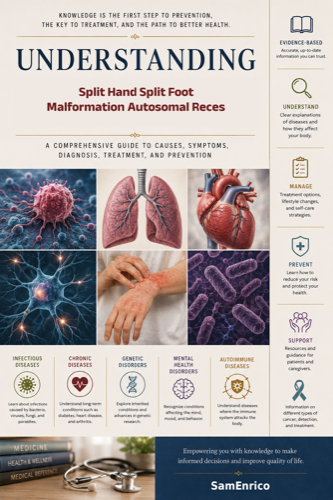
Understanding Split Hand Split Foot Malformation Autosomal Reces
This disease publication, published by SamEnrico,
This disease publication, published by SamEnrico, covers Understanding Split Hand Split Foot Malformation Autosomal Reces
Formats
About this book
Free sample
Chapter 1: The Hands We Hold...--You have just received news that has reshaped your world. Perhaps you saw it on an ultrasound, noticed something different at birth, or heard a diagnosis whispered in a geneticist’s office. Whatever your path, you are now part of a small and extraordinary community — families and individuals navigating life with Split Hand/Foot Malformation, or SHFM. This chapter is your first deep breath. It is not a medical textbook, nor a collection of frightening statistics.
It is an outstretched hand, inviting you to understand what SHFM truly is, what it is not, and why the story that begins today can still be one of joy, resilience, and remarkable possibility.What Is SHFM, Really?Split Hand/Foot Malformation (SHFM) is a congenital condition — meaning present at birth — characterized by the absence of one or more central digits (fingers or toes), often creating a deep central cleft in the hand or foot. The medical literature also refers to it as ectrodactyly, cleft hand/foot, or, outdatedly and inaccurately, “lobster claw” — a term we will discuss and discard momentarily. The condition affects the developing limb buds during the first trimester of pregnancy, typically between the fourth and eighth weeks of gestation, when the hands and feet are taking shape. Instead of forming five symmetrical digits, the central rays (the precursors to the middle fingers and toes) fail to develop properly, leaving a characteristic V-shaped gap.But here is what that clinical description does not capture: SHFM exists on an astonishingly wide spectrum. At one end, a child may have a deep cleft in one hand with two fully functional fingers on either side — a configuration that can grip, write, and play with minimal limitation.
At the other end, all four limbs may be significantly affected, with fused digits, missing bones, and complex structural differences. Between these poles lies every imaginable variation: webbed fingers (syndactyly), shortened digits (brachydactyly), or hands that resemble a split lobster claw — hence the offensive nickname. Some individuals have only hand involvement; others only feet; many have both. Some have unilateral (one-sided) findings…
This is the end of the free sample. Get the eBook to keep going. Buy now
Contents
- Chapter 1
- Chapter 2
- Chapter 3
- Chapter 4
- Chapter 5
- Chapter 6
- Chapter 7
- Chapter 8
- Chapter 9
- Chapter 10
- Chapter 11
- Chapter 12
Details
- Author
- Ashby Criselda
- Publisher
- SamEnrico
- Language
- English
- Genre
- Non-Fiction, Informative, Educational
- Released
- 2026-05-25
- Pages (approx.)
- 128
- Available as
- eBook, Audiobook

Read better in the ZLOADR app
Your eBooks on your phone or tablet. Sign in with your SamEnrico account and start reading.
More by Ashby Criselda
 Submarine War Cemetery GuideAshby Criselda$11.99
 Letting Go Of Comparison TrapAshby Criselda$11.99
 Workaholism Recovery GuideAshby Criselda$11.99
 The Coworker Conflict GuideAshby Criselda$11.99
 The Separation Anxiety Dream GuideAshby Criselda$11.99
 The Weaver and the Sky: A Cherokee Love That Shaped the WorldAshby Criselda$11.99
 How to Start a Cider (alcoholic) Business (Beginners Guide)Ashby Criselda$11.99
 Succession Plan Annual ReviewAshby Criselda$12.99
 Climate Adaptation InsuranceAshby Criselda$12.99
 Conversational Spanish for BeginnersAshby Criselda$11.99
You may also like
 Hong Kong Handover 1997Dunn Johnnie$11.99
 Zumba For Postnatal Recovery CourseNeal Christian$11.99
 Zumba for BeginnersLadner Nikia$11.99
 YouTube Comment Mining GuideHumes Pandora$12.99
 Worry Box MeditationCarlin Rudy$11.99
 Workplace Stress MeditationNguyen Lynn$11.99
 Workplace Stress and Sleep RepairHawley Ivory$11.99
 Workplace Perfectionism CureDelaney Jeffry$11.99
 Workplace Injustice Anger GuideWallen Isabelle$11.99
 Work Addiction and Burnout LinkGreenwood Ester$11.99
 Women in Yoga and WellnessBeattie Galina$11.99
 Women in Stand Up ComedyChun Evangeline$11.99