
Non-FictionInformativeEducational
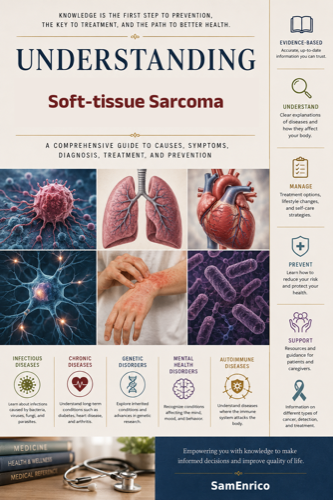
Understanding Soft-tissue Sarcoma eBook
This disease publication, published by SamEnrico,
by Raymond Luci
This disease publication, published by SamEnrico, covers Understanding Soft-tissue Sarcoma
Formats
Free sample
Chapter 1: The First Decision--–- The moment you first heard the words “soft-tissue sarcoma,” something shifted. Perhaps you were sitting in an exam room, the crinkle of paper loud in the silence after the doctor spoke. Perhaps you were on the phone, gripping the counter so hard your knuckles went white. Perhaps you were alone, scrolling through a patient portal late at night, and a biopsy result appeared like a thunderclap. Whatever the scene, you crossed a threshold.
On one side lay the ordinary world of everyday health concerns—the lumps that turned out to be nothing, the pains that faded with time. On the other side lies the world you now inhabit, a world of rare cancers, complex decisions, and an urgent need for reliable information.This chapter is not an introduction in the traditional sense. It will not offer a gentle warm-up or a series of reassuring generalities. Instead, it will give you something more valuable: the foundational knowledge you need to make the most important decision you will face on this journey. That decision is not about chemotherapy or radiation or surgery—not directly.
It is a more fundamental choice that will determine the success or failure of every subsequent intervention. The decision is this: who will manage your first intervention, and where will it take place?If you take only one principle from this entire book, let it be this. The first intervention—whether a biopsy, an imaging study, or a surgical procedure—is the single greatest determinant of your outcome. Get it right, and even a high-grade, aggressive sarcoma can be managed effectively. Get it wrong, and the consequences can cascade for years: higher rates of local recurrence, greater need for mutilating salvage surgery, increased risk of metastasis, and, in some studies, worse overall survival.
The stakes could not be higher. And yet, because soft-tissue sarcoma is rare, most patients initially present to physicians who have never treated a sarcoma, who may not recognize the warning signs, and who may inadvertently perform procedures that compromise future care.This chapter will teach you what soft-tissue sarcoma actually is, why its rarity creates both danger and opportunity, how to distinguish it from the benign lumps that are far more common, and—most critically—how to ensure that your first intervention is performed by the right team in the right setting. By the time you finish reading, you will understand why the first decision is the most important decision, and you will have the tools to make it wisely.What Soft-Tissue Sarcoma Really Is Let us begin with biology, because understanding the nature of this disease is the first step toward controlling it. The human body contains hundreds of different cell types, each with a specific function. These cells are organized into tissues, and tissues into organs.
When cancer arises, it takes the name of the tissue from which it originated. Carcinomas—the most common cancers, accounting for roughly 80 to 90 percent of all cases—arise from epithelial cells. Epithelial cells line the surfaces and cavities of the body: the skin, the lining of the lungs, the inside of the colon, the milk ducts of the breast, the lining of the prostate. If you have heard of breast cancer, lung cancer, colon cancer, or prostate cancer, you have heard of carcinomas.Soft-tissue sarcomas arise from a completely different family of tissues: the connective tissues of the body. These are the mesodermal tissues that form the body’s structural scaffolding.
They include fat (adipose tissue), muscle (skeletal and smooth), blood vessels (arteries, veins, capillaries), nerves (peripheral nerves), deep skin structures (the dermis), and the fibrous tissues that surround joints, tendons, and ligaments. When a sarcoma develops, it retains the characteristics of its tissue of origin. A liposarcoma looks and behaves like malignant fat. A leiomyosarcoma arises from smooth muscle. An angiosarcoma grows from blood vessel walls.This distinction between carcinomas and sarcomas is not merely academic.
It has profound implications for how the disease spreads, how it is treated, and how it responds to therapy. Carcinomas often spread through the lymphatic system, which is why lymph node removal is a standard part of breast cancer and melanoma surgery. Sarcomas, by contrast, rarely spread to lymph nodes. Instead, they spread hematogenously—through the bloodstream—with the lungs being the most common site of metastasis. This is why sarcoma surveillance focuses on chest imaging, not lymph node sampling.
Similarly, sarcomas are generally less responsive to chemotherapy than many carcinomas, though there are important exceptions based on subtype.There is one more distinction to make before we proceed. Soft-tissue sarcoma is not the same as bone sarcoma. Bone sarcomas—such as osteosarcoma, Ewing sarcoma, and chondrosarcoma—arise from bone tissue and have different biology, different treatment protocols, and different outcomes. This book focuses exclusively on soft-tissue sarcomas, though many of the principles regarding specialized care and multidisciplinary management apply to both.The Rarity Paradox: A Double-Edged Sword Soft-tissue sarcoma is rare. In the United States, approximately 12,000 to 15,000 new cases are diagnosed each year.
To put that number in perspective, the American Cancer Society estimates that in 2024 there will be approximately 300,000 new cases of breast cancer, 230,000 new cases of lung cancer, and 150,000 new cases of colorectal cancer. Sarcoma accounts for only about 1 percent of adult cancers. Among children and adolescents, the proportion is higher—approximately 15 percent of pediatric cancers are sarcomas—but in absolute numbers, pediatric sarcomas are still rare.This rarity is a double-edged sword, and understanding both edges is essential. On one edge lies the danger. Because sarcoma is rare, most physicians encounter it infrequently or not at all.
The average general surgeon or general oncologist may see one or two cases in an entire career. Many will see none. As a result, most doctors are not trained to recognize the subtle signs that distinguish a sarcoma from a benign lump. They may not know which imaging study to order. They may not understand the principles of sarcoma biopsy.
They may not be aware that a “simple excision” of a suspected lipoma can be catastrophic if the lump turns out to be a well-differentiated liposarcoma.On the other edge lies the opportunity. Because sarcoma is rare, specialized centers have developed that focus exclusively or primarily on these tumors. These centers—often located at major academic medical institutions or comprehensive cancer centers—treat hundreds of sarcoma patients each year. They have dedicated multidisciplinary teams that include surgical oncologists, medical oncologists, radiation oncologists, radiologists, pathologists, rehabilitation specialists, and genetic counselors who collaborate on every case. They have pathologists who have seen thousands of sarcoma specimens and can distinguish between subtypes that look nearly identical to a general pathologist.
They have surgeons who have performed hundreds of limb-sparing resections and know exactly where to cut and where to stop. They have medical oncologists who understand which chemotherapy regimens work for which subtypes.The existence of these specialized centers transforms the rarity of sarcoma from a liability into an asset. Your case may be rare in the general medical community, but it is not rare at a sarcoma center. At a high-volume center, your diagnosis will be met with expertise, not uncertainty.What Soft-Tissue Sarcoma Is Not Before…
This is the end of the free sample. Get the eBook to keep going. Buy now
About this book
Details
- Author
- Raymond Luci
- Publisher
- SamEnrico
- Language
- English
- Genre
- Non-Fiction, Informative, Educational
- Released
- 2026-05-08
- Pages (approx.)
- 155
- Available as
- eBook, Audiobook

Read better in the ZLOADR app
Your eBooks on your phone or tablet. Sign in with your SamEnrico account and start reading.
More by Raymond Luci
 NVC For School Counselors CourseRaymond Luci$11.99
 LBO HSR Filing GuideRaymond Luci$11.99
 Emotional Freedom Letting Go CourseRaymond Luci$11.99
 Metta For Teens GuideRaymond Luci$11.99
 The Breath Awareness for ADHDRaymond Luci$11.99
 The Timbuktu Scholars: Mathematicians of the Golden AgeRaymond Luci$11.99
 Telecommunications SpecialistRaymond Luci$11.99
 Week One HARO Account SetupRaymond Luci$12.99
 Skimpflation Pricing GuideRaymond Luci$12.99
 How to Start a Bank Note Printing Business (Beginners Guide)Raymond Luci$11.99
You may also like
 Hong Kong Handover 1997Dunn Johnnie$11.99
 Zumba For Postnatal Recovery CourseNeal Christian$11.99
 Zumba for BeginnersLadner Nikia$11.99
 YouTube Comment Mining GuideHumes Pandora$12.99
 Worry Box MeditationCarlin Rudy$11.99
 Workplace Stress MeditationNguyen Lynn$11.99
 Workplace Stress and Sleep RepairHawley Ivory$11.99
 Workplace Perfectionism CureDelaney Jeffry$11.99
 Workplace Injustice Anger GuideWallen Isabelle$11.99
 Work Addiction and Burnout LinkGreenwood Ester$11.99
 Women in Yoga and WellnessBeattie Galina$11.99
 Women in Stand Up ComedyChun Evangeline$11.99