
Non-FictionInformativeEducational
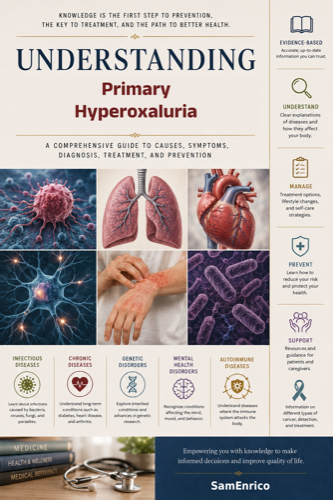
Understanding Primary Hyperoxaluria eBook
This disease publication, published by SamEnrico,
by Dodson Meda
This disease publication, published by SamEnrico, covers Understanding Primary Hyperoxaluria
Formats
Free sample
Chapter 1: The Crystal Prison...--Every human body is a factory. Most run quietly, efficiently, churning out what is needed, disposing of what is not, without the occupant ever thinking about the billions of microscopic transactions happening beneath the skin. But every factory has a weak point—a single assembly line where things can go wrong. For the approximately three people per million born with Primary Hyperoxaluria, that weak point is in the liver, and the consequence of that broken assembly line is a substance so destructive that it turns the body's own waste into tiny, razor-sharp crystals. These crystals do not announce themselves with subtlety.
They announce themselves with pain so severe that grown adults vomit, children scream, and emergency room doctors learn to recognize the distinctive writhing of a patient who cannot find a comfortable position no matter how they twist. This is the reality of Primary Hyperoxaluria. And this chapter is where understanding begins.The Disease Without a Name For most of medical history, Primary Hyperoxaluria was a ghost. Patients presented with kidney stones—sometimes dozens, sometimes hundreds—but doctors had no explanation beyond "some people just make stones." Children passed stones that adults would struggle to endure. Infants died of kidney failure without anyone understanding why.
Families were told it was bad luck, or dehydration, or something they ate. The disease had no name because the disease had no known cause.That changed in the 1960s and 1970s, when biochemists began mapping the intricate pathways by which the human body processes food into energy and waste. They discovered that oxalate—a simple molecule written as C₂O₄²⁻ on a chemist's whiteboard—was not just another waste product. It was a molecule with a dangerous talent: the ability to bind so tightly to calcium that the resulting crystal was nearly impossible to dissolve once formed. Under normal conditions, the body produces a modest amount of oxalate, keeps it dissolved in urine, and flushes it out without incident.
But in Primary Hyperoxaluria, the body produces oxalate like a dam that has cracked open—relentlessly, excessively, destructively.The "primary" in the name distinguishes this condition from secondary hyperoxaluria, which occurs when high oxalate levels result from diet or intestinal disease. Primary means the problem originates within the body itself, in the liver, where a single broken enzyme sets off a cascade of destruction. "Hyperoxaluria" simply means too much oxalate in the urine. But those clinical terms—accurate as they are—fail to capture the experience of living with this condition. They fail to capture the middle-of-the-night emergency room visits, the surgeries to remove stones the size of small marbles, the slow erosion of kidney function measured in declining e GFR numbers that patients learn to track like a stock market ticker.
They fail to capture the terror of watching a child writhe in pain.This book exists to fill that gap between medical terminology and lived experience.The Factory Analogy: Understanding the Broken Assembly Line To understand Primary Hyperoxaluria, imagine the liver as a sprawling industrial complex with thousands of assembly lines running simultaneously. Each assembly line takes raw materials—the food you eat, the breakdown products of your own tissues—and converts them into something useful or harmless. One particular assembly line is responsible for processing a substance called glyoxylate.In a properly functioning liver, an enzyme called alanine:glyoxylate aminotransferase (AGT for short) grabs glyoxylate and converts it into glycine, a harmless amino acid that the body can use or excrete without trouble. This happens thousands of times per second, silently, efficiently, without ever demanding your attention. The tiny amount of oxalate that the body produces naturally—about 20 to 40 milligrams per day, a speck smaller than a grain of salt—is easily dissolved in urine and washed away.Now imagine a factory worker who suddenly becomes incompetent.
That is what happens when the AGT enzyme is missing or damaged due to a genetic mutation. The assembly line backs up. Glyoxylate accumulates, and without AGT to convert it to glycine, it takes a different path—it converts to oxalate instead. Suddenly, that small trickle of 40 milligrams per day becomes a flood of 200, 300, even 500 milligrams per day. The liver continues producing this excess oxalate day after day, year after year, because the broken assembly line never gets fixed on its own.The oxalate enters the bloodstream and travels to the kidneys, the body's filtration system.
The kidneys are remarkably efficient at concentrating waste products into urine, and under normal circumstances, this is a good thing. But when that waste includes excessive oxalate, concentration becomes a problem. In the concentrated environment of the kidney tubules, oxalate meets calcium—and the two substances bind together with a ferocity that chemists call "insoluble." Once formed, calcium oxalate crystals do not dissolve. They accumulate. They grow.
And they destroy everything they touch.From Microscopic Crystals to Excruciating Pain The crystals that form in Primary Hyperoxaluria are not smooth like polished stones. Under a microscope, calcium oxalate crystals resemble shards of glass or bundles of needles. They have sharp edges and pointed ends that scrape against the delicate lining of the kidney tubules, causing micro-tears, bleeding, and inflammation. The body responds to this injury by trying to wall off the crystals, which only creates more opportunity for additional crystals to form. Over time, the crystals aggregate into stones—sometimes small like grains of sand, sometimes large like pebbles, and in severe cases, branching structures called staghorn calculi that fill the entire collecting system of the kidney.The pain of passing one of these stones through the ureter—the narrow tube connecting kidney to bladder—is legendary among those who have experienced it.
Renal colic, as doctors call it, is not a steady ache. It comes in waves, each wave corresponding to a contraction of the ureter as it tries to push the stone along. The pain radiates from the flank around to the groin, often accompanied by nausea, vomiting, and sweating. Patients describe it as worse than childbirth, worse than broken bones, worse than anything they have ever experienced. Some veterans of multiple stone attacks say they would rather break a limb than pass another stone.But stones are not the only problem.
Perhaps more insidious is a condition called nephrocalcinosis—the deposition of calcium oxalate crystals directly into the kidney tissue itself. Unlike stones, which form in the hollow spaces of the kidney and can sometimes be removed, nephrocalcinosis embeds crystals within the substance of the kidney, where they cause scarring, loss of function, and eventual kidney failure. Patients with nephrocalcinosis may never feel the dramatic pain of a passing stone, but their kidney function declines steadily, silently, until one day a routine blood test shows that they have lost 70, 80, or 90 percent of their kidney function. They have been damaged from the inside out without ever knowing it.The Three Types: PH1, PH2, and PH3Primary Hyperoxaluria is not a single disease but a family of three genetic disorders that produce the same final problem—excess oxalate—through different mechanisms. Understanding which type a patient has is essential for prognosis and treatment, and genetic testing (discussed in detail in Chapter 5) is the only definitive way…
This is the end of the free sample. Get the eBook to keep going. Buy now
About this book
Details
- Author
- Dodson Meda
- Publisher
- SamEnrico
- Language
- English
- Genre
- Non-Fiction, Informative, Educational
- Released
- 2026-05-09
- Pages (approx.)
- 153
- Available as
- eBook, Audiobook

Read better in the ZLOADR app
Your eBooks on your phone or tablet. Sign in with your SamEnrico account and start reading.
More by Dodson Meda
 Bipolar And Thyroid FunctionDodson Meda$11.99
 Open Source Dependency RisksDodson Meda$11.99
 The Teen Immigrant Confidence GuideDodson Meda$11.99
 Imposter Syndrome Peer SupportDodson Meda$11.99
 The Food Addiction Sleep Link GuideDodson Meda$11.99
 The Forgotten Ice Warriors: Japan's First Hockey Pioneers and the Birth of a Winter Sport (1880s)Dodson Meda$11.99
 Executive Summary Template HandbookDodson Meda$12.99
 Australia Export Green GuideDodson Meda$12.99
 A Beginners Guide to Five-a-side football (Volume 1)Dodson Meda$11.99
 Continuing Care AssistantDodson Meda$11.99
You may also like
 Hong Kong Handover 1997Dunn Johnnie$11.99
 Zumba For Postnatal Recovery CourseNeal Christian$11.99
 Zumba for BeginnersLadner Nikia$11.99
 YouTube Comment Mining GuideHumes Pandora$12.99
 Worry Box MeditationCarlin Rudy$11.99
 Workplace Stress MeditationNguyen Lynn$11.99
 Workplace Stress and Sleep RepairHawley Ivory$11.99
 Workplace Perfectionism CureDelaney Jeffry$11.99
 Workplace Injustice Anger GuideWallen Isabelle$11.99
 Work Addiction and Burnout LinkGreenwood Ester$11.99
 Women in Yoga and WellnessBeattie Galina$11.99
 Women in Stand Up ComedyChun Evangeline$11.99