
Non-FictionInformativeEducational
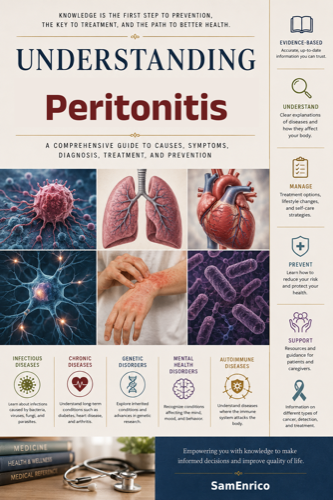
Understanding Peritonitis eBook
This disease publication, published by SamEnrico,
This disease publication, published by SamEnrico, covers Understanding Peritonitis
Formats
Free sample
Chapter 1: The Inner Battlefield...–- The human abdomen is a paradox. It houses the most vulnerable organs in the body—the intestines, liver, pancreas, and spleen—yet it lacks the bony armor that protects the brain, heart, and lungs. Instead, nature designed a different defense system: a shimmering, translucent membrane called the peritoneum. This membrane is the largest and most complex serous surface in the human body, covering a surface area roughly equivalent to that of the skin. When it works silently, as it does in health, no one ever thinks about it.
But when it fails—when inflammation ignites across its delicate surface—the result is one of the most lethal conditions a clinician will ever face.The Peritoneum: More Than Just a Sack Most medical students first encounter the peritoneum as a frustrating diagram to memorize for anatomy exams: parietal layer here, visceral layer there, greater omentum hanging like an apron, mesenteries suspending the small bowel. But this reductionist view misses the essential truth. The peritoneum is not merely a passive sack that holds the abdominal organs. It is a dynamic, living, immunologically active organ in its own right, constantly surveilling the abdominal cavity and mounting rapid responses to any threat.The peritoneum consists of two continuous layers. The parietal peritoneum lines the inner surface of the abdominal wall.
It is innervated by somatic nerves—the same nerves that supply the overlying skin. This is why parietal peritoneal irritation produces sharp, well-localized pain. A patient with a perforated ulcer directly under the anterior abdominal wall can point with one finger to the exact spot of maximum tenderness. The visceral peritoneum, in contrast, covers the abdominal organs and is innervated by autonomic nerves—the same nerves that sense stretch and distension but cannot localize precisely. Visceral peritoneal irritation produces dull, poorly localized pain, often referred to distant sites such as the shoulder or back.Between these two layers lies the peritoneal cavity, a potential space that in health contains only 50 to 100 milliliters of clear, straw-colored, sterile lubricating fluid.
This fluid is not simple transudate. It is a carefully regulated environment rich in proteins, immunoglobulins, complement factors, and macrophages. The fluid allows the intestines to glide against one another during peristalsis and breathing, preventing friction and injury.Understanding this anatomy is not an academic exercise. The distinction between parietal and visceral pain, taught here, will be the difference between a focused physical examination and a shotgun workup in Chapter 4. The concept of the peritoneal cavity as a potential space explains why a tiny perforation can flood the entire abdomen with infection within hours.
And the existence of the peritoneal lymphatic drainage pathways—particularly the stomata on the diaphragmatic surface—explains why subdiaphragmatic irritation causes referred shoulder pain and why infection can spread so rapidly from the abdomen to the chest.The Peritoneum as an Immune Fortress If the peritoneum were merely a passive lining, any breach of the gastrointestinal tract would be uniformly fatal. Bacteria would spill into the cavity and proliferate unchecked. But the peritoneum possesses a sophisticated, multilayered defense system that can clear moderate bacterial inocula without clinical illness. Understanding these defenses is essential because peritonitis occurs precisely when the bacterial challenge overwhelms them.The first line of defense is mechanical clearance. The diaphragmatic surface of the peritoneum contains specialized openings called lymphatic stomata—essentially one-way valves that drain fluid, particles, and bacteria into the lymphatic system and ultimately into the thoracic duct and bloodstream.
Under normal conditions, these stomata can clear the entire volume of peritoneal fluid several times per day. This mechanical clearance is so efficient that bacteria injected into the peritoneal cavity of a healthy animal disappear within minutes. The stomata are larger over the right diaphragm than the left, which explains why subphrenic abscesses are more common on the right side—the lymphatic drainage is simply more active there, and infection can seed more readily.The second line of defense is cellular immunity. The peritoneal cavity contains a resident population of macrophages—large, phagocytic cells that engulf and destroy bacteria without requiring prior exposure. These macrophages are not passive scavengers.
They express pattern recognition receptors, including Toll-like receptors, that detect conserved bacterial molecules such as lipopolysaccharide from Gram-negative bacteria. Upon activation, peritoneal macrophages release a cascade of cytokines—tumor necrosis factor, interleukin-1, interleukin-6—that recruit neutrophils from the bloodstream and initiate the systemic inflammatory response.The third line of defense is humoral immunity. Peritoneal fluid contains opsonins—antibodies and complement proteins—that coat bacteria and make them more palatable to phagocytes. This is why patients with cirrhosis, who have low complement levels due to impaired hepatic synthesis, are at dramatically increased risk for spontaneous bacterial peritonitis. Their peritoneal fluid simply cannot opsonize translocated bacteria effectively.The fourth line of defense, often overlooked, is the greater omentum.
This four-layered fold of peritoneum hangs from the greater curvature of the stomach like an apron, covering the intestines. The omentum is sometimes called the "abdominal policeman" because it migrates to sites of inflammation, wrapping around perforated organs and walling off infection. In patients with a perforated duodenal ulcer, the omentum may seal the perforation temporarily, converting a free rupture into a contained leak. This omental migration explains why some patients with peritonitis present with a localized abscess rather than diffuse contamination—the omentum has succeeded in containing the infection, at least temporarily.The Transition from Chemical Fire to Bacterial Inferno Peritonitis is not a single disease but a final common pathway of many insults. The peritoneum can become inflamed in response to chemical irritants, sterile blood, or bacteria.
The pathophysiology differs depending on the trigger, but the endpoint—a red, exudative, painful peritoneal surface—is universal.Chemical peritonitis occurs when sterile but noxious substances enter the peritoneal cavity. Bile, for example, contains bile salts that are potent detergents. A bile leak after cholecystectomy dissolves the protective phospholipid layer of the peritoneum, causing immediate, intense inflammation. Pancreatic enzymes—particularly trypsin, which activates other digestive enzymes—digest peritoneal proteins and fat, causing enzymatic fat necrosis visible as chalky white spots on the omentum. Blood, while sterile, contains iron that catalyzes free radical formation, causing oxidative damage.
Even urine, when extravasated from a ruptured bladder, can cause chemical peritonitis due to its high concentration of ammonia and urea.The peritoneum responds to chemical irritation with the same inflammatory cascade triggered by bacteria. Vasodilation increases blood flow, causing erythema. Increased capillary permeability allows protein-rich fluid to leak into the peritoneal cavity—the "exudate" of peritonitis. Neutrophils migrate into the cavity, and fibrin deposits coat the inflamed surfaces. This response is adaptive when the trigger is bacterial: the increased fluid dilutes bacteria, the neutrophils kill them, and the fibrin traps them, preventing spread.
But when the trigger is sterile, this same response is maladaptive—the inflammation causes pain, ileus, and systemic toxicity without serving any protective function.Bacterial peritonitis occurs when microorganisms reach the peritoneal cavity and multiply. The source may be the gastrointestinal tract (the most common), the female genital tract, the bloodstream (hematogenous spread), or the external environment (penetrating trauma or surgical contamination). Once bacteria establish themselves in the peritoneal cavity, they replicate rapidly. The normal peritoneal fluid is an excellent growth…
This is the end of the free sample. Get the eBook to keep going. Buy now
About this book
Details
- Author
- Boudreau Kandi
- Publisher
- SamEnrico
- Language
- English
- Genre
- Non-Fiction, Informative, Educational
- Released
- 2026-06-02
- Pages (approx.)
- 154
- Available as
- eBook, Audiobook

Read better in the ZLOADR app
Your eBooks on your phone or tablet. Sign in with your SamEnrico account and start reading.
More by Boudreau Kandi
 HRT Starting Dose Protocols WorkbookBoudreau Kandi$11.99
 The Commuter Anger Prevention PlanBoudreau Kandi$11.99
 Geothermal Energy InvestmentBoudreau Kandi$11.99
 Office Chair Lower Back SolutionBoudreau Kandi$11.99
 The Ghost Squad: Spain's Shadowy Police Corruption RingBoudreau Kandi$11.99
 Lagos Pop Up Marketing on InstagramBoudreau Kandi$12.99
 Stripe Billing Portal SetupBoudreau Kandi$12.99
 How to Become a Sprayer OperatorBoudreau Kandi$11.99
You may also like
 Hong Kong Handover 1997Dunn Johnnie$11.99
 Zumba For Postnatal Recovery CourseNeal Christian$11.99
 Zumba for BeginnersLadner Nikia$11.99
 YouTube Comment Mining GuideHumes Pandora$12.99
 Worry Box MeditationCarlin Rudy$11.99
 Workplace Stress MeditationNguyen Lynn$11.99
 Workplace Stress and Sleep RepairHawley Ivory$11.99
 Workplace Perfectionism CureDelaney Jeffry$11.99
 Workplace Injustice Anger GuideWallen Isabelle$11.99
 Work Addiction and Burnout LinkGreenwood Ester$11.99
 Women in Yoga and WellnessBeattie Galina$11.99
 Women in Stand Up ComedyChun Evangeline$11.99