
Non-FictionInformativeEducational
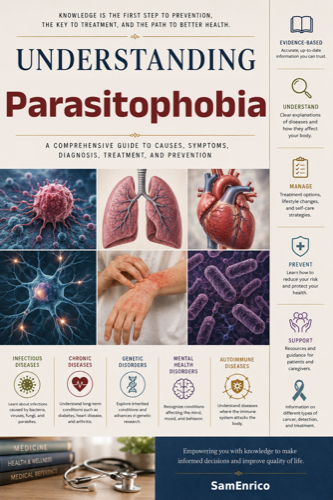
Understanding Parasitophobia eBook
This disease publication, published by SamEnrico,
This disease publication, published by SamEnrico, covers Understanding Parasitophobia
Formats
Free sample
Chapter 1: The Creep That Crawls...--–- Helen was forty-three years old when she stopped sleeping. Not because of insomnia in the traditional sense—not the restless tossing of a mind crowded with bills and regrets and tomorrow’s deadlines. Helen stopped sleeping because every time she closed her eyes, she felt them. Tiny legs. Microscopic bodies.
A slow, deliberate march across her scalp, down her neck, over the curve of her shoulder. She would lie perfectly still, breath held, waiting for the sensation to pass. It never did. She would bolt upright, turn on every light in the bedroom, and spend the next three hours examining her skin with a magnifying mirror and her phone’s camera zoomed to its maximum setting. She found nothing.
She knew she found nothing. And yet, the feeling returned the moment she dimmed the lights.Helen’s story is not unique. It is not rare. It is, in fact, the opening chapter of a silent epidemic—one that unfolds not in hospital wards or emergency rooms but in darkened bedrooms, public restrooms, and the endless scrolling hours of two in the morning. This is the landscape of parasitophobia: the specific, consuming, and often isolating fear of parasites.
Not the casual “ick” of a mosquito bite or the momentary disgust of finding a tick on a dog. This is a clinical terror that rewires the brain, hijacks the senses, and turns the most ordinary experiences—a loose hair on a pillow, a fleck of lint on a sweater, the natural sensation of dry skin—into evidence of an invisible invasion.This book is written for Helen. And for you, if you have ever found yourself inspecting a freckle for the tenth time, convinced it has moved. For you, if you have thrown away clothes, furniture, or even mattresses because you could not shake the certainty that something was living inside them. For you, if you have visited dermatologists, allergists, infectious disease specialists, and perhaps even an exterminator—only to be told, again and again, that there is nothing there.
And for you, if a small, exhausted part of you already knows that the fear is disproportionate, yet cannot stop the spiral.This is not a book about whether parasites are real. Some are. Some cause real diseases, real suffering, and demand real medical attention. This is a book about the space between rational caution and phobic paralysis. It is about the moment when the brain’s ancient threat-detection system, honed over millions of years of evolution, begins to treat a stray hair as a predator.
And it is about how to step back from that edge.The Universal “Ick”: Why Parasites Feel Different Let us begin with a confession: you are supposed to be disgusted by parasites. That revulsion—the sudden tightening of the stomach, the involuntary shudder, the urge to scrub one’s hands—is not a design flaw. It is a masterpiece of evolutionary engineering. Your ancestors who did not feel disgust at the sight of maggots in food, who did not avoid water sources known to harbor guinea worms, who did not check each other’s hair for lice—those ancestors did not become your ancestors. Disgust is a survival mechanism.
It is the immune system’s psychological wing.But here is where parasitophobia differs from ordinary disgust. Disgust is fleeting. It serves its purpose—avoidance of a genuine threat—and then dissipates. You see a cockroach in the kitchen, you feel a wave of revulsion, you call an exterminator, and you move on with your life. Parasitophobia, by contrast, is not fleeting.
It is persistent, recursive, and self-amplifying. It does not end with the removal of the trigger because the trigger is no longer external. The trigger has moved inside—into the interpretation of every tickle, every speck, every shadow on the skin.Consider the difference between a rational fear of parasites and a clinical phobia. A rational fear sounds like this: “I am going hiking in an area known for ticks. I will wear long pants, use repellent, and check myself thoroughly when I return home.” A clinical phobia sounds like this: “I cannot go hiking because I saw a photo of a tick once and now every blade of grass feels like it might be carrying a hundred of them.
I cannot wear long pants because the sensation of fabric against my skin feels like crawling. I cannot check myself because checking turns into three hours of scrubbing, and scrubbing turns into bleeding, and bleeding turns into scabs, and scabs turn into more checking.” The rational fear has a clear boundary. The phobia has none.Beyond the Creepy Crawlies: Defining Parasitophobia Let us anchor this discussion in clinical reality. Parasitophobia falls under the broader category of specific phobias in the Diagnostic and Statistical Manual of Mental Disorders, Fifth Edition (DSM-5). The diagnostic criteria for a specific phobia include several key elements, each of which applies directly to the experience of parasitophobia.First, there must be marked fear or anxiety about a specific object or situation.
In this case, the object is parasites—which can include an extraordinarily wide range of organisms: mites, lice, scabies, fleas, ticks, worms (tapeworms, roundworms, pinworms), bedbugs, and even, in some presentations, microscopic organisms that the sufferer cannot name but can vividly imagine. The fear is not diffuse or general; it attaches itself to the category of “creatures that live on or inside the human body.”Second, the phobic object almost invariably provokes immediate fear or anxiety. This is not a slow-building worry. It is a rapid, autonomic response. A single image, a stray sensation, even the word “mite” spoken in conversation can trigger a cascade of physiological events: increased heart rate, rapid breathing, sweating, trembling, and an overwhelming urge to escape or perform a compulsive behavior (washing, checking, scratching).Third, the phobic object is actively avoided or endured with intense fear or anxiety.
Avoidance in parasitophobia can become life-restricting. Some sufferers stop using public transportation. Others refuse to shake hands, hug family members, or allow visitors into their homes. Some change careers—leaving teaching (fear of lice from children), healthcare (fear of scabies from patients), or veterinary work (fear of animal parasites). Others avoid sleeping in their own beds, preferring a hard chair or the floor where, they reason, there are fewer places for parasites to hide.Fourth, the fear or anxiety is out of proportion to the actual danger posed by the specific object or situation.
This criterion is crucial—and often the source of profound shame. The person with parasitophobia typically knows, on some level, that their fear is excessive. They know that a single speck of lint is not a parasite egg. They know that the tickling sensation on their arm is probably just a hair. And yet, knowing does not stop the fear.
This gap between intellectual knowledge and emotional experience is the central paradox of all phobias.Fifth, the fear, anxiety, or avoidance is persistent, typically lasting for six months or more. Parasitophobia is not a passing concern. It is a chronic pattern that entrenches itself over time, often worsening as compulsive behaviors (washing, checking, reassurance-seeking) backfire and produce…
This is the end of the free sample. Get the eBook to keep going. Buy now
About this book
Details
- Author
- Gamble Madelyn
- Publisher
- SamEnrico
- Language
- English
- Genre
- Non-Fiction, Informative, Educational
- Released
- 2026-05-11
- Pages (approx.)
- 155
- Available as
- eBook, Audiobook

Read better in the ZLOADR app
Your eBooks on your phone or tablet. Sign in with your SamEnrico account and start reading.
More by Gamble Madelyn
 Sales Nonverbal Persuasion GuideGamble Madelyn$11.99
 Remote Review for Product ManagersGamble Madelyn$11.99
 Affirmations For Motivation HandbookGamble Madelyn$11.99
 Abortion Trauma TriggersGamble Madelyn$11.99
 Telemedicine Investment ForecastGamble Madelyn$11.99
 The Puppet King: How a Child Ruler Shaped Ancient EgyptGamble Madelyn$11.99
 Forensic PathologistGamble Madelyn$11.99
 Emerging Markets ESG PerformanceGamble Madelyn$12.99
 Creative Industry Mentor GuideGamble Madelyn$12.99
 How to Become a Set-up WorkerGamble Madelyn$11.99
You may also like
 Hong Kong Handover 1997Dunn Johnnie$11.99
 Zumba For Postnatal Recovery CourseNeal Christian$11.99
 Zumba for BeginnersLadner Nikia$11.99
 YouTube Comment Mining GuideHumes Pandora$12.99
 Worry Box MeditationCarlin Rudy$11.99
 Workplace Stress MeditationNguyen Lynn$11.99
 Workplace Stress and Sleep RepairHawley Ivory$11.99
 Workplace Perfectionism CureDelaney Jeffry$11.99
 Workplace Injustice Anger GuideWallen Isabelle$11.99
 Work Addiction and Burnout LinkGreenwood Ester$11.99
 Women in Yoga and WellnessBeattie Galina$11.99
 Women in Stand Up ComedyChun Evangeline$11.99