
Non-FictionInformativeEducational
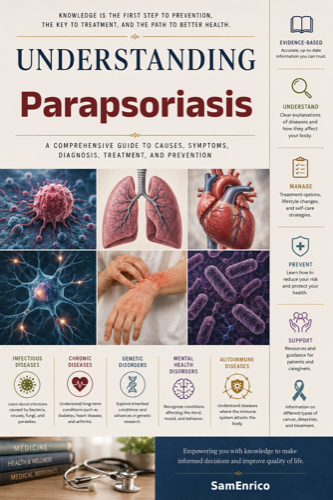
Understanding Parapsoriasis eBook
This disease publication, published by SamEnrico,
This disease publication, published by SamEnrico, covers Understanding Parapsoriasis
Formats
Free sample
UNDERSTANDING PARAPSORIASISA Comprehensive Guide to Diagnosis, Treatment, and Management By Sam Enrico Revised and Consistent Edition – In-Depth Chapter Summaries (Minimum 250 Words Each)Part I: Foundations and Clinical Presentation Chapter 1: The Name That Misleads – History, Nomenclature, and Classification In-Depth Summary (Revised for Cross-References):This chapter establishes the historical and conceptual foundation for understanding parapsoriasis, beginning with its introduction by French dermatologist Louis-Anne-Jean Brocq in 1902. Brocq coined the term "parapsoriasis" – literally meaning "alongside psoriasis" – as a pragmatic placeholder for chronic, scaling skin lesions that did not fit existing diagnostic categories. The name was never intended to imply a pathogenic relationship to psoriasis, yet it has persisted for over a century, creating ongoing confusion.The chapter traces the evolution of parapsoriasis nomenclature through the twentieth century, during which the condition accumulated an impressive collection of alternative names: "chronic superficial scaly dermatitis," "digitate dermatosis," "parapsoriasis en plaques," and "xanthoerythrodermia perstans." This proliferation of terms reflected diagnostic uncertainty rather than advancing understanding, hampering both clinical research and everyday practice.A significant step toward clarity came in the 1970s and 1980s, when dermatopathologists correlated clinical presentations with histologic findings. They observed that small-plaque parapsoriasis (lesions less than 5 centimeters in diameter) typically showed mild, nonspecific inflammation on biopsy, while large-plaque parapsoriasis (lesions larger than 5 centimeters) more often demonstrated features concerning for early cutaneous T-cell lymphoma.The modern classification framework divides parapsoriasis into two main categories based on lesion diameter. (The detailed evidence for the prognostic significance of this distinction – including the specific progression risk figures – is presented in Chapter 4.) Small-plaque disease generally follows a benign course; large-plaque disease carries a substantially higher risk of progression to cutaneous T-cell lymphoma and is often viewed as a premalignant condition or an early form of mycosis fungoides.The chapter clarifies the critical distinction between parapsoriasis and true psoriasis.
Psoriasis is an immune-mediated inflammatory disease driven by the interleukin-23/interleukin-17 axis, with well-demarcated, erythematous plaques covered by thick silvery scale. Histologically, psoriasis shows regular acanthosis, elongated rete ridges, and neutrophilic collections called Munro microabscesses. Parapsoriasis lacks these features, typically showing only mild spongiosis, lymphocytic infiltration, and variable epidermal atrophy.Several controversies and unresolved questions are examined. The precise relationship between large-plaque parapsoriasis and early-stage mycosis fungoides remains contentious. Recent advances in molecular diagnostics – including T-cell receptor gene rearrangement studies and immunophenotyping (detailed in Chapter 5) – have begun to illuminate the biology of parapsoriasis.
For now, however, the term remains clinically useful as a framework for describing chronic, scaling lesions that resist simple categorization. Chapter 2 explores the epidemiology of parapsoriasis.Chapter 2: Who Gets It and Why – Epidemiology and Etiology In-Depth Summary (Revised with Cross-Reference to Chapter 5 for Clonality):This chapter addresses the demographic patterns and potential causes of parapsoriasis, beginning with a clinical vignette of a fifty-year-old man whose chronic patches had been misdiagnosed for nearly a decade. The epidemiology of parapsoriasis is surprisingly difficult to characterize because the condition is uncommon enough to escape large population studies yet not so rare as to be a curiosity. Its clinical presentation overlaps with more common disorders, leading to underdiagnosis or misdiagnosis.Incidence and Prevalence: Precise incidence figures are not available. Most estimates come from dermatology clinic populations rather than general population surveys, introducing selection bias.
Parapsoriasis is considerably less common than psoriasis – in a typical dermatology practice, new cases might number a handful per year, accounting for approximately 0.5 to 1 percent of new patient visits. Small-plaque parapsoriasis is probably more common than large-plaque disease, though the ratio is difficult to quantify due to underreporting of benign cases.Age and Gender Distribution: Parapsoriasis primarily affects adults, with peak incidence in the fourth to sixth decades of life. Cases in children and adolescents are rare. Most studies suggest a slight male predominance, with male-to-female ratios ranging from 1.5:1 to 2:1. This gender difference is more pronounced in large-plaque parapsoriasis and in cases that progress to cutaneous T-cell lymphoma.Geographic and Ethnic Variation: Parapsoriasis has been described worldwide.
Some studies report lower incidence in individuals with darker skin types, but this may reflect diagnostic challenges – the hypopigmented variant may be more easily confused with vitiligo or post-inflammatory hypopigmentation.Genetic Factors: Unlike psoriasis, parapsoriasis does not show strong familial aggregation. Most cases are sporadic. The absence of a clear genetic predisposition is consistent with the view that parapsoriasis may represent a low-grade lymphoproliferative disorder rather than a primary inflammatory condition.Environmental Triggers: Several potential triggers have been proposed but none confirmed. Ultraviolet exposure has complex effects – some patients improve during summer months, while others worsen. No specific infectious agent has been consistently associated.
Drug-induced parapsoriasis is rare. Stress may worsen lesions, but this link is nonspecific.Theories of Pathogenesis: The chapter presents two competing hypotheses. The lymphoproliferative hypothesis posits that parapsoriasis – particularly large-plaque disease – is an early or indolent form of cutaneous T-cell lymphoma, supported by studies demonstrating monoclonal T-cell receptor gene rearrangements in a significant proportion of cases (see Chapter 5 for detailed discussion of clonality testing). The inflammatory hypothesis holds that parapsoriasis is primarily an inflammatory condition. The truth likely lies somewhere between these extremes.Comorbidities and Associations: Unlike psoriasis, parapsoriasis does not appear to carry significant extracutaneous comorbidity risk.
The primary clinical concern remains the potential for progression to cutaneous T-cell lymphoma (see Chapter 7). Chapter 3 turns to the clinical presentation.Chapter 3: The Many Faces – Clinical Presentation and Variants In-Depth Summary (Revised for Consistent Terminology and Cross-References):This chapter provides a detailed description of the clinical appearance, distribution, and evolution of parapsoriasis lesions. The clinical presentation varies considerably, contributing to diagnostic confusion, but several characteristic features help distinguish parapsoriasis from its mimics. (For a comprehensive differential diagnosis, see Chapter 6.)General Characteristics: Parapsoriasis presents as patches and thin plaques. Lesion color typically ranges from pink to yellowish-brown.
A fine, adherent scale is often present, thinner and less silvery than psoriasis scale. The surface often has a slightly wrinkled or "cigarette paper" appearance. Lesion diameter is the most important prognostic factor (see Chapter 4 for detailed discussion of the size distinction and progression risk).Small-Plaque Parapsoriasis (The Benign Variant): Defined by individual lesions measuring less than 5 centimeters in diameter, typically 2 to 4 centimeters across. The patches are oval or round, pink to yellowish, with fine scaling. A distinctive "digitate" morphology – finger-like projections extending from the main patch – is characteristic.
Distribution is typically bilateral and symmetric, favoring the trunk and proximal extremities. Lesions tend to be stable over time. Most patients are asymptomatic.Large-Plaque Parapsoriasis (The Concerning Variant): Defined by individual lesions measuring more than 5 centimeters in diameter, often exceeding 10 centimeters. The plaques are larger, more irregular in shape, and more variable in color. A yellowish or "xanthomatous" hue is characteristic.
The surface often shows pronounced atrophy with prominent wrinkling and telangiectasias. Distribution favors the trunk, but lesions may be unilateral or asymmetric. Lesions are more likely to progress over time.Special Clinical Variants: Hypopigmented parapsoriasis presents as pale patches, more common in darker skin types. Lichenoid parapsoriasis features more papular lesions overlapping with pityriasis lichenoides. Poikilodermatous parapsoriasis shows the triad of atrophy, telangiectasias, and pigmentary changes – raising concern for progression.
Photodistributed parapsoriasis is confined to sun-exposed areas.Clinical Mimics (Brief Introduction – See Chapter 6 for Full Discussion): Psoriasis plaques are thicker with silvery scale. Eczematous lesions are more pruritic. Tinea corporis has an active…
This is the end of the free sample. Get the eBook to keep going. Buy now
About this book
Details
- Author
- Burkhart Olympia
- Publisher
- SamEnrico
- Language
- English
- Genre
- Non-Fiction, Informative, Educational
- Released
- 2026-06-02
- Pages (approx.)
- 158
- Available as
- eBook, Audiobook

Read better in the ZLOADR app
Your eBooks on your phone or tablet. Sign in with your SamEnrico account and start reading.
More by Burkhart Olympia
 Peg System for WorkoutsBurkhart Olympia$11.99
 Interview Body Language PlaybookBurkhart Olympia$11.99
 Remote Review for Marketing TeamsBurkhart Olympia$11.99
 Miscarriage and Loss TriggersBurkhart Olympia$11.99
 EdTech Capital Strategy GuideBurkhart Olympia$11.99
 The Last Stand of the Dodo: A 500-Year Extinction MysteryBurkhart Olympia$11.99
 Food WorkerBurkhart Olympia$11.99
 How to Start a Painted Steel Sheet Business (Beginners Guide)Burkhart Olympia$11.99
 Education Mentor LinkedIn GuideBurkhart Olympia$12.99
 Asia Pacific ESG Benchmark GuideBurkhart Olympia$12.99
You may also like
 Hong Kong Handover 1997Dunn Johnnie$11.99
 Zumba For Postnatal Recovery CourseNeal Christian$11.99
 Zumba for BeginnersLadner Nikia$11.99
 YouTube Comment Mining GuideHumes Pandora$12.99
 Worry Box MeditationCarlin Rudy$11.99
 Workplace Stress MeditationNguyen Lynn$11.99
 Workplace Stress and Sleep RepairHawley Ivory$11.99
 Workplace Perfectionism CureDelaney Jeffry$11.99
 Workplace Injustice Anger GuideWallen Isabelle$11.99
 Work Addiction and Burnout LinkGreenwood Ester$11.99
 Women in Yoga and WellnessBeattie Galina$11.99
 Women in Stand Up ComedyChun Evangeline$11.99