
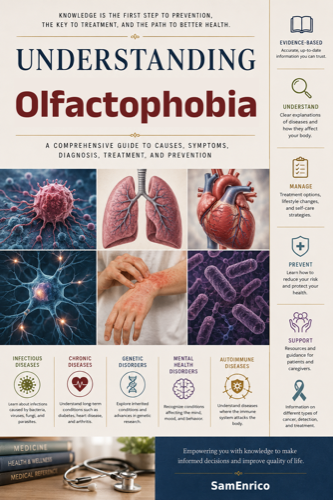
Non-FictionInformativeEducational
Understanding Olfactophobia eBook
This disease publication, published by SamEnrico,
This disease publication, published by SamEnrico, covers Understanding Olfactophobia
Formats
Free sample
Chapter 1: The Unbearable Air--–- The first time I ran from a smell, I didn’t even know I was running. I was twenty-three years old, standing in an elevator in a Chicago office building, when a woman stepped in wearing what I can only describe as a weaponized perfume. My throat closed. My heart slammed against my ribs. The doors hadn’t even closed yet, and I lunged past her, back into the lobby, gasping as if I had been held underwater.
I told myself I had forgotten something at my desk. But I hadn’t forgotten anything. I had been ambushed by a smell, and my body had decided—without consulting me—that the only option was escape.That was the beginning. Or maybe it was the middle. Looking back, there were earlier signs: the way I had stopped riding the bus in college because someone’s laundry detergent made me nauseous, the way I had started arriving at parties early so I could claim a seat near an open window, the way I had secretly, shamefully, broken up with a perfectly kind man because his apartment always smelled faintly of curry.
I didn’t have words for any of it then. I thought I was just particular. Sensitive. Maybe a little dramatic. It took another three years, two therapists, and one humiliating panic attack in a movie theater during the buttered popcorn scene—before the popcorn even arrived—to learn the word: olfactophobia.This book is what I wish I had read on the night of that elevator.
It is not a dry medical textbook. It is not a collection of case studies written for other clinicians. It is a practical, compassionate, and rigorously honest guide to understanding the fear of external odors—and, more importantly, to breaking free from it. Whether you have suffered from olfactophobia for decades or you are just beginning to wonder why the smell of coffee makes your heart race, this chapter will give you a clear definition, a way to distinguish your experience from related conditions, and the first step toward reclaiming the air you breathe.Defining the Invisible Enemy Let us begin with precision. Words matter, especially when you have spent years unable to describe what is happening inside you.
Olfactophobia (from the Latin olfactus, “to smell,” and the Greek phobos, “fear”) is the clinical fear of external environmental odors. The threat is perceived as coming from outside the body—perfume, cooking smells, gasoline, cleaning products, cigarette smoke, scented candles, air fresheners, the cologne of a passerby, the faint odor of garbage from a distant can. These are not simply dislikes or preferences. They are triggers that activate a full fight-or-flight response, often before conscious thought has even identified the smell.This external focus is what distinguishes olfactophobia from several related but fundamentally different conditions. A quick clarification, because confusion here has led to years of misdiagnosis and mistreatment:Olfactory Reference Syndrome (ORS) is the obsessive or delusional belief that one’s own body emits a foul or unpleasant odor that others can detect.
The person with ORS fears their own smell, not the world’s. They shower excessively, check their clothes, sniff their armpits, and ask for reassurance constantly. The shame is turned inward.Bromidrophobia is the fear of body odors—which can be either external (fear of others’ body odor) or internal (fear of one’s own). When the fear is of others’ body odor, it may overlap with olfactophobia. When it is of one’s own, it overlaps with ORS.Osmophobia is not a fear at all, despite the “phobia” suffix.
It refers to odor-triggered migraines—a neurological phenomenon, not a psychological one. (Chapter 7 will explore this distinction in depth.)Hyperosmia, parosmia, and phantosmia are sensory distortions: a heightened sense of smell, distorted odors, or hallucinated odors, often caused by pregnancy, Lyme disease, COVID-19, sinusitis, or head trauma. These are medical conditions, not phobias—though they can certainly lead to phobias over time.Olfactophobia, as defined in this book, is the fear of external, environmental, real odors that are not caused by a neurological or sensory disorder. Your nose works fine. Your brain, however, has learned to treat the smell of baking bread as if it were the smell of a house fire.The Spectrum: From Aversion to Disability Every human being on the planet has odors they dislike.
This is not a disorder; it is an evolutionary inheritance. The difference between a simple aversion and a clinical phobia is not the presence of dislike but the consequences of that dislike.A simple aversion sounds like this: “I really hate the smell of fish. I’ll avoid the seafood section at the grocery store.” This person holds her breath as she walks past the fish counter. She wrinkles her nose. She moves on.
The aversion costs her perhaps five seconds of mild discomfort per week. It does not shape her life.A clinical phobia sounds like this: “I cannot go to any restaurant that might serve fish. I check menus online before agreeing to meet friends. Last week, I smelled fish from across a parking lot and had to turn around and drive home. I have not visited my brother’s family in two years because they live near a fishing port.” This person has organized her life around avoidance.
The fear consumes hours of mental energy, limits her relationships, and causes her genuine, measurable distress.The diagnostic threshold for a specific phobia (which includes olfactophobia) requires that the fear be:Marked and persistent (lasting six months or more)Excessive or unreasonable (the threat is objectively minimal or nonexistent)Triggering an immediate anxiety response (panic attack, rapid heartbeat, sweating, trembling, shortness of breath, nausea)Actively avoided or endured with intense distress Out of proportion to the actual danger Causing significant impairment in social, occupational, or other important areas of functioning Let me pause here. If you are reading this book, there is a good chance that you meet several of these criteria. You may have never had a clinician say the words “specific phobia” to you. You may have been told you are “too sensitive” or “dramatic” or “controlling.” You may have spent years believing that if you just tried harder, just breathed slower, just thought positive thoughts, you could overcome this on your own. I want to be clear: you cannot willpower your way out of a phobia any more than you can willpower your way out of a broken leg.
The brain structures involved do not respond to scolding. They require retraining.And retraining is possible. That is the entire point of this book. But first, we have to name the enemy and understand how it works.The Evolutionary Paradox: Why Your Nose Lies to Protect You To understand why olfactophobia feels so visceral—so real, even when you know rationally that the smell of roasted chicken is not going to kill you—we have to go back about two hundred thousand years. The human sense of smell did not evolve to help us appreciate fine wine or choose a pleasing perfume.
It evolved to detect threats.Consider the environment of our ancestors. Rotting food carried pathogens. Feces carried parasites. Smoke signaled a…
This is the end of the free sample. Get the eBook to keep going. Buy now
About this book
Details
- Author
- Ketchum Jessenia
- Publisher
- SamEnrico
- Language
- English
- Genre
- Non-Fiction, Informative, Educational
- Released
- 2026-05-06
- Pages (approx.)
- 144
- Available as
- eBook, Audiobook

Read better in the ZLOADR app
Your eBooks on your phone or tablet. Sign in with your SamEnrico account and start reading.
More by Ketchum Jessenia
 Caregiver Burnout In CP FamiliesKetchum Jessenia$11.99
 Affirmations For Career SuccessKetchum Jessenia$11.99
 Trying to Conceive LGBTQ GuideKetchum Jessenia$11.99
 The Crowded Space Nightmare FixKetchum Jessenia$11.99
 Anger at Subordinate CognitiveKetchum Jessenia$11.99
 The Lost Codex of Constantinople: A Thief’s ObsessionKetchum Jessenia$11.99
 LinkedIn Remote Internship GuideKetchum Jessenia$12.99
 Cigna Group SWOTKetchum Jessenia$12.99
 Customer Support CoordinatorKetchum Jessenia$11.99
 How to Start a Personal Safety Devices of Metal Business (Beginners Guide)Ketchum Jessenia$11.99
You may also like
 Hong Kong Handover 1997Dunn Johnnie$11.99
 Zumba For Postnatal Recovery CourseNeal Christian$11.99
 Zumba for BeginnersLadner Nikia$11.99
 YouTube Comment Mining GuideHumes Pandora$12.99
 Worry Box MeditationCarlin Rudy$11.99
 Workplace Stress MeditationNguyen Lynn$11.99
 Workplace Stress and Sleep RepairHawley Ivory$11.99
 Workplace Perfectionism CureDelaney Jeffry$11.99
 Workplace Injustice Anger GuideWallen Isabelle$11.99
 Work Addiction and Burnout LinkGreenwood Ester$11.99
 Women in Yoga and WellnessBeattie Galina$11.99
 Women in Stand Up ComedyChun Evangeline$11.99