
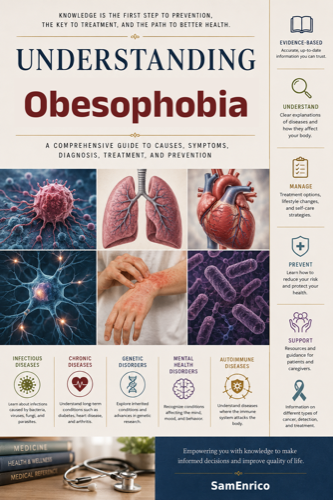
Non-FictionInformativeEducational
Understanding Obesophobia eBook
This disease publication, published by SamEnrico,
This disease publication, published by SamEnrico, covers Understanding Obesophobia
Formats
Free sample
Chapter 1: The Prison You Didn't Name--For seven years, Sarah weighed herself four times a day. Not because she was vain. Not because she was training for anything. But because the number on the scale was the only thing that could quiet the screaming voice in her head—the one that said if she gained even a fraction of a pound, everything she loved would collapse. Her boyfriend would leave.
Her coworkers would whisper. Her mother would finally say "I told you so." At 5'6" and 128 pounds, Sarah was not overweight by any medical definition. But she was also not free. She spent her lunch breaks walking laps around the parking lot instead of eating. She canceled birthday dinners because restaurant food was "too dangerous." She once ran six miles with a torn hamstring because she had eaten a bagel that morning and the math demanded it.
When she finally walked into a therapist's office at age thirty-one, she didn't say "I have a phobia." She said "I think I just need more willpower." Her therapist said something that changed everything: "Sarah, you don't have a willpower problem. You have a fear problem. And until you name it, you cannot fight it."That name is Obesophobia. Also known as pocrescophobia, it is the persistent, irrational, and life-limiting fear of gaining weight. And if you are reading this book, there is a significant chance that you have been living inside this prison for years without ever being told its name.The Most Common Phobia You've Never Heard Of Obesophobia sits in a strange and painful category of psychological suffering: it is extraordinarily common yet remarkably underdiagnosed.
Unlike agoraphobia (fear of open spaces) or arachnophobia (fear of spiders), which patients readily name and describe, Obesophobia disguises itself as something else. It masquerades as "being careful" about what you eat. It hides behind "staying healthy." It borrows the language of wellness and self-improvement while quietly starving your life of spontaneity, joy, and peace.Consider the numbers. Clinical surveys suggest that approximately 5-10% of the general population meets the diagnostic criteria for a specific phobia at some point in their lives. Among those, phobias related to body image, weight, and illness are consistently underreported because sufferers do not believe they have a phobia—they believe they are being responsible.
One study of university students found that nearly 15% of women and 6% of men reported clinically significant fear of weight gain, yet fewer than 2% had ever discussed this fear with a medical professional. The gap between suffering and help-seeking is enormous, and it is filled with shame.But here is what you need to understand immediately, before we go any further: Obesophobia is not about being fat. This is the single most important sentence in this chapter, and it is worth reading twice. The phobia is not a rational calculation about health outcomes. It is not a preference for a certain body type.
It is an anxiety disorder in which the idea of weight gain triggers a full fight-or-flight response, regardless of whether that weight gain is likely, medically significant, or even possible in the moment. The person with Obesophobia is not afraid of what their body is. They are afraid of what it might become. And because "might become" is an uncertain future, there is no amount of weight loss that ever feels like enough. The goalpost moves every time you get close to it.This is why "just losing weight" never works as a treatment for Obesophobia.
If the phobia were actually about weight, then reaching a target weight would cure it. It never does. Instead, reaching a goal weight typically triggers a period of intense anxiety about maintaining that weight, followed by either a relapse into restrictive behaviors or a paradoxical weight gain as the body rebels against prolonged deprivation. The fear, not the fat, is the problem. And the fear can be treated without changing a single number on the scale.The Symptom Spectrum: From Whisper to Scream Not everyone with Obesophobia experiences it the same way.
Like most phobias, it exists on a spectrum ranging from mild (intrusive thoughts that cause distress but do not disable daily function) to severe (panic attacks, complete avoidance of food-related social situations, and medical complications from chronic restriction). Understanding where you fall on this spectrum is not about labeling yourself or comparing your suffering to others. It is about knowing what tools you need.Mild Obesophobia: The Background Noise At the mild end of the spectrum, Obesophobia manifests as recurrent intrusive thoughts about weight that come and go throughout the day. You might find yourself mentally calculating the calories in a meal before you finish chewing. You might feel a small spike of anxiety when your clothing feels snug after a large meal.
You might avoid looking at photographs of yourself not because you think you look bad, but because you are afraid of what you might see. These thoughts are unpleasant but manageable. You still eat in public. You still go to social events. You still live your life, but there is a low hum of anxiety running underneath everything you do related to food and body.People with mild Obesophobia often describe it as "noise" or "static." One patient told me, "It's like having a radio playing in the back of my mind that's always tuned to a station about weight.
I can ignore it most of the time, but it never turns off. And some days, it gets loud." This level of phobia rarely brings someone to therapy on its own. More often, it is accepted as "just how I am" until an external event—a pregnancy, an injury, a medication change, a stressful life transition—turns the volume up.Moderate Obesophobia: The Daily Manager At the moderate level, Obesophobia begins to organize your daily life around its demands. You have food rules, and you follow them. Perhaps you do not eat after 7 PM.
Perhaps you weigh yourself every morning and adjust your eating based on the number. Perhaps you have a list of "safe foods" that you eat on rotation and "forbidden foods" that you never touch. Perhaps you exercise not because you enjoy it but because you have calculated exactly how many calories you need to burn to "earn" what you ate.These behaviors are not choices. They are compulsions driven by the fear that if you stop doing them, weight gain will follow immediately and catastrophically. The person with moderate Obesophobia spends a significant portion of their mental energy—often one to three hours per day—managing their weight through rituals.
Meal planning, calorie tracking, body checking, mirror inspection, clothing evaluation, and comparison to others are all time-consuming and exhausting. Yet stopping feels impossible because the anxiety of stopping is worse than the exhaustion of continuing.At this level, social life begins to suffer. You might decline dinner invitations because restaurant food is unpredictable. You might avoid dating because the prospect of eating in front of a new person is terrifying. You might skip family gatherings where there will be pressure to eat.
The phobia has not yet taken over your life completely, but it has become a full-time job you never applied…
This is the end of the free sample. Get the eBook to keep going. Buy now
About this book
Details
- Author
- Collado Cordelia
- Publisher
- SamEnrico
- Language
- English
- Genre
- Non-Fiction, Informative, Educational
- Released
- 2026-05-23
- Pages (approx.)
- 153
- Available as
- eBook, Audiobook

Read better in the ZLOADR app
Your eBooks on your phone or tablet. Sign in with your SamEnrico account and start reading.
More by Collado Cordelia
 Chronic Disease Memory ImpactCollado Cordelia$11.99
 The Body Scan for Postpartum GuideCollado Cordelia$11.99
 Walking Meditation For Caregivers HandbookCollado Cordelia$11.99
 Project Milestone TrackerCollado Cordelia$11.99
 Alcohol Sobriety Dating GuideCollado Cordelia$11.99
 Whispers of the Forgotten LibraryCollado Cordelia$11.99
 Soccer CoachCollado Cordelia$11.99
 How to Start a China Clay Pit Business (Beginners Guide)Collado Cordelia$11.99
 Cost of Living in Germany GuideCollado Cordelia$12.99
 Paccar Manufacturing SWOTCollado Cordelia$12.99
You may also like
 Hong Kong Handover 1997Dunn Johnnie$11.99
 Zumba For Postnatal Recovery CourseNeal Christian$11.99
 Zumba for BeginnersLadner Nikia$11.99
 YouTube Comment Mining GuideHumes Pandora$12.99
 Worry Box MeditationCarlin Rudy$11.99
 Workplace Stress MeditationNguyen Lynn$11.99
 Workplace Stress and Sleep RepairHawley Ivory$11.99
 Workplace Perfectionism CureDelaney Jeffry$11.99
 Workplace Injustice Anger GuideWallen Isabelle$11.99
 Work Addiction and Burnout LinkGreenwood Ester$11.99
 Women in Yoga and WellnessBeattie Galina$11.99
 Women in Stand Up ComedyChun Evangeline$11.99