
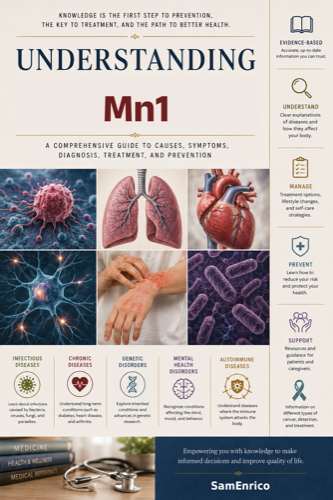
Non-FictionInformativeEducational
Understanding Mn1 eBook
This disease publication, published by SamEnrico,
This disease publication, published by SamEnrico, covers Understanding Mn1
Formats
Free sample
Chapter 1: The Conductor's Baton...--–- In the winter of 1995, a team of Dutch cancer researchers made a discovery that would take nearly three decades to fully understand. They were not searching for a rare pediatric syndrome. They were not looking for the cause of intellectual disability or skull deformities. They were studying meningioma—a typically benign brain tumor that arises from the membranes surrounding the brain and spinal cord. Under the microscope, these tumors held a secret.
Some of them carried a genetic anomaly on chromosome 22, at a precise location labeled q12.1. The researchers isolated a novel gene and named it MN1, an abbreviation of its origin: meningioma 1. It was a perfectly logical name for a gene discovered in cancer research. What no one could have predicted was that this same gene, when mutated in a different way, would become the hidden explanation for a devastating neurodevelopmental syndrome affecting children around the world.The story of MN1 is a story of dual identities. Like a respected community leader who secretly leads a double life, this gene plays two entirely different roles depending on how it is altered.
In the world of oncology, MN1 acts as an oncogene—a driver of aggressive cancers when it is overexpressed or fused with other genes. In the world of pediatric genetics, MN1 acts as a critical developmental gene whose disruption leads to a recognizable syndrome of brain malformations, distinctive facial features, intellectual disability, and a heartbreaking gap between what a child understands and what they can say. Understanding how one gene can play these two opposing roles is the first step toward understanding MCTT syndrome—MN1 C-terminal truncation syndrome—and the children who live with it every day.This chapter establishes the biological and historical foundation of the MN1 gene. Written for parents, clinicians, and anyone who has never taken a genetics course, it will explain what a gene actually is, what the MN1 gene does inside the human body, and why disrupting it leads to such profound consequences. By the end of this chapter, you will understand why MN1 is not a "disease gene" in the traditional sense, but rather a critical piece of the developmental machinery whose malfunction causes disease.
You will also understand why this distinction matters for how researchers think about treatments, how clinicians think about diagnosis, and how families think about their child's future.The Gene That Refuses to Be Simple Let us start with a fundamental question: What is a gene? In the simplest terms, a gene is a sequence of DNA that contains the instructions for building a protein. Think of your genome as a massive recipe book with approximately 20,000 recipes, each one written in a four-letter alphabet: A, T, C, and G, representing the chemical bases adenine, thymine, cytosine, and guanine. Each gene is a specific recipe. The MN1 gene is one recipe among 20,000, located on chromosome 22, one of the 23 pairs of chromosomes that carry your entire genetic inheritance.But here is where the analogy breaks down: unlike a cookbook recipe that produces a cake or a soup, most genes produce proteins that go on to perform thousands of tasks inside your cells.
Proteins are the workhorses of the body. They build structures, transport molecules, send signals, and regulate other genes. The MN1 gene produces the MN1 protein, and this protein has a very specific job: it is a transcription cofactor.The word "transcription" refers to the process of copying a gene's DNA sequence into RNA, which is then used as a template to build a protein. Transcription factors are proteins that bind directly to DNA and turn genes on or off. A transcription cofactor, by contrast, is more like a dimmer switch or a volume knob.
It does not bind to DNA itself. Instead, it interacts with transcription factors and modifies their activity, turning the volume up on some genes and down on others. The MN1 protein does not touch the DNA directly, but it tells other proteins how loudly or softly to read the genetic instructions.Imagine a symphony orchestra. The conductor stands at the podium, waving a baton. The conductor does not play an instrument, but every musician watches the conductor to know when to enter, how loudly to play, and when to stop.
In this analogy, the conductor is the transcription factor—the protein that directly guides the process. The conductor's baton is the transcription cofactor. Without the baton, the conductor's gestures are harder to see and interpret. The music still plays, but the timing is off, the dynamics are wrong, and the orchestra falls into chaos. That is what happens when the MN1 protein is missing or damaged.
The baton is broken. The music of development—the precisely timed expression of hundreds of genes necessary for building a human brain and skull—falls into discord.Why the Skull and Brain Depend on MN1Of all the organs in the developing human body, the brain and the skull are among the most dependent on the MN1 protein. Researchers have known this for decades, largely from studying mice in which the Mn1 gene (mouse genes are written in lowercase italics, while human genes are written in uppercase) has been deliberately disrupted. When scientists create mice that lack a functioning Mn1 gene, the results are dramatic and specific.These mice are born with severe craniofacial abnormalities. Their skulls are misshapen.
Their faces are flattened in the middle, a feature called midface hypoplasia. Their ears are low-set and abnormally shaped. Their palates may be cleft. Their brains show structural abnormalities, including reduced size and disorganized layering of neurons. They have difficulty feeding and often die shortly after birth.
The human condition that results from MN1 mutations is not identical to these mouse models—because humans are not mice, and because the specific mutations causing MCTT syndrome are not complete deletions of the gene—but the overlap is striking. The same structures that go wrong in the Mn1-deficient mouse are the ones that go wrong in the child with MCTT syndrome.Why is MN1 so important for the skull and brain? The answer lies in the genes that MN1 regulates. As a transcription cofactor, MN1 does not act alone. It partners with other proteins, most notably a transcription factor called RARA (retinoic acid receptor alpha), to control the expression of genes involved in cell division, cell migration, and cell differentiation.
During embryonic development, neural crest cells—a special population of cells that form at the border of the developing nervous system—migrate throughout the body to give rise to the bones of the face and skull, as well as parts of the peripheral nervous system. MN1 helps guide this process. When MN1 is mutated, neural crest cells do not behave normally. They may fail to migrate to the correct locations, or they may proliferate too much or too little, leading to the characteristic facial features and skull abnormalities seen in MCTT syndrome.At the same time, MN1 plays a critical role in the developing brain itself. The cerebellum, a structure at the back of the brain responsible for balance, coordination, and motor learning, is particularly dependent on MN1.
This is why approximately 80 percent of children with MCTT syndrome show a striking brain malformation called rhombencephalosynapsis, where the…
This is the end of the free sample. Get the eBook to keep going. Buy now
About this book
Details
- Author
- Devries Shaunda
- Publisher
- SamEnrico
- Language
- English
- Genre
- Non-Fiction, Informative, Educational
- Released
- 2026-05-11
- Pages (approx.)
- 148
- Available as
- eBook, Audiobook

Read better in the ZLOADR app
Your eBooks on your phone or tablet. Sign in with your SamEnrico account and start reading.
More by Devries Shaunda
 Haitian Canadian Return To Jacmel WorkbookDevries Shaunda$11.99
 The Supply Prepositioning StrategyDevries Shaunda$11.99
 Breath Counting For ADHD FocusDevries Shaunda$11.99
 The Body Language for Funeral DirectorsDevries Shaunda$11.99
 No Spend Weekend GuideDevries Shaunda$11.99
 The Green Sage of Timbuktu: Al-Mas'udi's Natural WondersDevries Shaunda$11.99
 Embryo TransferDevries Shaunda$11.99
 User Manual AI Production GuideDevries Shaunda$12.99
 EU VAT on Electronically Supplied ServicesDevries Shaunda$12.99
 How to Become a Nitrocellulose OperatorDevries Shaunda$11.99
You may also like
 Hong Kong Handover 1997Dunn Johnnie$11.99
 Zumba For Postnatal Recovery CourseNeal Christian$11.99
 Zumba for BeginnersLadner Nikia$11.99
 YouTube Comment Mining GuideHumes Pandora$12.99
 Worry Box MeditationCarlin Rudy$11.99
 Workplace Stress MeditationNguyen Lynn$11.99
 Workplace Stress and Sleep RepairHawley Ivory$11.99
 Workplace Perfectionism CureDelaney Jeffry$11.99
 Workplace Injustice Anger GuideWallen Isabelle$11.99
 Work Addiction and Burnout LinkGreenwood Ester$11.99
 Women in Yoga and WellnessBeattie Galina$11.99
 Women in Stand Up ComedyChun Evangeline$11.99