
Non-FictionInformativeEducational
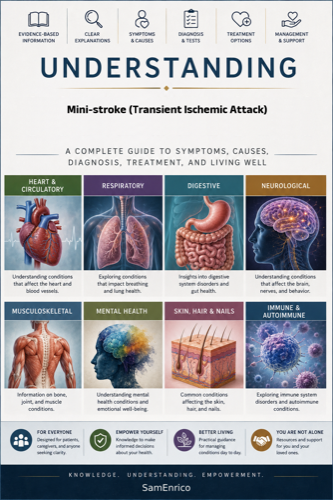
Understanding Mini-stroke (Transient Ischemic Attack) eBook
This condition publication, published by SamEnrico
This condition publication, published by SamEnrico, covers Understanding Mini-stroke (Transient Ischemic Attack)
Formats
Free sample
Chapter 1: The Warning Shot...--You were probably doing something ordinary when it happened. Maybe you were drinking your morning coffee, typing an email, or buttoning your shirt. Then your hand stopped working. Or your words came out wrong. Or half the world went dark, as if someone pulled a curtain across one eye.
And then, just as suddenly as it began, everything returned to normal. Your hand gripped the mug again. Your speech cleared. The curtain lifted.You took a breath. You told yourself it was nothing—a pinched nerve, low blood sugar, stress.
You might have even googled your symptoms and found a dozen benign explanations. After all, if it were truly serious, wouldn't something still be wrong? Wouldn't you still be in pain, still be weak, still be unable to speak?This is the most dangerous thought a human being can have after a transient ischemic attack. And it is exactly the thought that will kill thousands of people this year.What you just experienced was not nothing. It was not a pinched nerve, a migraine, or stress.
It was a warning shot—a temporary blockage of blood flow to part of your brain. In medical terms, it was a Transient Ischemic Attack, or TIA. And it is, without exaggeration, one of the most critical medical events of your life.The name “mini-stroke” is a tragedy of medical marketing. It implies something small, something cute, something you can shrug off. There is nothing mini about a TIA.
The only thing small about it is the window of opportunity you have to act before a major stroke potentially disables or kills you.This chapter exists to ensure you understand what just happened to your brain, why the old definition of TIA is dangerously outdated, and why the next hours and days will determine the rest of your life. By the time you finish reading, you will never again use the word “mini” when describing this event. And you will understand exactly why calling 911 or seeing a neurologist immediately—not tomorrow, not next week—is the single most important decision you will ever make.The 24-Hour Lie: Why the Old Definition Has Killed People For decades, medical students were taught a simple rule: if neurological symptoms resolve completely within 24 hours, call it a TIA. If they last longer, call it a stroke. This rule was tidy.
It fit on flashcards. It made exams easy to grade. It was also, as we now know, dead wrong.The 24-hour rule emerged from an era before modern brain imaging. Doctors had no way to see inside a living person's brain to determine whether tissue had actually died. So they used duration as a proxy: short symptoms equaled no permanent damage; long symptoms equaled permanent damage.
It was an educated guess dressed up as a clinical principle.Then came MRI with diffusion-weighted imaging (DWI). For the first time, doctors could watch what actually happened inside the brain during and after a suspected TIA. And what they found upended everything.When researchers scanned patients who had experienced transient symptoms—symptoms that resolved completely within an hour—they discovered something alarming. A substantial percentage of these patients had visible areas of brain tissue death on their MRIs. Their symptoms had gone away, but their brain cells had not.
These patients had not experienced TIAs at all. They had experienced minor strokes, complete with permanent, irreversible brain damage.Conversely, some patients whose symptoms lasted well beyond 24 hours showed no evidence of tissue death on MRI. Their brains had been temporarily stunned but not permanently destroyed.The duration of symptoms, it turned out, was nearly useless as a predictor of whether brain tissue had actually died. The 24-hour rule was a convenient fiction. And it had been guiding clinical decisions for generations.Today, the medical definition of TIA has been completely rewritten.
A TIA is now defined as a transient episode of neurological dysfunction caused by focal brain ischemia without acute infarction (tissue death) visible on standard MRI. In plain English: your symptoms go away, and your MRI shows no dead brain cells. That is a TIA.If your MRI shows even a pinprick of dead tissue—even if your symptoms lasted only five minutes—you have had a stroke. A minor stroke, yes. But a stroke nonetheless, with permanent damage.This distinction matters enormously, but not for the reason you might think.
Whether your event is classified as a TIA or a minor stroke, the treatment and urgency are essentially identical. Both are medical emergencies. Both put you at high risk for a subsequent, potentially devastating stroke. The only difference is whether the first event left a scar.So forget the 24-hour rule. Forget the word "mini." What matters is this: you had a temporary loss of blood flow to part of your brain.
That event is a siren, not a whisper.The Three Ways a TIA Happens Your brain is the most metabolically demanding organ in your body. Weighing only about three pounds—roughly two percent of your body weight—it consumes twenty percent of your oxygen and twenty-five percent of your blood sugar. It has no meaningful energy reserves. Interrupt its blood supply for even a few seconds, and neurons begin to struggle. Interrupt it for a few minutes, and they begin to die.A TIA occurs when something temporarily reduces or blocks blood flow to a specific region of your brain.
That "something" falls into one of three main categories. Understanding which category applies to you is essential because the long-term treatment differs dramatically.Type One: Embolic TIAThis is the most common mechanism, accounting for roughly half of all TIAs. An embolus is simply a traveling clot—a small clump of material that forms somewhere in your body, breaks loose, and rides the bloodstream until it lodges in an artery too narrow to pass.The most common source of these traveling clots is the heart. Atrial fibrillation (AFib), a condition where the upper chambers of the heart quiver instead of beating effectively, allows blood to pool and form clots. When the heart returns to a normal rhythm, it can eject these clots into circulation.
One of those clots may travel to the brain.The second most common source is the carotid arteries in your neck. These major vessels can develop atherosclerotic plaque—the same fatty, calcified buildup that causes heart attacks. Pieces of that plaque can break off and travel north to the brain.Other sources include the aortic arch (the main artery leaving your heart) and, in younger patients, a patent foramen ovale (PFO)—a small hole between the upper chambers of the heart that can allow a clot to bypass the lungs' natural filtering system.Why this matters for treatment: Embolic TIAs are often treated with antiplatelet medications (like aspirin or clopidogrel) or, if the source is the heart, with anticoagulants (blood thinners like apixaban or warfarin). If a carotid artery is the source, you may need surgery or a stent.Type Two: Lacunar TIAThe word "lacunar" comes from the Latin word for "lake" or "cavity." In stroke medicine, it refers to small, deep strokes caused by disease in the tiny penetrating arteries that supply the deepest parts…
This is the end of the free sample. Get the eBook to keep going. Buy now
About this book
Details
- Author
- Robins Rolande
- Publisher
- SamEnrico
- Language
- English
- Genre
- Non-Fiction, Informative, Educational
- Released
- 2026-05-09
- Pages (approx.)
- 159
- Available as
- eBook, Audiobook

Read better in the ZLOADR app
Your eBooks on your phone or tablet. Sign in with your SamEnrico account and start reading.
More by Robins Rolande
 Humanities in DubaiRobins Rolande$11.99
 Female Diplomats and AmbassadorsRobins Rolande$11.99
 Israel Green Tax CreditsRobins Rolande$11.99
 Cannabis Use Disorder and Chronic PainRobins Rolande$11.99
 Caregiver Sleep RecoveryRobins Rolande$11.99
 Bhagwan Jewelry CollectionRobins Rolande$11.99
 Publication List StrategyRobins Rolande$11.99
 Growth Mindset For Social AnxietyRobins Rolande$11.99
 Letters from the Derby: Love, Rivalry, and the Birth of Asian FootballRobins Rolande$11.99
 The Lost Crown of the Pharaohs: A Heist in the Sands of TimeRobins Rolande$11.99
 Metric and KPI Definition PromptsRobins Rolande$12.99
 MBA Scholarships for Africans AbroadRobins Rolande$12.99
You may also like
 Hong Kong Handover 1997Dunn Johnnie$11.99
 Zumba For Postnatal Recovery CourseNeal Christian$11.99
 Zumba for BeginnersLadner Nikia$11.99
 YouTube Comment Mining GuideHumes Pandora$12.99
 Worry Box MeditationCarlin Rudy$11.99
 Workplace Stress MeditationNguyen Lynn$11.99
 Workplace Stress and Sleep RepairHawley Ivory$11.99
 Workplace Perfectionism CureDelaney Jeffry$11.99
 Workplace Injustice Anger GuideWallen Isabelle$11.99
 Work Addiction and Burnout LinkGreenwood Ester$11.99
 Women in Yoga and WellnessBeattie Galina$11.99
 Women in Stand Up ComedyChun Evangeline$11.99