
Non-FictionInformativeEducational
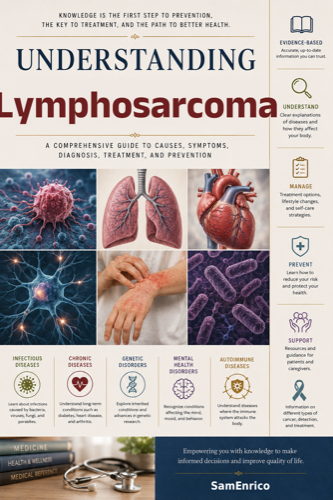
Understanding Lymphosarcoma eBook
This disease publication, published by SamEnrico,
by Orozco Wally
This disease publication, published by SamEnrico, covers Understanding Lymphosarcoma
Formats
Free sample
Chapter 1: The Word That Changes Everything...–- The call comes when you least expect it. Maybe you are sitting in a grocery store parking lot, a bag of bagels on the passenger seat, the radio playing a song you will never hear again without flinching. Maybe you are at work, in a meeting about quarterly projections, your phone buzzing with an unknown number that you almost ignore. Maybe you are lying in bed at two in the morning, scrolling through a patient portal because you could not sleep, and there it is—a word you have seen before but never applied to yourself.Lymphosarcoma.Or perhaps your doctor said "Non-Hodgkin Lymphoma." Perhaps they said "NHL." Perhaps they said "cancer" and then a flurry of other words—B-cell, indolent, stage, biopsy, oncology—that flew past you like birds in a storm, visible but impossible to catch. What you remember is the silence that followed.
The way the room seemed to tilt. The way your own heartbeat became suddenly, terrifyingly loud.This chapter is for that moment. Not the moment after you have researched, after you have told your family, after you have gathered binders and bookmarked websites and joined support groups. This chapter is for the first hour—the hour when you do not know what to ask, when you are not even sure you can speak, when the only thing you know for certain is that your life has just split into before and after.Let us start with the word itself, because words matter.The Archaic Term That Refuses to Die Lymphosarcoma is not a word most oncologists use anymore. It is an artifact, a fossil from an earlier era of medicine, like "dropsy" or "consumption." In modern practice, the disease you have been diagnosed with is called Non-Hodgkin Lymphoma, or NHL for short.
The term "lymphosarcoma" appears in old medical textbooks, in pathology reports from the 1970s, in the medical records of patients who were diagnosed decades ago and are now navigating survivorship. If you search for it online, you will find a confusing mix of current information and outdated terminology, veterinary references (dogs and cats get lymphosarcoma too, though it is called by a different name in veterinary medicine), and academic papers that assume you have a medical degree.So why use it in the title of this book?Because you might encounter it. Because your grandmother's medical records might say it. Because some doctors, particularly older ones or those trained outside the United States, still use the term interchangeably with NHL. Because the history of how we name diseases matters—it shapes how we think about them, how we treat them, and how we live with them.More importantly, this book uses "Lymphosarcoma" alongside "Non-Hodgkin Lymphoma" because you deserve to know that these are not two different diseases.
They are the same family of conditions, viewed through different historical lenses. Throughout this book, we will use the terms interchangeably, with preference for NHL when discussing current treatments and "lymphosarcoma" when referencing the historical context or when the term appears in your own medical records.You are not dealing with a mystery disease. You are dealing with a disease that has been studied, named, renamed, and studied again. That is good news. It means we know things about what is happening inside your body.The River You Never Knew You Had To understand what lymphosarcoma is, you must first understand the lymphatic system—a part of your body that most people never think about until something goes wrong.Imagine, if you will, a river.This river runs through your entire body, parallel to your bloodstream but distinct from it.
The river carries a clear fluid called lymph, which contains white blood cells known as lymphocytes. These lymphocytes are soldiers. Their job is to patrol your body, identify invaders (bacteria, viruses, fungi, even early cancer cells), and destroy them before they can cause harm.Along the river, there are dams. These are your lymph nodes—small, bean-shaped structures clustered in your neck, armpits, groin, chest, and abdomen. You have hundreds of them.
Most of the time, you do not know they exist. They are soft, quiet, doing their work without applause or acknowledgment.When you get a sore throat, the lymph nodes in your neck swell. That is because your soldier lymphocytes are multiplying rapidly to fight the infection. The swelling is a sign of a healthy immune system at work. The nodes go back down when the infection clears.Now imagine that one of those soldier lymphocytes stops taking orders.It does not die when it is supposed to.
It does not retire. Instead, it begins to copy itself—again and again and again—creating millions of identical clones. These clones do not fight infections. They do not patrol. They simply accumulate, clogging the river, overwhelming the dams, spreading to other parts of the body through the very system that was meant to protect you.That is lymphosarcoma.
That is Non-Hodgkin Lymphoma. It is not a tumor that started in your breast or your lung or your colon and then spread. It is a cancer of the immune system itself—a mutiny within the army that was supposed to keep you safe.This distinction matters more than you might think.The Big Split: Hodgkin Versus Non-Hodgkin When doctors first started describing lymphomas in the nineteenth century, they noticed that some patients had large, abnormal cells in their lymph nodes that looked like owl eyes under the microscope. These cells were named Reed-Sternberg cells after the two physicians who identified them. Patients with these cells seemed to have a different disease course than patients without them.Thus, lymphoma split into two families: Hodgkin lymphoma (named after Thomas Hodgkin, who first described it in 1832) and everything else—which was called, for lack of a better term, Non-Hodgkin lymphoma.Lymphosarcoma is the old name for Non-Hodgkin lymphoma.The distinction between Hodgkin and Non-Hodgkin is not just academic.
It matters for prognosis, for treatment, and for how the disease behaves. Hodgkin lymphoma is less common (about 10 percent of all lymphomas) and tends to spread in a predictable, stepwise fashion from one lymph node group to the next. Non-Hodgkin lymphoma is more common (about 90 percent of all lymphomas) and can spread in unpredictable patterns, sometimes jumping from the neck to the bone marrow without ever passing through the nodes in between.If you have been diagnosed with lymphosarcoma, you have Non-Hodgkin lymphoma. That means your disease belongs to the larger, more diverse family—the one with over sixty subtypes, ranging from extremely slow-growing (indolent) to ferociously fast (aggressive). Do not let the word "non" fool you.
This is not the lesser lymphoma or the second-best lymphoma. It is simply the other one.Who Gets This Disease? (And Why You Should Not Blame Yourself)The first question most patients ask—after "am I going to die?"—is "why me?"It is a natural question. It is also, in most cases, an unanswerable one.Epidemiology is the study of who gets which diseases and why. For Non-Hodgkin lymphoma, the epidemiology looks like this:Age is the strongest risk factor.
The median age at diagnosis is sixty-seven years old. That means half of all patients are older than sixty-seven, and…
This is the end of the free sample. Get the eBook to keep going. Buy now
About this book
Details
- Author
- Orozco Wally
- Publisher
- SamEnrico
- Language
- English
- Genre
- Non-Fiction, Informative, Educational
- Released
- 2026-06-02
- Pages (approx.)
- 150
- Available as
- eBook, Audiobook

Read better in the ZLOADR app
Your eBooks on your phone or tablet. Sign in with your SamEnrico account and start reading.
More by Orozco Wally
 Burnout In Doctoral StudentsOrozco Wally$11.99
 In Line Breath Awareness PracticeOrozco Wally$11.99
 Physical Sensation AwarenessOrozco Wally$11.99
 Anger and Mental Health IssuesOrozco Wally$11.99
 The Enmeshed Family Self Recovery GuideOrozco Wally$11.99
 The Hollow Knight’s Last Vow: A Forgotten Arthurian OathOrozco Wally$11.99
 Inventory CounterOrozco Wally$11.99
 Chart Type Selection Quick GuideOrozco Wally$12.99
 South Africa Renewable Energy GuideOrozco Wally$12.99
 How to Become a Drapery And Upholstery MeasurerOrozco Wally$11.99
You may also like
 Hong Kong Handover 1997Dunn Johnnie$11.99
 Zumba For Postnatal Recovery CourseNeal Christian$11.99
 Zumba for BeginnersLadner Nikia$11.99
 YouTube Comment Mining GuideHumes Pandora$12.99
 Worry Box MeditationCarlin Rudy$11.99
 Workplace Stress MeditationNguyen Lynn$11.99
 Workplace Stress and Sleep RepairHawley Ivory$11.99
 Workplace Perfectionism CureDelaney Jeffry$11.99
 Workplace Injustice Anger GuideWallen Isabelle$11.99
 Work Addiction and Burnout LinkGreenwood Ester$11.99
 Women in Yoga and WellnessBeattie Galina$11.99
 Women in Stand Up ComedyChun Evangeline$11.99