
Non-FictionInformativeEducational
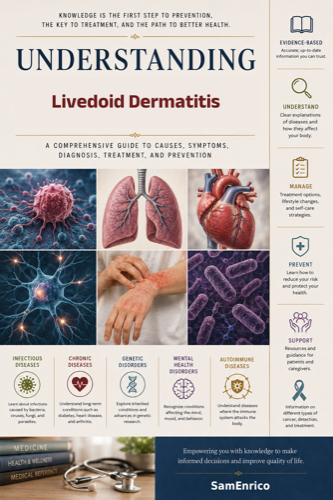
Understanding Livedoid Dermatitis eBook
This disease publication, published by SamEnrico,
This disease publication, published by SamEnrico, covers Understanding Livedoid Dermatitis
Formats
Free sample
Chapter 1: The Silent Fire...--–- The first time Eleanor noticed the lacework on her ankles, she assumed it was a reaction to new laundry detergent. The delicate, net-like pattern of purple-red lines curled across her skin like a botanical illustration—beautiful in a disturbing way. She photographed it, sent it to her sister, and joked that she was developing “old lady legs” at thirty-seven. Her sister laughed. Her primary care doctor did not.
“Probably just livedo reticularis,” the doctor said, tapping a pen against a prescription pad. “It’s benign. Happens in cold weather. Don’t worry about it.”That was eighteen months before the first ulcer.Eighteen months before Eleanor would find herself sobbing in an emergency department, her lower leg burning as though someone had poured hot wax into her veins, while a young resident suggested—with genuine concern but complete inaccuracy—that she might have “anxiety manifesting as dermatologic symptoms.” Eighteen months before she would see six different physicians across three specialties, receive two misdiagnoses, try three ineffective treatments, and finally, desperately, drive four hours to a university dermatologist who took one look at her scars and said, “This is not benign. This is livedoid vasculopathy.
And I am so sorry no one recognized it sooner.”Eleanor’s story is not exceptional. It is, in fact, painfully typical.If you are reading this book, you or someone you love has likely walked a similar path. You have watched skin that once seemed healthy transform into a landscape of retiform purpura, painful ulcerations, and finally, the distinctive ivory-white stellate scars known as atrophie blanche. You have been told it might be vasculitis. Or venous insufficiency.
Or perhaps, in your darker moments, you have wondered if the pain was somehow “in your head.” It is not. The fire beneath your skin is real, it has a name, and understanding that name is the first step toward extinguishing the flames.This chapter is not a dry recitation of medical facts. It is an invitation to understand what livedoid dermatitis—more precisely called livedoid vasculopathy (LV)—actually is, why it has been so confusingly named over the past century, who it affects, and most importantly, why the distinction between primary and secondary forms of the disease will shape everything about your journey from diagnosis to management. By the end of this chapter, you will have a clear conceptual map of this rare disease and the vocabulary to advocate effectively for yourself or your patient.The Confusing Legacy of a Name Let us begin with a confession: the name of this disease is a historical accident, and it has caused no small amount of confusion among physicians and patients alike. The term “livedoid dermatitis” literally means “skin inflammation that looks like livedo,” with livedo referring to the net-like or lace-like discoloration of the skin that occurs when blood flow through small vessels is disrupted.
The problem is that the word “dermatitis” implies inflammation—specifically, inflammation of the skin. And while there is undoubtedly inflammation present in the affected tissues, the primary driver of livedoid dermatitis is not inflammation at all. It is thrombosis.Livedoid vasculopathy (LV) is the more accurate, modern term, and it will be used throughout this book. “Vasculopathy” simply means “disease of the blood vessels,” without specifying the mechanism. This is both more honest and more useful, because it leaves room for the growing understanding that LV is fundamentally a disorder of inappropriate clotting in the smallest blood vessels of the skin.To understand why this distinction matters, consider the difference between a house fire caused by faulty wiring (a structural problem) and a house fire caused by an arsonist (an intentional inflammatory process).
If you send firefighters to put out the flames but never fix the wiring, the fire will recur. For decades, physicians treated LV as though it were an inflammatory disease—like lupus or rheumatoid arthritis—using powerful immunosuppressants such as prednisone. And sometimes the ulcers improved temporarily, because prednisone does have some effects on blood vessels and pain perception. But the underlying wiring remained faulty. The clots kept forming.
The ulcers kept returning.It was only in the 1980s and 1990s, through the careful work of dermatopathologists such as Dr. Thomas Fitzpatrick and Dr. Jean L. Bolognia, that the true nature of LV became clear. Biopsy after biopsy revealed the same findings: segmental hyalinization of vessel walls (a glassy thickening caused by fibrin deposition), fibrin thrombi plugging the lumens of small dermal vessels, and a conspicuous absence of vasculitis—no leukocytoclasia, no fibrinoid necrosis, no neutrophilic infiltration.
The vessel walls were not being attacked by the immune system; they were being clogged from within.This discovery was a paradigm shift, but old habits die hard. Many physicians trained before the 1990s still use outdated terminology, and even today, a search of medical literature will turn up the terms “livedoid vasculitis” and “atrophie blanche” used interchangeably with LV. They are not the same. Atrophie blanche, as we will explore in Chapter 3, is a scar—the end-stage remnant of healed ulcers, not a disease entity. And “livedoid vasculitis” is a misnomer that implies a mechanism not supported by evidence.
Throughout this book, we will use the precise terminology recommended by the International Society for the Study of Vascular Anomalies and current dermatology consensus guidelines.What Livedoid Vasculopathy Actually Is At its core, LV is a disease of microvascular thrombosis. The smallest blood vessels in the skin—the arterioles, capillaries, and venules that make up the dermal microcirculation—become narrowed or completely blocked by clots. When a vessel is occluded, the tissue downstream is deprived of oxygen and nutrients. If the blockage is temporary, the tissue may survive, leaving behind only the reddish-purple net-like pattern of livedo racemosa. If the blockage persists or recurs repeatedly, the tissue dies, resulting in a painful, shallow ulcer with a characteristic “punched-out” appearance.
Over time, as ulcers heal, they leave behind the smooth, ivory-white, star-shaped scars known as atrophie blanche—the landscape of healing, yes, but also a map of past suffering.Why do these clots form? This is where the distinction between primary (idiopathic) and secondary LV becomes critical, and it is a theme that will recur throughout this book.Primary (idiopathic) LV is diagnosed when no underlying systemic disease or identifiable coagulopathy can be found after a thorough evaluation. In these cases, the pathogenesis is thought to involve localized endothelial dysfunction—the cells lining the vessel walls become “sticky” or damaged—combined with impaired fibrinolysis, the body’s natural process for breaking down clots. Some researchers have identified abnormalities in the fibrinolytic system, such as low levels of tissue plasminogen activator (t PA) or high levels of plasminogen activator inhibitor-1 (PAI-1). Others have found evidence of platelet activation or dysfunction.
But in many cases, no single abnormality is found; instead, it appears that a combination of subtle factors, perhaps triggered by local trauma, pressure, or temperature changes, leads to clot formation in susceptible individuals.Secondary LV is diagnosed when an underlying prothrombotic condition is identified. These conditions fall into three broad categories: inherited thrombophilias (genetic mutations that increase clotting tendency, such as Factor V Leiden or the prothrombin G20210A mutation)…
This is the end of the free sample. Get the eBook to keep going. Buy now
About this book
Details
- Author
- Loveless Arianne
- Publisher
- SamEnrico
- Language
- English
- Genre
- Non-Fiction, Informative, Educational
- Released
- 2026-06-02
- Pages (approx.)
- 160
- Available as
- eBook, Audiobook

Read better in the ZLOADR app
Your eBooks on your phone or tablet. Sign in with your SamEnrico account and start reading.
More by Loveless Arianne
 Aging Parents Self Esteem WorkbookLoveless Arianne$11.99
 Child Star Cult Escape StoriesLoveless Arianne$11.99
 The Military Deployment Reunion Stress GuideLoveless Arianne$11.99
 PNE for Yoga InstructorsLoveless Arianne$11.99
 Steve Jobs Lisa Project FailureLoveless Arianne$11.99
 Shadows of the Ballot Box: The Forgotten Cyberwar of 1996Loveless Arianne$11.99
 US Bank Account For LLC Non ResidentLoveless Arianne$12.99
 Gen Z Value Alignment GuideLoveless Arianne$12.99
 How to Become a Service Supervisor IiLoveless Arianne$11.99
 Executive Medical RepresentativeLoveless Arianne$11.99
You may also like
 Hong Kong Handover 1997Dunn Johnnie$11.99
 Zumba For Postnatal Recovery CourseNeal Christian$11.99
 Zumba for BeginnersLadner Nikia$11.99
 YouTube Comment Mining GuideHumes Pandora$12.99
 Worry Box MeditationCarlin Rudy$11.99
 Workplace Stress MeditationNguyen Lynn$11.99
 Workplace Stress and Sleep RepairHawley Ivory$11.99
 Workplace Perfectionism CureDelaney Jeffry$11.99
 Workplace Injustice Anger GuideWallen Isabelle$11.99
 Work Addiction and Burnout LinkGreenwood Ester$11.99
 Women in Yoga and WellnessBeattie Galina$11.99
 Women in Stand Up ComedyChun Evangeline$11.99