
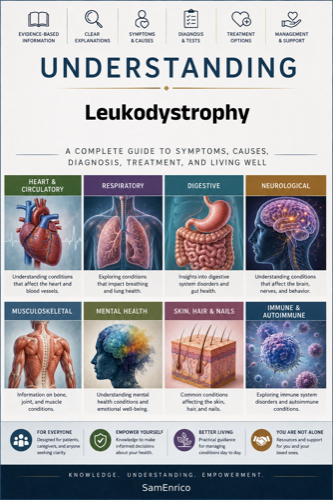
Non-FictionInformativeEducational
Understanding Leukodystrophy eBook
This condition publication, published by SamEnrico
This condition publication, published by SamEnrico, covers Understanding Leukodystrophy
Formats
Free sample
Chapter 1: The Short Circuit...--The first time you heard the word "leukodystrophy," it probably felt like a foreign language. Your brain scrambled to find meaning—leuko something, dystrophy something—but came up empty. The neurologist might have said it quickly, or written it on a prescription pad, or handed you a photocopied pamphlet with words you couldn't pronounce. Then they left the room. And you sat there, in that small exam room with the paper-covered table and the anatomical posters on the wall, holding a word that felt like a life sentence.This chapter is for that moment.We are going to start at the very beginning.
Not with complex biochemistry or genetic pedigrees, but with a question: What is actually happening inside the brain? And we are going to answer it using something you already understand: electricity.The Electrical Wire Analogy Imagine, for a moment, that the human brain is a vast city. A city with millions of buildings (the neurons, or nerve cells) and an incomprehensibly complex network of roads and power lines connecting them. Every thought you have, every movement you make, every memory you recall, every beat of joy or pang of sadness—all of it depends on messages traveling along those roads and lines.Now, let us focus on one critical component of that infrastructure: the wiring.A healthy nerve cell works like an electrical wire. In the center, you have the copper conductor—this is the axon, the long, thin projection of the nerve cell that carries signals from one part of the brain to another.
But a bare copper wire is useless. If you ran electricity through an uninsulated wire, the current would leak out, short-circuit against other wires, and never reach its destination. That is why electrical wires are coated in rubber or plastic insulation. The insulation keeps the current contained, focused, and moving in the right direction.In the brain, that insulation is called myelin.Myelin is a fatty, whitish substance that wraps around the axon like the layers of a jelly roll. It is produced by specialized cells called oligodendrocytes (we will meet them properly in Chapter 2).
Myelin does three essential things: it speeds up nerve transmission, it prevents electrical signals from leaking out, and it allows the brain to pack more "wiring" into a smaller space.A healthy brain is a symphony of insulated wires, firing in precise sequence.Now, what is leukodystrophy?The word itself gives us a clue. Leuko comes from the Greek word for "white"—referring to the white matter of the brain, which is the tissue made up of myelinated axons. (The gray matter, by contrast, is mostly the cell bodies of neurons.) Dystrophy comes from Greek roots meaning "bad" or "disordered" growth. So leukodystrophy literally means "disordered growth of the white matter."In practical terms: Leukodystrophy is the slow, progressive deterioration of the myelin insulation in the brain.Imagine an electrical wire where the rubber coating begins to crack. At first, only tiny bits of insulation flake off.
The wire still works, but there is a little more resistance, a little more leakage. Over time, more cracks appear. The cracks widen. The copper wire becomes exposed. Electricity jumps from one wire to another, causing short circuits.
Eventually, the wire stops working altogether.That is leukodystrophy.And here is the most important distinction you will read in this entire book: Leukodystrophy does not primarily destroy intelligence. It destroys communication.The neurons themselves—the thinking cells—often remain intact for years, sometimes decades. What fails is the infrastructure that allows them to talk to one another. A child with leukodystrophy may understand everything you say. They may remember the song you sang to them last week.
They may feel love, fear, joy, and frustration. But the pathways that allow them to speak, to walk, to control their bladder, to wave goodbye—those pathways are short-circuiting.This is both a comfort and a profound responsibility. It means your loved one is still in there. It also means that when they cannot speak or move, you cannot assume they have stopped thinking or feeling. They may be trapped inside a body whose wiring is failing, while their mind remains vibrant and aware.We will return to this idea throughout the book.
For now, hold onto it tightly. It will guide everything that follows.The Difference Between Leukodystrophy and Leukodystrophies You will notice that doctors use two words: leukodystrophy (singular) and leukodystrophies (plural). This is not a typo. It is an important distinction.Leukodystrophy, in the singular, refers to the general category of disease—the process of myelin deterioration we just described. But there is no single disease called "leukodystrophy." Instead, there are over 50 distinct genetic disorders that fall under this umbrella.
Each one has a different genetic cause, a different pattern of symptom onset, a different rate of progression, and different treatment options.That is why the plural form—leukodystrophies—is more accurate. You will hear researchers say things like "the leukodystrophies are a heterogeneous group of disorders." That just means they are many different diseases that share a common feature: progressive white matter dysfunction.The five most common forms are X-linked adrenoleukodystrophy (X-ALD), Krabbe disease, metachromatic leukodystrophy (MLD), Alexander disease, and Canavan disease. We will devote all of Chapter 3 to understanding each of these in depth, including their unique signatures, typical ages of onset, and the specific genes involved. For now, just know that if your family has received a specific diagnosis—say, MLD or Krabbe—your journey will have some unique features, but the general principles of care, advocacy, and support in this book apply to all forms.If your family's specific diagnosis is not one of the five major types, do not worry. The United Leukodystrophy Foundation maintains a complete list of all known leukodystrophies, and Chapter 12 will guide you to condition-specific resources.
The science, the care strategies, and the emotional journey we cover here will still serve you.What Leukodystrophy Is NOTBefore we go any further, we need to clear away some common misconceptions. These misunderstandings can delay diagnosis, cause unnecessary guilt, and lead families down unhelpful paths.Leukodystrophy is not multiple sclerosis (MS). MS is an acquired demyelinating disease, meaning the immune system attacks myelin later in life, often in episodes or relapses. Leukodystrophies are inherited and progressive—they do not come and go. The damage accumulates steadily over time.
Some adults with late-onset leukodystrophy are initially misdiagnosed with MS because the MRI findings look similar. But the underlying biology, the genetic cause, and the treatment approach are completely different. If you have been told "atypical MS" or "MS that doesn't respond to treatment," read Chapter 5 carefully and ask your neurologist for genetic testing.Leukodystrophy is not caused by anything a parent did or did not do. This is so important that we will repeat it in multiple chapters. No food you ate during pregnancy.
No vaccine. No fall. No stress. No parenting choice. These are genetic disorders.
In some cases, both parents are silent carriers of a recessive gene. In others, a spontaneous mutation occurred in the egg or sperm that created your child. In X-linked forms, the mother carries the mutation…
This is the end of the free sample. Get the eBook to keep going. Buy now
About this book
Details
- Author
- Newkirk Millicent
- Publisher
- SamEnrico
- Language
- English
- Genre
- Non-Fiction, Informative, Educational
- Released
- 2026-06-02
- Pages (approx.)
- 154
- Available as
- eBook, Audiobook

Read better in the ZLOADR app
Your eBooks on your phone or tablet. Sign in with your SamEnrico account and start reading.
More by Newkirk Millicent
 Insurance Purchase BehaviorNewkirk Millicent$11.99
 Habit Reward GuideNewkirk Millicent$11.99
 Immigrant Women's ContributionsNewkirk Millicent$11.99
 Step Workbook for AgnosticsNewkirk Millicent$11.99
 Psychopathy in GangsNewkirk Millicent$11.99
 Recognizing Problem Cannabis Use EarlyNewkirk Millicent$11.99
 Growth Mindset For RelationshipsNewkirk Millicent$11.99
 Dubai Student Housing GuideNewkirk Millicent$11.99
 The Vancouver Vampire: Canada's Forgotten Prohibition-Era KillerNewkirk Millicent$11.99
 The Birth of the Open Championship: Golf's First Major and the Men Who Made HistoryNewkirk Millicent$11.99
 A Collector's Handbook to the Chevrolet JbNewkirk Millicent$11.99
 Data Mapping Prompt EngineeringNewkirk Millicent$12.99
You may also like
 Hong Kong Handover 1997Dunn Johnnie$11.99
 Zumba For Postnatal Recovery CourseNeal Christian$11.99
 Zumba for BeginnersLadner Nikia$11.99
 YouTube Comment Mining GuideHumes Pandora$12.99
 Worry Box MeditationCarlin Rudy$11.99
 Workplace Stress MeditationNguyen Lynn$11.99
 Workplace Stress and Sleep RepairHawley Ivory$11.99
 Workplace Perfectionism CureDelaney Jeffry$11.99
 Workplace Injustice Anger GuideWallen Isabelle$11.99
 Work Addiction and Burnout LinkGreenwood Ester$11.99
 Women in Yoga and WellnessBeattie Galina$11.99
 Women in Stand Up ComedyChun Evangeline$11.99