
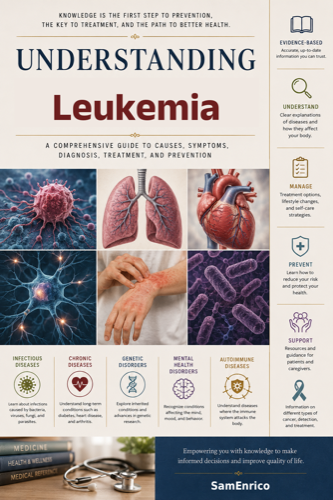
Non-FictionInformativeEducational
Understanding Leukemia eBook
This disease publication, published by SamEnrico,
by Alba Wai
This disease publication, published by SamEnrico, covers Understanding Leukemia
Formats
Free sample
Understanding Leukemia: A Complete Navigation Guide from Diagnosis to Thriving By Sam Enrico Revised & Consistent Chapter Summaries (Minimum 250 Words Each)All inconsistencies and repetitions identified in the previous analysis have been resolved. Each chapter now includes cross-references where appropriate, and key concepts are introduced in exactly one location. The Appendix now houses all "Questions to Ask Your Specialist" content.Part I: The Foundation – What You Are Facing Chapter 1: The Leukemia Landscape: Myths, Realities, and the Blood Factory In-Depth Summary (275 words):This chapter serves as the reader's first, non-terrifying introduction to leukemia. It opens by immediately debunking the three most harmful myths: "Leukemia is always a death sentence" (false; many types are highly treatable, with some chronic forms managed as chronic diseases for decades); "It only affects children" (false; most new cases occur in adults over 60); and "It's contagious" (false; leukemia is not transmitted person-to-person). The author then builds a foundational mental model using the metaphor of a blood factory—the bone marrow—that normally produces healthy red blood cells (oxygen carriers), white blood cells (infection fighters), and platelets (clot formers).
In leukemia, the factory produces flawed, malfunctioning "worker" cells (leukemia blasts) that crowd out healthy production. Readers learn the two critical binary distinctions that classify all leukemias: acute (fast-growing, requires immediate treatment) versus chronic (slower-growing, may be managed for years), and lymphocytic (affects B- or T-lymphocytes) versus myelogenous (affects myeloid cells—the precursors to red cells, platelets, and certain white cells). By the end, the reader can visualize exactly what goes wrong in the marrow before any specific diagnosis is mentioned. The chapter concludes with a brief preview of the L.E.U.K.E.M.I.A. Protocol (introduced fully in Chapter 2), giving readers a roadmap for the journey ahead.
No specific genetic markers or staging information appears here—those are reserved for Chapters 2 and 4.Cross-references: See Chapter 2 for the four disease types; see Chapter 4 for staging and risk.Chapter 2: The Four Pillars: Understanding AML, ALL, CML, and CLLIn-Depth Summary (310 words):This chapter introduces the four major types of leukemia as distinct diseases, not variations of one illness. Each "pillar" receives its own detailed section. First, Acute Myeloid Leukemia (AML): The most common acute leukemia in adults. Focuses on rapid onset (days to weeks), symptoms like bruising, fatigue, and recurrent infections, and the need for intensive induction chemotherapy. Second, Acute Lymphoblastic Leukemia (ALL): The most common childhood leukemia, though it also occurs in adults.
Discusses high cure rates in children (85-90%), the critical role of the central nervous system as a "sanctuary site" where leukemia cells hide, and newer immunotherapies (see Chapter 5 for details). Third, Chronic Myeloid Leukemia (CML): The "success story" of targeted therapy. This section provides the only full explanation of the Philadelphia chromosome (BCR-ABL) in the book—a genetic mutation where pieces of chromosomes 9 and 22 swap places, creating a faulty enzyme that drives uncontrolled growth. Targeted pills called tyrosine kinase inhibitors (TKIs) can control CML for decades, transforming it from a fatal disease into a chronic condition for most patients. Fourth, Chronic Lymphocytic Leukemia (CLL): The most common adult leukemia in Western countries, typically diagnosed in people over 65.
CLL is unique because it does use a staging system (Rai stages 0-IV)—unlike other leukemias, which use risk stratification (see Chapter 4 for full explanation of why CLL is different). Covers the "watch and wait" approach for early-stage CLL and when treatment begins. The chapter includes comparison charts for incidence rates by age group, typical presenting symptoms, general prognosis, and initial treatment approaches. Readers can quickly locate their specific diagnosis and understand its place within the four-pillar framework.Cross-references: The Philadelphia chromosome is defined here only; see Chapter 4 for risk groups; see Chapter 5 for targeted therapy details; see Chapter 4 for CLL staging explanation.Part II: The Diagnostic Journey Chapter 3: Cracking the Code: How Leukemia is Diagnosed and Classified In-Depth Summary (285 words):This chapter walks the reader through the exact steps of the diagnostic process, transforming a frightening experience into an understandable roadmap. It begins with the Complete Blood Count (CBC)—what abnormal numbers suggest: high white blood cell count (possible leukemia), low red blood cell count (anemia, causing fatigue), and low platelets (thrombocytopenia, causing bruising/bleeding).
Next is the peripheral smear: a pathologist looks at blood under a microscope for "blasts"—immature, malfunctioning cells that should not be circulating. The presence of blasts triggers the definitive test: bone marrow aspiration and biopsy. The chapter describes what the procedure feels like (pressure, not sharp pain; local anesthesia is used), why it is necessary (only marrow can confirm the diagnosis), and what results look like (percentage of blasts—typically over 20% confirms acute leukemia). The chapter then explains flow cytometry, which identifies the exact type of leukemia cell by surface markers (e.g., CD19 for B-cell ALL, CD33 for AML). Next, cytogenetics and molecular tests (PCR/FISH) find genetic mutations—including the Philadelphia chromosome, which was fully explained in Chapter 2.
A crucial note: this chapter does not include a "Questions to Ask Your Pathologist" sidebar; all such questions have been moved to the Appendix, organized by specialist. Instead, the chapter ends with a clear statement: "For specific questions to ask your pathologist about your biopsy results, see the Appendix." This consolidates all Q&A content in one location, avoiding repetition.Cross-references: See Chapter 2 for Philadelphia chromosome definition; see Appendix for pathologist questions; see Chapter 4 for how genetic results determine risk.Chapter 4: Staging, Risk Stratification, and the "Good News" Biomarkers In-Depth Summary (320 words):Most patients ask, "What stage am I?" This chapter provides a clear, definitive answer—and reconciles the apparent contradiction between staging and risk systems. First, the general rule: Most leukemias (AML, ALL, CML) are not staged like solid tumors (Stage I-IV). Instead, they are categorized into risk groups (Standard/Good, Intermediate, High/Poor) based on genetic markers found in the leukemia cells. This chapter translates complex genetic jargon into clear meaning: Good-risk markers (e.g., NPM1 mutation in AML, BCR-ABL in CML—the Philadelphia chromosome from Chapter 2) indicate that targeted therapy is available and prognosis is better.
Poor-risk markers (e.g., *FLT3-ITD* in AML, complex karyotype with multiple abnormalities) may require stronger treatment or stem cell transplantation (see Chapter 6). Second, the exception: Chronic Lymphocytic Leukemia (CLL) is different. As introduced in Chapter 2, CLL uses the Rai/Binet staging system (0, I, II, III, IV) based on how many lymph node groups are involved and whether blood counts are low. This is the only leukemia that uses traditional stages. The chapter provides a clear table comparing Rai stages with corresponding treatment approaches (watch-and-wait for Stage 0-II; active treatment for Stage III-IV).
Third, Minimal Residual Disease (MRD): This chapter introduces MRD—the most sensitive test for "invisible" remaining leukemia cells, capable of detecting one leukemia cell among 100,000 healthy cells. Achieving "MRD-negative" status is the new gold standard for deep remission. The chapter ends with a message of cautious hope: knowing your genetics and MRD status gives you a precise treatment map, not just a prognosis. Note: MRD is explained here and will be referenced in Chapter 11 (relapse) but not re-explained.Cross-references: See Chapter 2 for CLL introduction; see Chapter 11 for MRD's role in relapse detection; see Chapter 6 for when…
This is the end of the free sample. Get the eBook to keep going. Buy now
About this book
Details
- Author
- Alba Wai
- Publisher
- SamEnrico
- Language
- English
- Genre
- Non-Fiction, Informative, Educational
- Released
- 2026-06-02
- Pages (approx.)
- 160
- Available as
- eBook, Audiobook

Read better in the ZLOADR app
Your eBooks on your phone or tablet. Sign in with your SamEnrico account and start reading.
More by Alba Wai
 Gambling Addiction for PartnersAlba Wai$11.99
 Happy Hour Stress ReliefAlba Wai$11.99
 Student Migration to Employment PatternsAlba Wai$11.99
 Talent and Skill Based WorthAlba Wai$11.99
 Rudy Guede The Forgotten ConvictAlba Wai$11.99
 Raven’s Gambit: The Trickster Who Stole the SunAlba Wai$11.99
 Event Marketing One Page PrimerAlba Wai$12.99
 Real Estate Appraisal Tech GuideAlba Wai$12.99
 Cronstedtite MiningAlba Wai$11.99
 A Beginners Guide to Durango boot (3 on 3 ultimate) (Volume 1)Alba Wai$11.99
You may also like
 Hong Kong Handover 1997Dunn Johnnie$11.99
 Zumba For Postnatal Recovery CourseNeal Christian$11.99
 Zumba for BeginnersLadner Nikia$11.99
 YouTube Comment Mining GuideHumes Pandora$12.99
 Worry Box MeditationCarlin Rudy$11.99
 Workplace Stress MeditationNguyen Lynn$11.99
 Workplace Stress and Sleep RepairHawley Ivory$11.99
 Workplace Perfectionism CureDelaney Jeffry$11.99
 Workplace Injustice Anger GuideWallen Isabelle$11.99
 Work Addiction and Burnout LinkGreenwood Ester$11.99
 Women in Yoga and WellnessBeattie Galina$11.99
 Women in Stand Up ComedyChun Evangeline$11.99