
Non-FictionInformativeEducational
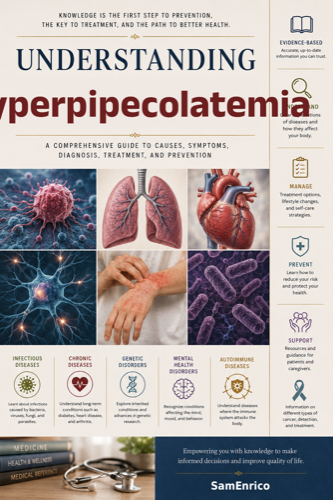
Understanding Hyperpipecolatemia eBook
This disease publication, published by SamEnrico,
by Turnbull Tu
This disease publication, published by SamEnrico, covers Understanding Hyperpipecolatemia
Formats
Free sample
Chapter 1: The Floppy Baby--The call came on a Tuesday afternoon, three weeks after the last spinal tap, two months after the first brain MRI, and four months after a pediatrician had first smiled and said, “Don’t worry, some babies just take a little longer.”The geneticist’s voice was careful, measured, the way people sound when they are about to say something they wish they didn’t have to say. “Your daughter has hyperpipecolatemia.”Silence on the other end of the line. Then: “What is that?”“It’s a peroxisomal disorder,” the geneticist said. “A very rare one. We don’t have a cure, but we have a plan.”The mother—let us call her Sarah, because that was not her real name but it could have been, because her story is every parent’s story—wrote down three words on the notepad by the phone: hyperpipecolatemia, peroxisomal, rare.
She stared at the word hyperpipecolatemia for a full minute. It looked like a typo. It looked like a word that had no business existing. It looked like a life sentence written in a language she did not speak.She was wrong about the life sentence part. But she was right about one thing: this word, this condition, this unexpected detour in her daughter’s life, would demand that she learn an entirely new vocabulary.
She would learn about lysine pathways and pipecolic acid oxidation, about PEX genes and peroxisomal biogenesis, about very long-chain fatty acids and the terrifying difference between a biomarker and a cause. She would learn all of this not because she wanted to become a biochemist but because her daughter’s future depended on it.This book is for Sarah. And for the geneticist who had to make that phone call. And for the pediatrician who missed the early signs. And for the neurologist who ordered the wrong tests the first time.
And for the grandmother who said, “He’ll grow out of it.” And for the family who has just heard the word hyperpipecolatemia for the first time and needs to know: What does this mean? What do I do next? Is there hope?The answer to that last question is complicated. But it is not no.What This Chapter Will Give You Before we dive into the biochemistry and the genetics and the management protocols—before we talk about PEX1 mutations and plasmalogen synthesis and the delicate question of whether pipecolic acid itself is toxic or just a messenger—we need to start with the basics. This chapter serves as your roadmap.
It will:Define hyperpipecolatemia clearly and distinguish it from similar-sounding terms Walk through the history of how this condition went from medical mystery to recognized diagnosis Explain why this disease is so rare and why it is almost certainly underdiagnosed Identify who this book is for and how to use it whether you are a clinician or a family member Set the tone for everything that follows—compassionate, evidence-based, and unflinching in its honesty By the end of this chapter, you will understand what hyperpipecolatemia is and what it is not. You will know where it fits in the larger family of peroxisomal disorders. And you will have a clear sense of how the remaining eleven chapters will guide you through diagnosis, management, and the future of research.Let us begin.Defining the Beast: Pipecolic Acidemia vs. Hyperpipecolatemia Words matter. In medicine, the difference between two similar-sounding terms can mean the difference between a correct diagnosis and years of mismanagement.
So let us be precise from the very first page.Pipecolic acidemia (pronounced pie-PEEK-oh-lick as-i-dee-me-ah) is a biochemical finding. It means that when a laboratory measures the level of pipecolic acid in a person’s blood—using a technique called tandem mass spectrometry or, more specifically, liquid chromatography-tandem mass spectrometry (LC-MS/MS)—that level is above the normal reference range. That is all it means. Pipecolic acidemia is a number on a lab report. It is not a diagnosis.
It is not a disease. It is a clue.Hyperpipecolatemia (high-per-pie-PEEK-oh-luh-tee-me-ah) is a clinical condition. It means that a person has both (a) elevated pipecolic acid in their blood and (b) a specific set of clinical features: typically hypotonia (low muscle tone), developmental delay, seizures, and often—though not always—hepatic abnormalities, dysmorphic features, and retinopathy. Hyperpipecolatemia is a diagnosis. It is a way of saying: This child has a peroxisomal disorder that presents with these particular symptoms, and one of the laboratory markers is an elevated pipecolic acid level.Why does this distinction matter?
Because not everyone with pipecolic acidemia has hyperpipecolatemia. Consider:A premature infant may have transiently elevated pipecolic acid due to immature peroxisomal function. The level normalizes by six months of age. The infant is otherwise healthy. This is pipecolic acidemia without hyperpipecolatemia.A child with a known peroxisomal biogenesis disorder such as Zellweger syndrome will have dramatically elevated pipecolic acid—but also severe dysmorphism, profound hypotonia, and death within the first year.
That child meets criteria for hyperpipecolatemia, but the more specific diagnosis is Zellweger syndrome.A child with the condition that is the subject of this book—isolated hyperpipecolatemia, the mildest end of the Zellweger spectrum—has elevated pipecolic acid, hypotonia, developmental delay, and often seizures, but without the severe dysmorphism or the neonatal lethality of Zellweger syndrome.So the term hyperpipecolatemia is both a diagnosis and a spectrum. In this book, unless otherwise specified, we are talking about the milder, later-onset, non-lethal form—the one that allows children to survive into adulthood, albeit with significant disabilities.A Brief History: From Medical Mystery to Recognized Condition Every rare disease has a history of being ignored, misunderstood, and misdiagnosed. Hyperpipecolatemia is no exception. Its story begins in the 1970s, a golden age for the discovery of inborn errors of metabolism.The First Descriptions (1970s): The earliest cases of what we now call hyperpipecolatemia appeared in the medical literature as case reports of children with hypotonia, seizures, and developmental delay who also happened to have elevated pipecolic acid. At the time, pipecolic acid was a little-known metabolite—a minor footnote in lysine degradation.
Most physicians had never heard of it. The first patients were often labeled as having “cerebral palsy of unknown cause” or “global developmental delay, unspecified.” The elevated pipecolic acid was dismissed as an incidental finding, a curiosity, a red herring.The Zellweger Connection (1980s): As biochemical testing improved, researchers noticed something striking. Patients with Zellweger syndrome—a devastating peroxisomal disorder first described by Hans Zellweger in 1964—also had elevated pipecolic acid. In fact, pipecolic acid elevation became recognized as a biomarker of peroxisomal dysfunction. This led to a period of confusion: was hyperpipecolatemia simply a mild form of Zellweger syndrome?
Or was it a separate entity?For a time, the medical literature referred to “hyperpipecolatemia” as a variant of Zellweger syndrome. Some authors called it “Zellweger syndrome type II” or “neonatal adrenoleukodystrophy with hyperpipecolatemia.” The boundaries were fuzzy. The classification was messy.The Genetic Revolution (1990s–2000s): The discovery of the PEX gene family changed everything. Researchers learned that peroxisomal biogenesis disorders—including Zellweger syndrome, neonatal adrenoleukodystrophy, and Refsum disease—all resulted from mutations in genes required to build functional peroxisomes.…
This is the end of the free sample. Get the eBook to keep going. Buy now
About this book
Details
- Author
- Turnbull Tu
- Publisher
- SamEnrico
- Language
- English
- Genre
- Non-Fiction, Informative, Educational
- Released
- 2026-06-03
- Pages (approx.)
- 160
- Available as
- eBook, Audiobook

Read better in the ZLOADR app
Your eBooks on your phone or tablet. Sign in with your SamEnrico account and start reading.
More by Turnbull Tu
 Franchise Builder's Franchise FlippingTurnbull Tu$11.99
 Anger Trigger NeurodivergenceTurnbull Tu$11.99
 Time Blocking For DesignersTurnbull Tu$11.99
 Gamblers Anonymous Step PrimerTurnbull Tu$11.99
 The Phantom of the Stock Exchange: The Rise and Fall of Jordan BelfortTurnbull Tu$11.99
 The Clockwork Genius: Benjamin Banneker's Astronomical LegacyTurnbull Tu$11.99
 Foundation Grant Research PrimerTurnbull Tu$12.99
 Digital Asset Custody GuideTurnbull Tu$12.99
 How to Start a Casting of Grey Iron Business (Beginners Guide)Turnbull Tu$11.99
 Civil Project ManagerTurnbull Tu$11.99
You may also like
 Hong Kong Handover 1997Dunn Johnnie$11.99
 Zumba For Postnatal Recovery CourseNeal Christian$11.99
 Zumba for BeginnersLadner Nikia$11.99
 YouTube Comment Mining GuideHumes Pandora$12.99
 Worry Box MeditationCarlin Rudy$11.99
 Workplace Stress MeditationNguyen Lynn$11.99
 Workplace Stress and Sleep RepairHawley Ivory$11.99
 Workplace Perfectionism CureDelaney Jeffry$11.99
 Workplace Injustice Anger GuideWallen Isabelle$11.99
 Work Addiction and Burnout LinkGreenwood Ester$11.99
 Women in Yoga and WellnessBeattie Galina$11.99
 Women in Stand Up ComedyChun Evangeline$11.99