
Non-FictionInformativeEducational
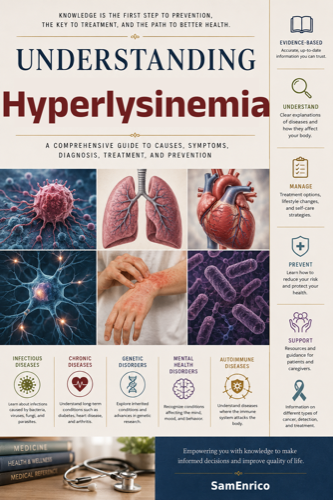
Understanding Hyperlysinemia eBook
This disease publication, published by SamEnrico,
by Pino Marita
This disease publication, published by SamEnrico, covers Understanding Hyperlysinemia
Formats
Free sample
Chapter 1: The Metabolic Traffic Jam...–- Every morning, millions of people wake up, eat breakfast, and never once think about the chemical reactions happening inside their cells. Eggs are scrambled, toast is buttered, coffee is poured—and somewhere in the liver, a microscopic machine called the lysine degradation pathway quietly goes to work. For the vast majority of humanity, this process is invisible, effortless, and utterly unremarkable. But for a small number of individuals born with a variation in a single gene on chromosome 7, that silent metabolic machinery sputters and stalls. The result is a laboratory finding that has generated confusion, controversy, and more than a few sleepless nights for parents and physicians alike: hyperlysinemia.This chapter introduces the core concept that will shape everything that follows—understanding hyperlysinemia not as a terrifying diagnosis but as a biochemical phenomenon.
We will explore what lysine is and why your body cannot live without it, what happens when its breakdown pathway becomes blocked, and why the term "hyperlysinemia" describes a blood test result rather than a destiny. By the end of this chapter, you will have a clear framework for thinking about this condition that strips away the fear and replaces it with knowledge—because knowledge, as every experienced metabolic geneticist will tell you, is the most powerful tool a family can possess when facing a rare diagnosis.What Is Lysine and Why Does Your Body Need It?To understand hyperlysinemia, you must first understand lysine. Lysine is one of the twenty standard amino acids that serve as the building blocks of every protein in your body—from the hemoglobin that carries oxygen in your blood to the antibodies that fight infection to the collagen that holds your skin together. But unlike some amino acids that your body can synthesize from other molecules, lysine falls into a special category: the essential amino acids. "Essential" in this context does not mean "important" (though it is certainly that).
In the language of biochemistry, an essential amino acid is one that your body cannot produce on its own. It must come from the food you eat.Every time you consume protein—whether from a chicken breast, a bowl of lentils, a glass of milk, or a handful of nuts—your digestive system breaks that protein down into its constituent amino acids, including lysine. Your body then absorbs these amino acids and uses them to build its own proteins. This process is so fundamental to life that without dietary protein, humans would eventually sicken and die. But like so many things in biology, balance is everything.
Too little lysine leads to protein deficiency, with symptoms including fatigue, hair loss, anemia, and impaired immune function. Too much lysine—at least in the context of a broken degradation pathway—leads to hyperlysinemia.The average adult requires approximately 30 to 40 milligrams of lysine per kilogram of body weight each day. A 70-kilogram (154-pound) person therefore needs about 2,500 to 3,000 milligrams of lysine daily. This is easily obtained from a standard diet. A single chicken breast contains roughly 4,000 milligrams of lysine.
A cup of cooked lentils provides about 1,200 milligrams. Even a slice of whole wheat bread contributes 100 milligrams. For most people, the body's lysine degradation pathway handles this influx without any difficulty. The pathway acts like a well-designed factory assembly line, taking in lysine at one end and producing harmless end products at the other. But when a genetic variant disrupts a key enzyme on that assembly line, the factory backs up.
Lysine accumulates. And that accumulation is detectable in the blood.The Analogy That Changes Everything: The Metabolic Traffic Jam Metabolic geneticists often use analogies to help families understand complex biochemical concepts, and one of the most effective is the traffic jam analogy. Imagine a six-lane highway that represents the lysine degradation pathway. At the entrance to this highway, cars (lysine molecules) merge from on-ramps (the digestive system). The highway flows smoothly toward its destination (the end products of lysine breakdown), with each segment of the highway representing a different chemical reaction catalyzed by a specific enzyme.Now imagine that one of the lanes on this highway suddenly closes due to construction.
The construction zone represents a deficiency in one of the enzymes—perhaps the lysine-ketoglutarate reductase (LKR) enzyme or the saccharopine dehydrogenase (SDH) enzyme. Cars continue to enter the highway from the on-ramps because you continue to eat protein, but they cannot pass through the closed lane. What happens? A traffic jam forms. Cars back up behind the construction zone, creating a long line of idling vehicles.
That backup of cars represents the accumulation of lysine in the blood—hyperlysinemia.Here is where the analogy becomes particularly powerful—and where it helps explain the central mystery of hyperlysinemia. In most traffic jams, the backed-up cars cause no harm beyond inconvenience. They simply wait until the construction is complete or until they can find an alternate route. Similarly, for the majority of individuals with hyperlysinemia, the backed-up lysine appears to cause no damage whatsoever. The body simply tolerates the higher levels, perhaps by excreting excess lysine in the urine or by storing it in ways that do not interfere with normal cellular function.But in a minority of cases, the traffic jam seems to cause problems.
Why? The analogy offers two possibilities. First, perhaps some individuals have a more complete enzyme deficiency—a complete lane closure rather than a partial one—leading to much higher levels of lysine that overwhelm the body's tolerance mechanisms. Second, perhaps some individuals have other metabolic vulnerabilities that make them less able to handle even moderate traffic jams. This second possibility, known as the multifactorial threshold model, suggests that hyperlysinemia alone may not be sufficient to cause symptoms; rather, it may require an additional genetic or environmental "second hit" to push a person over the threshold into clinical illness.This analogy—and the questions it raises—will reappear throughout this book.
For now, the key takeaway is simple: hyperlysinemia is a traffic jam in the lysine degradation highway. For most people, that traffic jam is a harmless inconvenience. For a few, it may contribute to real health problems. The goal of this book is to help you understand which group you or your child falls into and what to do about it.The Lysine Degradation Pathway: A Step-by-Step Guide To truly understand hyperlysinemia, you need a basic map of the lysine degradation pathway. Do not let the biochemical terms intimidate you.
Think of this section as learning the names of the streets in the traffic jam analogy—helpful but not overwhelming.Lysine degradation occurs primarily in the liver, though other tissues including the kidneys and brain also participate. The pathway begins in the mitochondria—the tiny power plants inside your cells that generate energy. Here is what happens step by step:Step 1: The First Reaction (LKR)Lysine encounters the enzyme lysine-ketoglutarate reductase (LKR). This enzyme combines lysine with a molecule called alpha-ketoglutarate to form a new molecule: saccharopine. Think of LKR as the first worker on the assembly line, taking raw materials (lysine and alpha-ketoglutarate) and producing an intermediate product (saccharopine).Step 2: The Second Reaction (SDH)Saccharopine then encounters a second enzyme attached to the same protein complex: saccharopine dehydrogenase (SDH).…
This is the end of the free sample. Get the eBook to keep going. Buy now
About this book
Details
- Author
- Pino Marita
- Publisher
- SamEnrico
- Language
- English
- Genre
- Non-Fiction, Informative, Educational
- Released
- 2026-06-02
- Pages (approx.)
- 152
- Available as
- eBook, Audiobook

Read better in the ZLOADR app
Your eBooks on your phone or tablet. Sign in with your SamEnrico account and start reading.
More by Pino Marita
 Value Violation Anger TriggersPino Marita$11.99
 AA Twelve Step Recovery GuidePino Marita$11.99
 PNE Flip Chart for CliniciansPino Marita$11.99
 Email Blocking Strategy GuidePino Marita$11.99
 The Unseen Architect: How a Forgotten Woman Built the Modern InternetPino Marita$11.99
 The Architect of the Cosmos: Imhotep and the Birth of Egyptian EngineeringPino Marita$11.99
 Sainfoin HarvestingPino Marita$11.99
 Three Sector Career Comparison GuidePino Marita$12.99
 Neobank Core Systems GuidePino Marita$12.99
 How to Start a Mountain Guides Business (Beginners Guide)Pino Marita$11.99
You may also like
 Hong Kong Handover 1997Dunn Johnnie$11.99
 Zumba For Postnatal Recovery CourseNeal Christian$11.99
 Zumba for BeginnersLadner Nikia$11.99
 YouTube Comment Mining GuideHumes Pandora$12.99
 Worry Box MeditationCarlin Rudy$11.99
 Workplace Stress MeditationNguyen Lynn$11.99
 Workplace Stress and Sleep RepairHawley Ivory$11.99
 Workplace Perfectionism CureDelaney Jeffry$11.99
 Workplace Injustice Anger GuideWallen Isabelle$11.99
 Work Addiction and Burnout LinkGreenwood Ester$11.99
 Women in Yoga and WellnessBeattie Galina$11.99
 Women in Stand Up ComedyChun Evangeline$11.99