
Non-FictionInformativeEducational
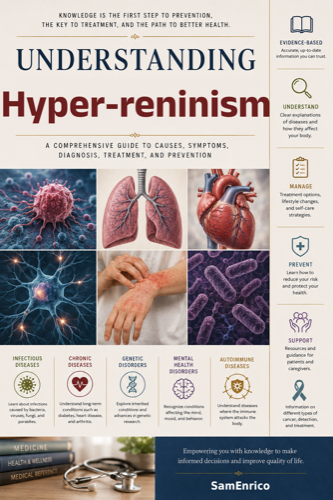
Understanding Hyper-reninism eBook
This disease publication, published by SamEnrico,
This disease publication, published by SamEnrico, covers Understanding Hyper-reninism
Formats
Free sample
Chapter 1: The Renin Paradox--–- Dr. Elena Vasquez stared at the lab results in disbelief. Her patient, a 47-year-old marathon runner with no prior medical history, had blood pressure readings of 210/115 mm Hg despite being on four antihypertensive medications. His potassium was 2.7 m Eq/L. His kidneys were normal on ultrasound.
His renal arteries were clean on CT angiography. For two years, three different specialists had labeled his condition "essential hypertension" – the medical equivalent of saying "we don't know." But Elena had ordered one additional test that most physicians overlooked: plasma renin activity. The result came back at 24 ng/m L/hr, more than six times the upper limit of normal. Her patient didn't have essential hypertension. He had a reninoma – a tiny, benign tumor in his kidney that had been secretly driving his blood pressure into dangerous territory for nearly a decade.
Six weeks after laparoscopic partial nephrectomy, his blood pressure was 118/72 without a single medication. The renin paradox, Elena realized, was that one of the most treatable causes of severe hypertension is also one of the most frequently missed.The Most Overlooked Diagnosis in Hypertension Hypertension affects more than 1.4 billion people worldwide and is the leading cause of premature death, responsible for nearly 10 million deaths annually. Yet despite decades of research and hundreds of antihypertensive medications, blood pressure control rates remain dismal – fewer than one in four hypertensive patients in the United States achieve target blood pressure, and globally the numbers are far worse. This epidemic of uncontrolled hypertension has many causes: medication non-adherence, dietary indiscretion, and the rising prevalence of obesity. But there is another, more troubling explanation that the medical establishment has been slow to acknowledge: we are misdiagnosing a significant subset of hypertensive patients because we have forgotten how to look for the root cause.The renin-angiotensin system (RAS) is one of the most powerful blood pressure regulatory systems in the human body, yet most physicians reduce it to a simple diagram in a textbook: renin converts angiotensinogen to angiotensin I, ACE converts angiotensin I to angiotensin II, and angiotensin II constricts blood vessels and stimulates aldosterone release.
This linear, mechanistic model is taught in medical schools, tested on board examinations, and then largely forgotten. What is not taught – and what this chapter will reveal – is that the RAS is not a simple linear pathway but an exquisitely complex, bidirectional, multi-organ system with redundant feedback loops, counter-regulatory arms, and tissue-specific variants that defy the textbook model.The renin paradox is this: hyper-reninism – a state of inappropriately elevated renin production – causes some of the most severe, treatment-resistant hypertension known to medicine, yet it is almost never considered in the initial diagnostic workup. Reninomas (juxtaglomerular cell tumors) are curable with surgery. Renal artery stenosis is treatable with stenting or bypass. Bartter syndrome and Gitelman syndrome, while not curable, are highly manageable once diagnosed.
But these conditions share a common thread: they all present with hypertension (or in the case of the tubulopathies, hypotension) and an elevated renin level. The problem is not that these diseases are untreatable. The problem is that physicians rarely order the test that would identify them.A Brief History of a Forgotten Hormone The story of renin begins in 1898, when Swedish physiologist Robert Tigerstedt and his medical student Per Bergman were conducting experiments on rabbit kidneys at the Karolinska Institute. They observed that injecting kidney extracts into rabbits caused a sustained rise in blood pressure – a finding so unexpected that Tigerstedt himself was skeptical. He named the active substance "renin" from the Latin ren, meaning kidney.
For the next three decades, renin was largely forgotten, dismissed as a laboratory curiosity. It wasn't until 1934, when Harry Goldblatt and colleagues demonstrated that constricting the renal artery in dogs produced persistent hypertension, that the medical world began to reconsider. Goldblatt's work established the kidney as a central player in blood pressure regulation and sparked a search for the renal pressor substance.The modern era of renin research began in the 1950s and 1960s with the discovery of angiotensin I, angiotensin II, and angiotensin-converting enzyme (ACE). The development of ACE inhibitors in the 1970s revolutionized hypertension treatment and earned their developers the 1982 Lasker Award. But while the therapeutic success of ACE inhibitors and later ARBs (angiotensin receptor blockers) confirmed the clinical importance of the RAS, it also had an unintended consequence: it shifted attention away from renin itself.
Why measure renin when you can simply block its downstream effects? This question, asked by countless physicians over the past four decades, is precisely why hyper-reninism has become a forgotten diagnosis.The clinical consequences of this forgetfulness are not trivial. A 2019 systematic review found that reninomas have an average time to diagnosis of 4.7 years from symptom onset. During those years, patients endure severe hypertension, recurrent hypokalemia, medication side effects, and the psychological burden of being told their symptoms are "idiopathic" or "anxiety-related." By the time a reninoma is finally discovered – often only after a catastrophic cardiovascular event – many patients have already developed irreversible target organ damage. This is a failure not of technology but of medical education and diagnostic reasoning.Beyond the Textbook: The Modern RASTo understand hyper-reninism, one must first abandon the simplistic linear model of the RAS.
The modern understanding, which has emerged over the past two decades, reveals a system of remarkable complexity. The classic pathway – renin to angiotensin I to angiotensin II to aldosterone – is only one part of the story. There are at least three additional axes that every clinician must understand.The first is the counter-regulatory axis, mediated by ACE2 (angiotensin-converting enzyme 2), angiotensin-(1-7), and the Mas receptor. This arm of the RAS opposes the classic pathway: it causes vasodilation, natriuresis, and anti-fibrotic effects. ACE2, the same enzyme that SARS-Co V-2 uses to enter human cells, is a critical brake on the pressor effects of angiotensin II.
When this counter-regulatory arm is deficient – whether due to genetic variation, disease, or pharmacological inhibition – the result is unopposed angiotensin II activity and worsening hypertension.The second is the prorenin receptor pathway. For decades, prorenin was considered an inert precursor molecule with no biological activity. We now know that prorenin binds to the (pro)renin receptor (PRR), triggering intracellular signaling cascades that are completely independent of angiotensin II. PRR activation stimulates the MAP kinase pathway, leading to cell proliferation, fibrosis, and inflammation. PRR is also a critical component of the vacuolar H+-ATPase, meaning it plays a role in cellular p H regulation.
This dual function – part of the RAS and part of cellular metabolism – has opened new avenues of research into how hyper-reninism might cause end-organ damage beyond its effects on blood pressure.The third is the distinction between circulating versus tissue RAS. The classical model assumes that renin produced in the kidney acts systemically on angiotensinogen produced in the liver. This is true, but it is only half the picture. Virtually every organ – including the heart, brain, blood vessels, adrenal glands, pancreas, and adipose tissue – contains a complete, locally expressed RAS. These tissue RAS systems operate independently of the circulating RAS, meaning that a patient with a normal plasma renin level can still have pathologically elevated tissue renin activity in, for…
This is the end of the free sample. Get the eBook to keep going. Buy now
About this book
Details
- Author
- Barnhart Olin
- Publisher
- SamEnrico
- Language
- English
- Genre
- Non-Fiction, Informative, Educational
- Released
- 2026-06-02
- Pages (approx.)
- 153
- Available as
- eBook, Audiobook

Read better in the ZLOADR app
Your eBooks on your phone or tablet. Sign in with your SamEnrico account and start reading.
More by Barnhart Olin
 Anapanasati Breath Meditation GuideBarnhart Olin$11.99
 Emotions Anonymous Step GuideBarnhart Olin$11.99
 Time Blocking For Graduate StudentsBarnhart Olin$11.99
 Franchise Builder's Partner SplitBarnhart Olin$11.99
 The Unbreakable Comeback: The Miraculous Recovery of Bethany HamiltonBarnhart Olin$11.99
 The Silk Road Empire: How a 13th-Century Land Baron Built a Global Trade NetworkBarnhart Olin$11.99
 How to Start a Multiplexers for Telephone Exchanges Business (Beginners Guide)Barnhart Olin$11.99
 Cognos AnalystBarnhart Olin$11.99
 Credit Card Issuer AI GuideBarnhart Olin$12.99
 Brand Deal Negotiation PrimerBarnhart Olin$12.99
You may also like
 Hong Kong Handover 1997Dunn Johnnie$11.99
 Zumba For Postnatal Recovery CourseNeal Christian$11.99
 Zumba for BeginnersLadner Nikia$11.99
 YouTube Comment Mining GuideHumes Pandora$12.99
 Worry Box MeditationCarlin Rudy$11.99
 Workplace Stress MeditationNguyen Lynn$11.99
 Workplace Stress and Sleep RepairHawley Ivory$11.99
 Workplace Perfectionism CureDelaney Jeffry$11.99
 Workplace Injustice Anger GuideWallen Isabelle$11.99
 Work Addiction and Burnout LinkGreenwood Ester$11.99
 Women in Yoga and WellnessBeattie Galina$11.99
 Women in Stand Up ComedyChun Evangeline$11.99