
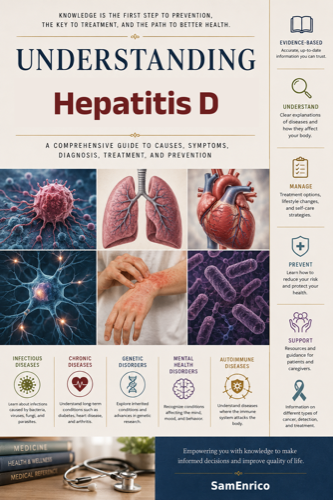
Non-FictionInformativeEducational
Understanding Hepatitis D eBook
This disease publication, published by SamEnrico,
by Heaton Ludie
This disease publication, published by SamEnrico, covers Understanding Hepatitis D
Formats
Free sample
Chapter 1: The Silent Furnace...--The human body is a masterclass in inefficient design. Consider the appendix, a vestigial pouch with no clear purpose other than to rupture at the worst possible moment. Consider the wisdom tooth, an evolutionary relic that crowds out its neighbors and requires surgical extraction. Consider the knee, a hinge joint engineered with the structural integrity of a house of cards, prone to tearing, grinding, and collapsing under the modest stress of a jog. But of all the body's flawed designs, none is more treacherous, more deceptive, more dangerously quiet than the liver.The liver sits in the upper right quadrant of the abdominal cavity, tucked beneath the rib cage like a sleeping animal.
It is the largest solid internal organ, roughly the size of a football in an average adult, weighing about three pounds of reddish-brown tissue. It performs over five hundred known functions—a fact that alone should make any reader pause. Five hundred distinct jobs. The heart has one primary job: pump blood. The lungs have one primary job: exchange gases.
The kidneys have one primary job: filter waste. The liver has five hundred. It is a metabolic factory, a detoxification plant, a protein synthesizer, a bile producer, a glucose storage depot, a vitamin warehouse, a cholesterol regulator, an immune sentinel, and a blood filter. It is the closest thing the human body has to a universal solvent, capable of breaking down everything from alcohol and medications to hormones and cellular debris. And it performs all of these functions simultaneously, continuously, without rest, from the moment of fetal development until the moment of death.Yet despite its monumental importance, the liver has a fatal flaw: it does not feel pain.Not because it lacks nerves entirely—it has them, but they are sparse and poorly distributed.
The liver itself has no pain receptors. The capsule that surrounds the liver does, but only when it is stretched. This means that a liver can be inflamed, infected, scarred, or even riddled with tumors, and the person carrying it will feel nothing. No ache. No twinge.
No warning signal. By the time the liver hurts, the capsule has stretched so far that the organ is already significantly enlarged or cirrhotic. By the time a patient feels something wrong, the disease has often progressed beyond the window where simple intervention could have made a difference.This is the first and most important fact that anyone seeking to understand Hepatitis D must internalize: the liver is a silent furnace, and it burns quietly.The Organ That Does Everything To appreciate what Hepatitis D does to the liver, one must first appreciate what the liver does for the person who carries it. This is not academic curiosity. This is survival-level knowledge.
Patients who understand their liver are patients who can recognize when it is under threat, communicate effectively with their doctors, and make informed decisions about treatment.Let us take a tour of the liver's five hundred functions, not as a catalog but as a narrative. Imagine, for a moment, that you are a molecule of glucose. You have just been absorbed from a meal—perhaps a bowl of oatmeal with berries, or a slice of toast with eggs. Your journey through the bloodstream will eventually bring you to the liver's doorstep. The liver, sensing that blood sugar levels are rising, will capture you and convert you into glycogen, a storage form of glucose.
Later, when blood sugar drops—perhaps during exercise or between meals—the liver will break that glycogen back into glucose and release you into the bloodstream. This is homeostasis. This is why people who do not eat for twelve hours do not immediately collapse into hypoglycemic coma. The liver is their backup battery.Now imagine that you are a toxin. Perhaps you are a molecule of alcohol from an evening glass of wine.
Perhaps you are a breakdown product of acetaminophen, taken for a headache. Perhaps you are a bacterial endotoxin that snuck through the intestinal wall. The liver recognizes you as a threat. It deploys a family of enzymes—the cytochrome P450 system, a chemical arsenal of staggering complexity—to oxidize, reduce, hydrolyze, and conjugate you into a harmless form that can be excreted in bile or urine. This is detoxification.
This is why moderate alcohol consumption is survivable and why most medications do not poison us. The liver is the body's hazardous waste disposal unit.Now imagine that you are a red blood cell, aged and worn out after a hundred and twenty days of service. Your journey through the spleen will mark you for destruction, and your hemoglobin will be broken down into heme and globin. The heme will be converted into bilirubin, a yellow pigment that is toxic if it accumulates. The liver captures bilirubin, conjugates it to make it water-soluble, and excretes it in bile.
This is why healthy people are not jaundiced. This is why a failing liver produces the yellow discoloration of the skin and eyes that has been recognized as a sign of death since ancient times. The liver is the body's waste management system.Now imagine that you are a protein. Perhaps you are fibrinogen, needed to form a blood clot. Perhaps you are albumin, needed to maintain fluid balance in the tissues.
Perhaps you are a complement protein, needed to fight infection. The liver synthesizes all of these, packaging amino acids into precisely folded, functional molecules and releasing them into the bloodstream. This is why people with advanced liver disease bruise easily—they cannot make enough clotting factors. This is why they develop fluid accumulation in the abdomen, a condition called ascites—they cannot make enough albumin to keep fluid in the blood vessels. The liver is the body's manufacturing plant.These four functions—metabolic regulation, detoxification, waste excretion, and protein synthesis—represent only a fraction of what the liver does.
It also stores vitamins A, D, E, K, and B12. It produces bile, which emulsifies fats and allows for their absorption. It regulates cholesterol levels, synthesizing about eight hundred milligrams per day. It clears bacteria and endotoxins from the portal blood. It processes hormones, removing excess estrogen, testosterone, and cortisol.
It maintains iron balance, storing ferritin and releasing it as needed. It even plays a role in the immune system, housing a population of specialized macrophages called Kupffer cells that engulf pathogens and cellular debris.The liver is, in short, indispensable. There is no artificial substitute that can perform all of its functions. Dialysis can replace the kidneys. Ventilators can replace the lungs.
Pacemakers can replace the heart's electrical conduction. But there is no liver machine. There is only transplantation—taking a healthy liver from a deceased or living donor and implanting it into a patient whose own liver has failed. And transplantation, as we will explore in later chapters, is a last resort, an option available to only a fraction of those who need it.Inflammation: The Body's Double-Edged Sword If the liver is the furnace, then hepatitis is the fire. The word itself comes from the Greek hepar (liver) and the suffix -itis (inflammation).
Inflammation is not a disease but a response. It is the body's attempt to contain and eliminate a threat, whether…
This is the end of the free sample. Get the eBook to keep going. Buy now
About this book
Details
- Author
- Heaton Ludie
- Publisher
- SamEnrico
- Language
- English
- Genre
- Non-Fiction, Informative, Educational
- Released
- 2026-05-09
- Pages (approx.)
- 148
- Available as
- eBook, Audiobook

Read better in the ZLOADR app
Your eBooks on your phone or tablet. Sign in with your SamEnrico account and start reading.
More by Heaton Ludie
 Self Esteem And Relationship LabelsHeaton Ludie$11.99
 Emotional Energy Protection GuideHeaton Ludie$11.99
 Parental Guilt And Stress ConnectionHeaton Ludie$11.99
 The Jade Phoenix's Last Flight: A Tale of the Nine HeavensHeaton Ludie$11.99
 Ibn Battuta in the Frozen South: The Untold Arctic Journey of a Medieval ExplorerHeaton Ludie$11.99
 How to Become a Natural-gas-treating-unit OperatorHeaton Ludie$11.99
 E-Commerce Loyalty Program OutlookHeaton Ludie$12.99
 Working Professional Degree ShowdownHeaton Ludie$12.99
 AEM DeveloperHeaton Ludie$11.99
You may also like
 Hong Kong Handover 1997Dunn Johnnie$11.99
 Zumba For Postnatal Recovery CourseNeal Christian$11.99
 Zumba for BeginnersLadner Nikia$11.99
 YouTube Comment Mining GuideHumes Pandora$12.99
 Worry Box MeditationCarlin Rudy$11.99
 Workplace Stress MeditationNguyen Lynn$11.99
 Workplace Stress and Sleep RepairHawley Ivory$11.99
 Workplace Perfectionism CureDelaney Jeffry$11.99
 Workplace Injustice Anger GuideWallen Isabelle$11.99
 Work Addiction and Burnout LinkGreenwood Ester$11.99
 Women in Yoga and WellnessBeattie Galina$11.99
 Women in Stand Up ComedyChun Evangeline$11.99