
Non-FictionInformativeEducational
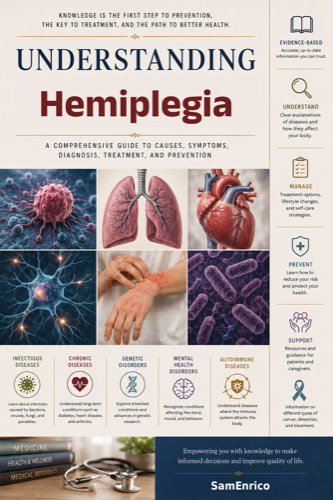
Understanding Hemiplegia
This disease publication, published by SamEnrico,
This disease publication, published by SamEnrico, covers Understanding Hemiplegia
Formats
About this book
Free sample
Chapter 1: The Unexpected Thief--It begins with a word you never expected to define your life: hemiplegia. Maybe you heard it from a doctor in a hospital hallway, the word bouncing off sterile walls while your mind was still reeling from the words “stroke” or “brain injury” or “tumor.” Maybe you read it in a report about your child, typed coldly in a neurologist’s note: “Infant presents with right-sided hemiplegia secondary to perinatal stroke.” Or maybe you are the one living inside the body that no longer obeys, waking up each morning to a limb that feels like it belongs to someone else—heavy, absent, or frozen in a clenched position you cannot release.Whatever path brought you here, you are not alone. Hemiplegia affects approximately one million people in the United States alone, and tens of millions worldwide. It crosses every boundary of age, race, income, and geography. A premature infant in a neonatal intensive care unit.
A thirty-four-year-old mother who suffers a ruptured brain aneurysm while making dinner. A seventy-two-year-old retired teacher whose left arm and leg stop working without warning. A teenager with cerebral palsy who has never known what it feels like to open both hands at the same time.This book is for all of you. And it begins with a single, essential truth: hemiplegia is not a disease. It is a symptom.
It is the visible footprint of an invisible injury somewhere deep inside the brain. Understanding that footprint—where it came from, what it means, and what it does not mean—is the first step toward taking back control of your life.Let us be clear about what we are dealing with. The word “hemiplegia” comes from Greek: hemi meaning half, and plegia meaning stroke or paralysis. In strict medical terms, hemiplegia means complete paralysis of one side of the body—the arm, the leg, and often the face and trunk on that side. But you will also hear a related word: hemiparesis.
Paresis means weakness. So hemiparesis is weakness on one side of the body, not complete paralysis. In everyday conversation, patients…
This is the end of the free sample. Get the eBook to keep going. Buy now
Contents
- Chapter 1
- Chapter 2
- Chapter 3
- Chapter 4
- Chapter 5
- Chapter 6
- Chapter 7
- Chapter 8
- Chapter 9
- Chapter 10
- Chapter 11
- Chapter 12
Details
- Author
- Pennington Jonell
- Publisher
- SamEnrico
- Language
- English
- Genre
- Non-Fiction, Informative, Educational
- Released
- 2026-05-06
- Pages (approx.)
- 154
- Available as
- eBook, Audiobook

Read better in the ZLOADR app
Your eBooks on your phone or tablet. Sign in with your SamEnrico account and start reading.
More by Pennington Jonell
 Sex Addiction Recovery For Introverts CoursePennington Jonell$11.99
 Dreams in Wilderness TherapyPennington Jonell$11.99
 Dreams After Identity Theft GuidePennington Jonell$11.99
 Purpose in Midlife GuidePennington Jonell$11.99
 The Vanishing Vermeer: A Forger’s MasterpiecePennington Jonell$11.99
 The Silent Hunt: How the Soviet Union's Deadliest Spy Outmaneuvered the WestPennington Jonell$11.99
 Jack Russell Terrier BreedingPennington Jonell$11.99
 EU Student Work Visa ManualPennington Jonell$12.99
 Renewable Energy Wildlife Impact OutlookPennington Jonell$12.99
 How to Become a Second Cook And BakerPennington Jonell$11.99
You may also like
 Hong Kong Handover 1997Dunn Johnnie$11.99
 Zumba For Postnatal Recovery CourseNeal Christian$11.99
 Zumba for BeginnersLadner Nikia$11.99
 YouTube Comment Mining GuideHumes Pandora$12.99
 Worry Box MeditationCarlin Rudy$11.99
 Workplace Stress MeditationNguyen Lynn$11.99
 Workplace Stress and Sleep RepairHawley Ivory$11.99
 Workplace Perfectionism CureDelaney Jeffry$11.99
 Workplace Injustice Anger GuideWallen Isabelle$11.99
 Work Addiction and Burnout LinkGreenwood Ester$11.99
 Women in Yoga and WellnessBeattie Galina$11.99
 Women in Stand Up ComedyChun Evangeline$11.99