
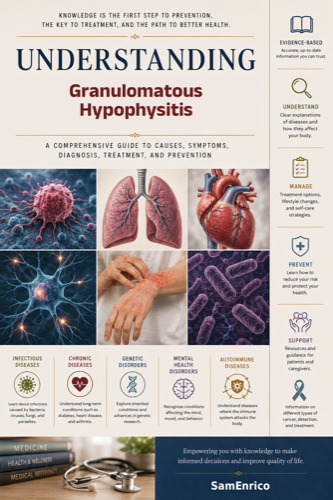
Non-FictionInformativeEducational
Understanding Granulomatous Hypophysitis Audiobook
This disease publication, published by SamEnrico,
This disease publication, published by SamEnrico, covers Understanding Granulomatous Hypophysitis
Formats
Free sample
Chapter 1: Beyond the Label--–- In the winter of 2018, a 52-year-old accountant named Margaret began noticing that the numbers on her computer screen looked slightly blurred at the edges. She scheduled an appointment with her optometrist, who prescribed new glasses. When the symptoms worsened over the next three months—evolving into patchy blind spots in her peripheral vision—she underwent a visual field test that revealed bitemporal hemianopia, a pattern of vision loss so specific that it immediately pointed to one anatomical location: the optic chiasm, the crossroads where nerve fibers from both eyes converge just above the pituitary gland. An MRI followed, and the radiologist’s report read, "Sellar mass measuring 2.1 cm, consistent with pituitary macroadenoma." Margaret was referred to a neurosurgeon, who recommended transsphenoidal resection. She scheduled the surgery.
She told her family she had a brain tumor. She began preparing for the worst.–- But three days before the scheduled operation, a second opinion changed everything. A different neurosurgeon reviewed the MRI and noticed something subtle: the mass was not eccentric or lobulated, as most adenomas are, but rather symmetrically enlarged and uniformly enhancing. He ordered a baseline pituitary hormonal panel, which revealed low morning cortisol and low free T4 with inappropriately normal TSH—central hypothyroidism and secondary adrenal insufficiency. He also checked a prolactin level, which was mildly elevated at 68 ng/m L.
These findings, he explained, did not rule out an adenoma but were also entirely compatible with something far less common and far less aggressive: granulomatous hypophysitis. He recommended a trial of high-dose glucocorticoids instead of surgery. Margaret canceled the operation. Within six weeks of starting prednisone, her visual field defects resolved, her hormone levels normalized, and her MRI showed a 40 percent reduction in gland size. She did not have a tumor.
She had an inflammatory disease that most doctors had never heard of.–- Margaret’s story is not an anomaly. It is the rule. Granulomatous hypophysitis (GH) is one of the most underdiagnosed and misdiagnosed conditions in neuroendocrinology, and its victims—like Margaret—are routinely referred for unnecessary surgery, exposed to the risks of anesthesia, permanent hypopituitarism, and the psychological trauma of a cancer diagnosis they never actually had. The problem is not malice or incompetence. It is ignorance.
GH is rare enough that most endocrinologists will see only one or two cases in their careers, and many neurosurgeons will never encounter…
This is the end of the free sample. Get the Audiobook to keep going. Buy now
About this book
Details
- Author
- Shaffer Alysa
- Publisher
- SamEnrico
- Language
- English
- Genre
- Non-Fiction, Informative, Educational
- Released
- 2026-05-06
- Pages (approx.)
- 158
- Available as
- eBook, Audiobook

Listen in the VoxFlicks app
Audiobooks and audio dramas wherever you go. Sign in with your SamEnrico account and press play.
More by Shaffer Alysa
 Boring Conversation Escape HandbookShaffer Alysa$11.99
 Customer Service Habit GuideShaffer Alysa$11.99
 Strategic Group Mapping HandbookShaffer Alysa$11.99
 Nobel Laureates In Prion BiologyShaffer Alysa$11.99
 Walking Meditation for Multiple SclerosisShaffer Alysa$11.99
 Echoes of the Abyss: The Atlantic’s Forgotten Black Hole PioneersShaffer Alysa$11.99
 Silent Siege: The Phantom of the BosphorusShaffer Alysa$11.99
 Skilled Resort Line CookShaffer Alysa$11.99
 Payment Reminder Sequence GuideShaffer Alysa$12.99
 Indian BPO Landscape GuideShaffer Alysa$12.99
 How to Start a Buffalo Raising and Breeding for Meat Business (Beginners Guide)Shaffer Alysa$11.99
You may also like
 Hong Kong Handover 1997Dunn Johnnie$11.99
 Zumba For Postnatal Recovery CourseNeal Christian$11.99
 Zumba for BeginnersLadner Nikia$11.99
 YouTube Comment Mining GuideHumes Pandora$12.99
 Worry Box MeditationCarlin Rudy$11.99
 Workplace Stress MeditationNguyen Lynn$11.99
 Workplace Stress and Sleep RepairHawley Ivory$11.99
 Workplace Perfectionism CureDelaney Jeffry$11.99
 Workplace Injustice Anger GuideWallen Isabelle$11.99
 Work Addiction and Burnout LinkGreenwood Ester$11.99
 Women in Yoga and WellnessBeattie Galina$11.99
 Women in Stand Up ComedyChun Evangeline$11.99