
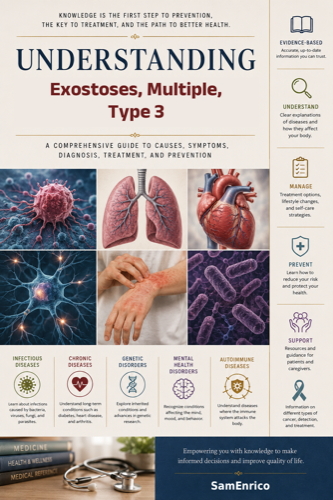
Understanding Exostoses, Multiple, Type 3 eBook
This disease publication, published by SamEnrico,
This disease publication, published by SamEnrico, covers Understanding Exostoses, Multiple, Type 3
Formats
Free sample
Chapter 1: The First Pebble...--The moment you first feel it—a hard, immovable lump beneath your child’s skin where no lump should be—the world tilts on its axis. For some, that discovery happens during bath time, fingers sliding over a knee that suddenly feels wrong. For others, it is a pediatrician’s furrowed brow during a routine physical, followed by the ominous phrase: “Let’s get an X-ray.” And for a smaller number of adults reading this book, the first pebble was found on your own body, years ago, dismissed as “just a funny bump” until a chance X-ray for an unrelated injury revealed a skeleton dotted with bony outcroppings like a landscape of forgotten mountains.Whatever path brought you here, you are now asking the same questions: What is this thing? Is it dangerous? Will it grow?
Will my child be in pain? And the most haunting question of all—did I cause this?Let me answer that last one immediately, because it is the question that keeps parents awake at 3 a.m. No, you did not cause this. There is no dietary misstep, no environmental toxin, no parenting failure that leads to Hereditary Multiple Exostoses. This is not your fault.
It is not your partner’s fault. It is not the fault of the child’s other parent or anyone in your family tree who chose to have children knowing there was a “history of funny bones.” This is a random, brutal piece of genetic luck in most cases, and in families where it has been passed down for generations, it is simply the roll of a biological die. Put that guilt down now. You will not need it for the rest of this book.What you will need is knowledge. And that is what this chapter—and every chapter that follows—exists to provide.
Not the dry, impenetrable language of a medical textbook. Not the terrifying, worst-case-scenario rabbit holes of internet forums. But real, usable, evidence-based information that will make you the most informed person in the room when you sit across from your orthopedic surgeon. By the time you finish this chapter, you will understand exactly what an exostosis is, how it forms, why it is not cancer (but why we still watch it carefully), and why the strange word “benign” is actually your new best friend.The Simple Definition: What Are We Actually Talking About?Let us begin with the most basic building block. An exostosis (plural: exostoses) is simply a bony outgrowth—a lump of extra bone that forms on the surface of a normal bone.
Think of it like a stalactite hanging from the ceiling of a cave, except instead of limestone dripping over millennia, this is living bone growing over months or years. The word itself comes from the Greek ex (out) and osteon (bone). Out-bone. A perfectly literal description.But in the context of this book, we are not talking about any exostosis. We are talking about a specific type called an osteochondroma (pronounced oss-tee-oh-kon-DRO-ma).
This is the most common benign bone tumor in children and adolescents, accounting for roughly 35 to 40 percent of all benign bone growths. An osteochondroma is not just a lump of bone—it is a bony projection capped with living cartilage, exactly like the cartilage on the end of a child’s growing bones. This cartilage cap is the engine of growth for the exostosis. As long as that cap is alive and active, the bump can get bigger.Here is the critical distinction that will save you hours of unnecessary worry: An osteochondroma is not cancer. It is a benign (non-cancerous) growth.
The cells are normal bone and cartilage cells. They do not invade nearby tissues. They do not metastasize (spread) to the lungs or other organs. They simply grow outward from the bone surface, like a branch growing from a tree trunk. And in the vast majority of people with Hereditary Multiple Exostoses, that is all they ever do.So why the fear?
Because, as we will explore in depth in Chapter 7, a very small percentage of osteochondromas—approximately 1 to 5 percent in people with the hereditary form—can undergo malignant transformation later in life, turning into a low-grade cancer called chondrosarcoma. That number is real, and you should know it. But let that number sit in its proper context: 95 to 99 percent do not transform. And even when transformation occurs, it is typically a slow, low-grade process that is highly curable if caught early. The goal of this book is to teach you how to monitor intelligently without living in fear.The Anatomy Lesson: Where Do These Bumps Live?To understand where exostoses appear, you need a quick tour of your skeleton’s real estate.
Most exostoses arise on the long bones of the body—the femur (thigh bone), tibia (shin bone), humerus (upper arm bone), radius and ulna (forearm bones). They have a particular fondness for the metaphysis, which is the flared, wide portion of a long bone near the joint, just below the growth plate. If you imagine a drumstick, the metaphysis is the wide part just before the drumstick narrows into the shaft.Why the metaphysis? Because this is where the most active bone growth occurs during childhood. The physis, or growth plate, is a thin layer of cartilage near the end of every long bone that produces new bone tissue, allowing the bone to lengthen.
In a child with an EXT gene mutation (more on that in Chapter 2), a small fragment of that growth plate cartilage can herniate—push outward—through a defect in the surrounding periosteal ring (a fibrous sleeve that normally contains the growth plate). That herniated fragment then begins ossifying (turning into bone) from the outside in, creating a new bony bump that is continuous with the underlying bone.This is why exostoses are almost never found on flat bones like the skull, the pelvis (though they can occur there), or the vertebrae of the spine (rare, but possible and more serious). They are growth plate accidents. No growth plate, no exostosis. This also explains why new exostoses rarely appear after a person reaches skeletal maturity, typically around ages 16 to 18 for girls and 18 to 20 for boys.
Once the growth plates close, the engine for new bump formation shuts down.The most common locations, in order of frequency, are:Distal femur (just above the knee, pointing away from the joint)Proximal tibia (just below the knee)Proximal humerus (upper arm, near the shoulder)Distal radius and ulna (wrist area)Scapula (shoulder blade)Ribs (usually along the front of the chest, palpable as hard lumps)Pelvis (less common, but can be problematic around the hip joint)Notice a pattern? Nearly all of these are locations where tendons and muscles slide over bone during movement. That is not a coincidence. The mechanical stress of tendons pulling against bone may actually encourage the herniation of growth plate cartilage in genetically susceptible children. This is why exostoses are almost always found on the surface of bones, not inside the bone marrow.The "Patient Voice": What Does This Feel Like?Let me pause the science for a moment and tell you what this actually feels like for the person living with it.…
This is the end of the free sample. Get the eBook to keep going. Buy now
About this book
Details
- Author
- Kenney Tomeka
- Publisher
- SamEnrico
- Language
- English
- Genre
- Non-Fiction, Informative, Educational
- Released
- 2026-06-02
- Pages (approx.)
- 159
- Available as
- eBook, Audiobook

Read better in the ZLOADR app
Your eBooks on your phone or tablet. Sign in with your SamEnrico account and start reading.
More by Kenney Tomeka
 Shift Work Microsleep PreventionKenney Tomeka$11.99
 Self Esteem for Dyslexia Adults HandbookKenney Tomeka$11.99
 The Speaker ConnectionKenney Tomeka$11.99
 Hunger Emotion ConnectionKenney Tomeka$11.99
 Method of Loci Speed Building CourseKenney Tomeka$11.99
 The Last Whisper of the Silk Road: A Caravan’s SecretKenney Tomeka$11.99
 The Lost River of the Sahara: When Africa’s Desert Was an OceanKenney Tomeka$11.99
 OJT AssessorKenney Tomeka$11.99
 Catalog Management GuideKenney Tomeka$12.99
 Writing Executive Summaries for Grant ApplicationsKenney Tomeka$12.99
 How to Become a Mold Sheet CleanerKenney Tomeka$11.99