
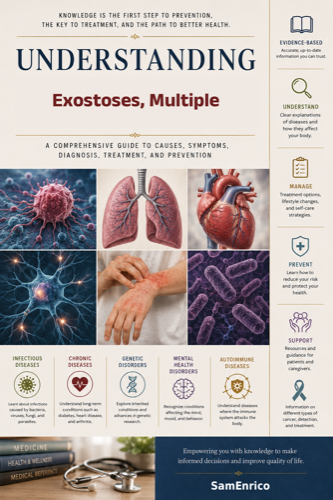
Understanding Exostoses, Multiple eBook
This disease publication, published by SamEnrico,
This disease publication, published by SamEnrico, covers Understanding Exostoses, Multiple
Formats
Free sample
Chapter 1: The Hidden Geography--–- Imagine running your fingers along the inside of your knee, just above the kneecap. For most people, that contour is smooth—a gentle slope of bone beneath skin and muscle. But for someone with Hereditary Multiple Exostoses, that same spot might feel like a landscape of unexpected hills. A hard ridge here. A sharp prominence there.
Perhaps a lump the size of a marble or even a golf ball, fixed and unyielding, that wasn't there a few years ago. This is the hidden geography of HME—a terrain of extra bone growing silently, often unnoticed until it asserts itself through pain, limitation, or the simple shock of discovery.This chapter is not a dry medical introduction. It is the first step on a journey from confusion to clarity, from fear to informed action. Whether you are reading this because you found a lump on your child, because you were just diagnosed, or because you have lived with mysterious bone bumps for years without a name, this chapter will give you the foundational map. You will learn what exostoses actually are, how they differ from solitary bone spurs, the correct terminology to use with doctors, how common this condition truly is, and—most critically—the truth about cancer risk.
By the end of this chapter, you will no longer be at the mercy of vague explanations or internet rabbit holes. You will have a clear framework for understanding everything that follows.What Is an Osteochondroma, Anyway?Let us start with precision. The medical term for an individual bony growth in this condition is osteochondroma (pronounced oss-tee-oh-kon-DRO-muh). Break it down: "osteo" means bone, "chondro" means cartilage, and "oma" means growth or tumor. An osteochondroma is a benign (non-cancerous) bone tumor that arises from the growth plate—the area of developing cartilage near the ends of long bones in children and adolescents.Think of a growing bone like a construction site.
The growth plate is where new bone is laid down, like a busy foundation crew adding floors to a building. In a person with HME, a small group of cells in that growth plate receives the wrong instruction. Instead of producing normal bone in an orderly direction, they produce a lump of bone capped with cartilage that grows outward, perpendicular to the original bone. Imagine a tree trunk with a branch growing out at an odd angle—that is the relationship between the host bone and the osteochondroma. The "branch" shares the same marrow cavity and cortical bone as the "trunk," which is why these growths are considered continuous with the underlying bone rather than separate masses.Under a microscope, an osteochondroma has two distinct layers.
The inner layer is normal bone with bone marrow. The outer layer is hyaline cartilage—the same smooth, slippery tissue that covers the ends of your joints—forming a cap. That cartilage cap is the active growing region. In children and adolescents, this cap is typically thin, ranging from a few millimeters to one centimeter. It is the source of ongoing growth as long as the child's skeleton is maturing.
Once skeletal maturity is reached (typically around ages 14 to 16 for girls and 16 to 18 for boys), the cartilage cap normally stops growing and may even thin out or calcify. This is a critical point: an osteochondroma that continues to grow after skeletal maturity is a red flag, as you will learn in Chapter 9.Osteochondromas can vary dramatically in size, from a few millimeters to more than ten centimeters. They can be sessile (broad and flat, like a rock shelf) or pedunculated (narrow stalk with a bulbous end, like a mushroom). The shape matters clinically. Pedunculated lesions are more likely to cause mechanical problems—tendons can snap over them, nerves can be stretched around them.
Sessile lesions are more likely to alter joint mechanics and cause arthritis over time.The Critical Distinction: Solitary Versus Multiple Here is where many people get confused, and where misdiagnosis often begins. An solitary osteochondroma is a single bone growth found in someone with no family history and no other similar growths. These are surprisingly common. Autopsy studies suggest that about 1 to 3 percent of the general population has a solitary osteochondroma without ever knowing it. Most are discovered incidentally—a chest X-ray for pneumonia reveals a rib exostosis, or a knee X-ray after a sports injury shows a lump near the femur.
These solitary lesions rarely cause symptoms, almost never require treatment, and have a negligible risk of malignant transformation (far below 1 percent). In essence, a solitary osteochondroma is like an isolated birthmark—present but typically irrelevant.Hereditary Multiple Exostoses (HME) is an entirely different condition. The diagnostic criteria require either: (a) two or more osteochondromas in a person with a first-degree relative (parent, sibling, child) who has HME, or (b) three or more osteochondromas in a person with no known family history. This numerical threshold is not arbitrary—it reflects the biological reality that multiple benign bone tumors in a single individual, especially with a family pattern, represent a genetic syndrome, not a coincidence.The difference between solitary and multiple exostoses is not merely quantitative; it is qualitative. Solitary exostoses are sporadic, meaning they occur by chance due to a random mutation in a single growth plate cell.
HME is hereditary, meaning every cell in the body carries a mutation in either the EXT1 or EXT2 gene (Chapter 2 explains this in depth). This genetic root causes widespread skeletal dysplasia—not just more lumps, but also deformities of the forearm, ankle, knee, and sometimes spine. Patients with HME face a lifetime of monitoring, potential surgeries, and a small but real risk of malignant transformation that is orders of magnitude higher than the solitary form.Why does this distinction matter for you? Because many general practitioners, and even some orthopedists, fail to make it. A child who presents with one obvious lump and a vague complaint of knee pain might be sent for physical therapy and told to follow up as needed.
Meanwhile, that child has three other smaller lumps on the ribs, scapula, and tibia that no one has noticed or imaged. The diagnosis of HME is missed, and the family loses years of surveillance and preventive care. If you are reading this book because you or your child has been told "It's just a bone spur, nothing to worry about," and you have a family history of lumps or bone problems, push back and ask the specific question: "Could this be Hereditary Multiple Exostoses? Do I need imaging of other bones to check for additional lesions?"Why Language Matters: HME, MHE, and What to Call It Medical terminology can feel like alphabet soup, but the labels carry meaning. This condition has two accepted names, and understanding them helps you navigate the medical literature and patient communities.Hereditary Multiple Exostoses (HME) is the preferred term in most modern medical texts and genetic literature.
It emphasizes the hereditary nature and the presence of multiple bony growths. Multiple Hereditary Exostoses (MHE) reverses the same words and is used interchangeably, particularly in patient advocacy groups. The MHE Research Foundation, for example, uses this ordering. Do not let the different acronyms confuse…
This is the end of the free sample. Get the eBook to keep going. Buy now
About this book
Details
- Author
- Thornburg Shawanda
- Publisher
- SamEnrico
- Language
- English
- Genre
- Non-Fiction, Informative, Educational
- Released
- 2026-05-06
- Pages (approx.)
- 160
- Available as
- eBook, Audiobook

Read better in the ZLOADR app
Your eBooks on your phone or tablet. Sign in with your SamEnrico account and start reading.
More by Thornburg Shawanda
 Shift Work On Call Sleep GuideThornburg Shawanda$11.99
 Chloride And DigestionThornburg Shawanda$11.99
 The Academic NetworkThornburg Shawanda$11.99
 Hypnotic Visualization For RunnersThornburg Shawanda$11.99
 Self Esteem When Partner OutperformsThornburg Shawanda$11.99
 The Zodiac’s Last Transmission: Decoding the Unfinished MessageThornburg Shawanda$11.99
 The Trial of the Golden Fleece: A Mythic Legal BattleThornburg Shawanda$11.99
 How to Become a Mold StripperThornburg Shawanda$11.99
 Writing Executive Summaries for Board of DirectorsThornburg Shawanda$12.99
 Procurement Spend AnalysisThornburg Shawanda$12.99
 Office Services CoordinatorThornburg Shawanda$11.99Office Services CoordinatorThornburg Shawanda$11.99