
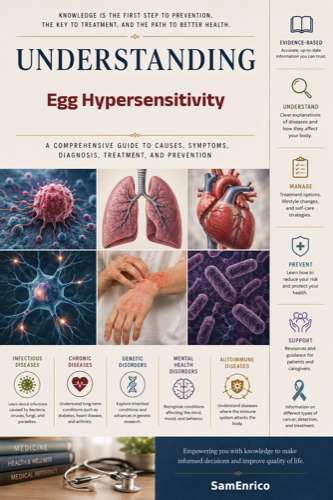
Understanding Egg Hypersensitivity eBook
This disease publication, published by SamEnrico,
This disease publication, published by SamEnrico, covers Understanding Egg Hypersensitivity
Formats
Free sample
Chapter 1: The Perfect Storm...--–- Emma was nine months old when the world stopped making sense. Her mother, Sarah, had done everything by the book—breastfed exclusively for six months, introduced single-ingredient purees one at a time, and kept a meticulous feeding log. On a Tuesday morning in March, she offered Emma a small spoonful of softly scrambled egg, the same food her older son had devoured without issue at the same age. Within three minutes, Emma’s face turned crimson. Within five, her lips swelled like tiny balloons.
Within ten, she was vomiting violently in the pediatric urgent care, and a nurse was pressing an epinephrine auto-injector into her tiny thigh. Sarah sat in the waiting room afterward, holding her trembling daughter, and whispered to no one in particular: “What just happened? She’s never had a problem with anything.”Emma’s story is not unusual. It is not rare. And it is certainly not unique.
Every day, in every developed nation, parents watch in horror as their infants transform from happy eaters into medical emergencies over a food that has been a dietary staple for millennia. Egg allergy is the second most common food allergy in children worldwide—trailing only cow’s milk—and yet it remains profoundly misunderstood. It is not a sensitivity, not an intolerance, and certainly not “all in your head.” It is a specific, reproducible, and sometimes life-threatening immune reaction to proteins found in chicken eggs. And for the roughly two percent of children under five who have it, life becomes a minefield of birthday parties, restaurant meals, and school lunches.But here is the paradox that has confounded immunologists for two decades: egg allergy is both incredibly common and remarkably transient. Most children outgrow it.
Unlike peanut or tree nut allergies, which persist into adulthood for the majority of sufferers, egg allergy resolves by school age in approximately eighty percent of cases. Yet during those early years, it causes more emergency room visits, more parental anxiety, and more dietary disruption than almost any other food allergy. This chapter is about why that happens—mechanistically, immunologically, and biologically. It is about the proteins that trigger chaos, the immune cells that overreact, and the critical distinction between an allergy and everything else that gets called one.To understand egg hypersensitivity, you must first understand that not all egg reactions are created equal. The medical literature distinguishes between two fundamentally different types of immune responses, and confusing them has led to misdiagnosis, unnecessary dietary restriction, and even dangerous medical errors.
The first type is called Ig E-mediated allergy. This is the classic, rapid-onset reaction that Emma experienced. It involves the production of specific antibodies called immunoglobulin E (Ig E), which prime the immune system to attack egg proteins as if they were invading parasites. When an Ig E-allergic person eats egg—or sometimes even touches or inhales it—these antibodies trigger mast cells to explode with histamine and other inflammatory chemicals. The result is hives, swelling, wheezing, vomiting, and in severe cases, anaphylaxis: a systemic crash that can close the airway and drop blood pressure to fatal levels within minutes.The second type is non-Ig E-mediated allergy.
This is slower, more insidious, and often harder to diagnose. Instead of immediate histamine release, non-Ig E reactions involve other immune cells—particularly T-cells—that cause delayed inflammation hours to days after ingestion. The symptoms are gastrointestinal or dermatologic: chronic reflux, colic, loose stools, constipation, blood in the stool, and worsening eczema. There are no hives, no wheezing, no sense of doom. The reaction is real—it is an allergy, not an intolerance—but it does not respond to epinephrine, does not show up on standard allergy tests, and is often mistaken for a viral illness or a digestive disorder.
The most severe form is called Food Protein-Induced Enterocolitis Syndrome (FPIES) , a dramatic reaction characterized by profuse, repetitive vomiting two to four hours after eating egg, leading to dehydration, lethargy, and sometimes shock. Babies with egg FPIES look like they have a severe stomach bug, but the cause is their own immune system reacting to a protein that their gut should have tolerated.Why does the immune system make this catastrophic error? The answer lies in the unique structure of egg proteins themselves. Chicken eggs contain more than forty different proteins, but only a handful are significant allergens. The two most important are Ovomucoid (Gal d 1) and Ovalbumin (Gal d 2) , and understanding their differences is the single most important piece of biological knowledge for anyone managing egg allergy.Ovomucoid is a nightmare of a protein—if you are allergic to it.
It comprises approximately eleven percent of egg white protein, but its structure makes it virtually indestructible. Ovomucoid is compact, tightly folded, and studded with disulfide bonds that resist heat, acid, and digestive enzymes. You can bake it at 350 degrees for an hour, and it emerges largely unchanged. You can send it through the stomach’s caustic acid bath, and it survives. You can douse it in pepsin and trypsin, and it shrugs them off.
This heat-stability is why children with ovomucoid-dominant allergy rarely tolerate any form of egg—baked, fried, boiled, or raw. Their immune system recognizes the protein in cake, in muffins, in crackers, and even in heavily processed foods because the protein’s shape never changes. These children are the twenty to thirty percent who do not outgrow egg allergy by school age. They are the ones who require strict, lifelong avoidance in many cases.Ovalbumin, by contrast, is fragile. It makes up about fifty-four percent of egg white protein, but it is heat-labile—meaning heat destroys its shape.
When you bake a cake at 350 degrees, ovalbumin denatures, unfolding like a crumpled paper bag. The immune system’s Ig E antibodies recognize specific three-dimensional shapes on the protein’s surface; when those shapes are destroyed, the antibodies no longer bind. A child who is allergic only to ovalbumin—or whose allergy is dominated by ovalbumin rather than ovomucoid—can often eat baked egg products without any reaction. Muffins, pancakes, waffles, and cakes are safe for them because the heat has dismantled the offending protein. This is not theoretical; it has been proven in dozens of oral food challenges.
Approximately seventy percent of egg-allergic children tolerate baked egg, and those children are far more likely to outgrow their allergy entirely by age five or six.This distinction between heat-stable ovomucoid and heat-labile ovalbumin explains one of the most confusing phenomena in food allergy: why some children can eat a cupcake but react violently to a scrambled egg. The cupcake has been baked at high heat for a prolonged period, denaturing ovalbumin but leaving ovomucoid intact. If the child’s allergy is primarily to ovalbumin, the cupcake is safe. The scrambled egg, cooked briefly at lower heat, retains enough ovalbumin structure to trigger a reaction. Conversely, a child with ovomucoid-dominant allergy will react to both—the cupcake and the scrambled egg—because their allergenic protein survives heat.
Understanding which protein drives your child’s allergy is not an academic exercise; it determines whether they can eat baked goods, whether they qualify for an egg ladder, and what their…
This is the end of the free sample. Get the eBook to keep going. Buy now
About this book
Details
- Author
- Fredericks Rosena
- Publisher
- SamEnrico
- Language
- English
- Genre
- Non-Fiction, Informative, Educational
- Released
- 2026-05-23
- Pages (approx.)
- 153
- Available as
- eBook, Audiobook

Read better in the ZLOADR app
Your eBooks on your phone or tablet. Sign in with your SamEnrico account and start reading.
More by Fredericks Rosena
 Self Hypnosis Children BedtimeFredericks Rosena$11.99
 Sugar Addiction and Skin Health CourseFredericks Rosena$11.99
 Adrenal Fatigue and Histamine IntoleranceFredericks Rosena$11.99
 Personal Ing For Success ResearchFredericks Rosena$11.99
 Digital Distraction Audit WorkbookFredericks Rosena$11.99
 Skyfall: The Tunguska EnigmaFredericks Rosena$11.99
 Operation Midnight Sun: The Untold Story of the 1983 Soviet Spy RingFredericks Rosena$11.99
 10 Ways to Use Cranberry Sauce (Recipe Book)Fredericks Rosena$11.99
 Environmental Graphic DesignerFredericks Rosena$11.99
 Canadian Transport DirectoryFredericks Rosena$12.99
 Bookkeeping Service PackagesFredericks Rosena$12.99