
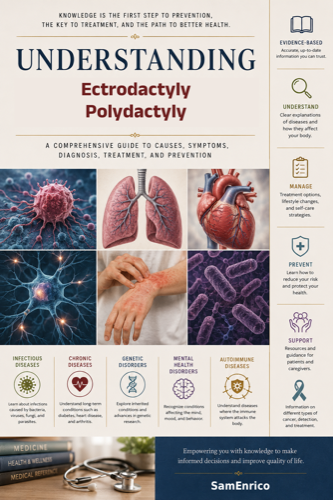
Non-FictionInformativeEducational
Understanding Ectrodactyly Polydactyly eBook
This disease publication, published by SamEnrico,
This disease publication, published by SamEnrico, covers Understanding Ectrodactyly Polydactyly
Formats
Free sample
Chapter 1: The Delivery Room Silence...–- The first sound you expect is a cry. The first thing you count is fingers. Ten tiny fingernails, ten perfect little digits, ten reasons to exhale. But when the nurse pauses, when the pediatrician leans in closer, when the room goes quiet in a way that has nothing to do with professional concentration – that is the moment everything changes. For parents who receive a diagnosis of ectrodactyly or polydactyly, that silence becomes a before-and-after line drawn through their lives.
Nothing before it prepared them. Nothing after it will ever feel quite the same.This book exists because that silence should not be empty. It should be filled with answers, with roadmaps, with the voices of families who have walked this path before you, and with the unshakeable truth that your child’s hands – however different they appear – are capable of a remarkable life.The Two Conditions That Share This Book Before we go any further, let us name what we are talking about. Ectrodactyly (pronounced ek-troh-DAK-tih-lee) is a congenital condition characterized by the absence of one or more central digits, typically creating a deep V-shaped or “cleft” appearance in the hand. The word comes from Greek roots: ektroma meaning “miscarriage” or “absence,” and daktylos meaning “finger.” For much of medical history, this condition was cruelly and inaccurately called “lobster claw hand” – a term that compares a child’s hand to a sea creature’s pincer.
That name persists in some older textbooks and online forums, but it is offensive, inaccurate, and we will not use it again in this book. Ectrodactyly is a cleft hand. That is the respectful, accurate term.Polydactyly (pol-ee-DAK-tih-lee) comes from polys meaning “many” and daktylos meaning “finger.” It is the presence of one or more supernumerary digits on the hand or foot. These extra digits range dramatically in form: from a tiny, pedunculated “nubbin” attached by a slender skin bridge, to a fully formed, articulated finger with its own bone, joint, nail, and tendon. Polydactyly is significantly more common than ectrodactyly, and many people live their entire lives with an extra finger, never seeking surgical removal or even thinking much about it.These two conditions share this book because they share a fundamental experience: the moment a parent looks at their child’s hand and sees something unexpected.
But they are also deeply different – in genetic origins, surgical complexity, functional outcomes, and psychosocial impact. Throughout this book, we will honor both similarities and differences. When a chapter applies to both conditions equally, we will say so. When it does not, we will be explicit about which condition we are addressing.The Epidemiology: How Common Is This, Really?Numbers matter because isolation feeds on the feeling that you are alone. You are not.Polydactyly is one of the most common congenital hand differences in the world.
Its frequency varies significantly by geography, ethnicity, and the specific type of polydactyly. In general populations of European descent, polydactyly occurs in approximately 1 in 1,000 to 1 in 1,500 live births. Among individuals of African descent, the rate is substantially higher – approximately 1 in 150 to 1 in 300 live births – due almost entirely to an increased frequency of postaxial (small finger) polydactyly. In some communities in sub-Saharan Africa, the rate of postaxial polydactyly approaches 1 in 100 live births, making it a relatively common finding in newborn nurseries. Preaxial (thumb) polydactyly does not show the same racial variation and occurs at roughly 1 in 3,000 live births globally.Bilateral polydactyly (involving both hands) occurs in approximately 25–30% of cases, with higher rates in syndromic forms.
Isolated polydactyly (no other abnormalities) accounts for the vast majority – roughly 85-90% of all cases. The remaining 10-15% are syndromic, meaning the polydactyly is one feature of a broader genetic condition affecting multiple organ systems. We will cover syndromic associations in depth in Chapter 10, but for now, understand this: if your child has polydactyly and no other anomalies on physical exam, the probability of an underlying syndrome is low – but not zero.Ectrodactyly is considerably rarer. The best global estimates place its incidence at approximately 1 in 90,000 live births. However, this figure masks significant regional variation due to genetic founder effects – situations where a single ancestor carried a mutation and passed it to a large number of descendants in a geographically isolated population.
The most famous example is the Alföldy family cluster in Hungary, where ectrodactyly appears with far higher frequency than anywhere else in Europe. Similarly, certain communities in Brazil, China, and Pakistan have documented higher rates due to consanguinity (marriage between relatives) and founder mutations.Isolated ectrodactyly (no other anomalies) accounts for roughly 70-75% of cases. The remaining 25-30% are syndromic, most commonly EEC syndrome (Ectrodactyly, Ectodermal dysplasia, Clefting), which we will explore in detail in Chapter 10. Because ectrodactyly is rarer and more commonly syndromic than polydactyly, the diagnostic workup is more extensive. If your child has been diagnosed with ectrodactyly, you should expect a referral to a geneticist.
That is not cause for panic – it is thorough medicine.Left, Right, and Both: Patterns of Involvement Not all hands are affected equally. In polydactyly, unilateral involvement (one hand only) is more common than bilateral, occurring in approximately 65-70% of cases. The left and right hands are affected with roughly equal frequency. Among bilateral cases, the same type of polydactyly typically appears on both sides – for example, preaxial polydactyly on both thumbs, or postaxial on both small fingers – though the precise Wassel classification (which you will learn in Chapter 3) may vary between the two hands.In ectrodactyly, bilateral involvement is more common, occurring in approximately 50-60% of cases. The cleft often appears symmetrically – the same fingers missing on both hands – but not always.
Asymmetrical involvement, where one hand has a deeper cleft or more missing digits than the other, occurs in roughly 20-25% of cases. Feet are also commonly involved in ectrodactyly, with cleft foot deformities occurring in about 30-40% of patients. This is why any child diagnosed with ectrodactyly should have a careful examination of both hands and both feet, along with a full physical exam to rule out syndromic features.The Spectrum of Congenital Hand Differences: Where Do These Conditions Fit?Understanding ectrodactyly and polydactyly requires placing them within the broader universe of congenital hand differences. The most current and clinically useful classification system is the Oberg, Manske, and Tonkin (OMT) classification, published in 2010 and updated in subsequent years. Unlike older systems that grouped conditions by appearance alone, the OMT system organizes anomalies by their underlying developmental biology – specifically, the point in embryonic development at which something went wrong.The OMT system has three major categories:Category I: Malformations.
These arise from a problem in the formation of the limb bud during the early embryonic period (weeks 4-8 of gestation). The problem is intrinsic to the developing tissue – the instructions were wrong. Both ectrodactyly and polydactyly fall into this category. Within malformations, the OMT system further divides conditions into those affecting the entire upper limb (e.g., radial longitudinal deficiency, where the thumb and radius are underdeveloped) and those affecting only the hand plate. Ectrodactyly and polydactyly are primarily hand plate malformations.Category II: Deformations.
These arise from external mechanical forces acting on a normally formed limb later in development. Amniotic band sequence (where strands…
This is the end of the free sample. Get the eBook to keep going. Buy now
About this book
Details
- Author
- Lavigne Dotty
- Publisher
- SamEnrico
- Language
- English
- Genre
- Non-Fiction, Informative, Educational
- Released
- 2026-05-09
- Pages (approx.)
- 143
- Available as
- eBook, Audiobook

Read better in the ZLOADR app
Your eBooks on your phone or tablet. Sign in with your SamEnrico account and start reading.
More by Lavigne Dotty
 Binge Eating Self Compassion CourseLavigne Dotty$11.99
 Deep Sleep Hypnosis Script GuideLavigne Dotty$11.99
 Personal Ing For Success Remote WorkersLavigne Dotty$11.99
 Morning Routine Distraction ShieldLavigne Dotty$11.99
 Cortisol and Brain Fog RecoveryLavigne Dotty$11.99
 The Last Oracle of Delphi: A Demand for TruthLavigne Dotty$11.99
 The Tides of Calculus: How a Forgotten Mathematician Charted the South China SeaLavigne Dotty$11.99
 How to Start a Fats (edible) Business (Beginners Guide)Lavigne Dotty$11.99
 Electric Linear Dichroism TechnicianLavigne Dotty$11.99
 SaaS Data Breach GuideLavigne Dotty$12.99
You may also like
 Hong Kong Handover 1997Dunn Johnnie$11.99
 Zumba For Postnatal Recovery CourseNeal Christian$11.99
 Zumba for BeginnersLadner Nikia$11.99
 YouTube Comment Mining GuideHumes Pandora$12.99
 Worry Box MeditationCarlin Rudy$11.99
 Workplace Stress MeditationNguyen Lynn$11.99
 Workplace Stress and Sleep RepairHawley Ivory$11.99
 Workplace Perfectionism CureDelaney Jeffry$11.99
 Workplace Injustice Anger GuideWallen Isabelle$11.99
 Work Addiction and Burnout LinkGreenwood Ester$11.99
 Women in Yoga and WellnessBeattie Galina$11.99
 Women in Stand Up ComedyChun Evangeline$11.99