
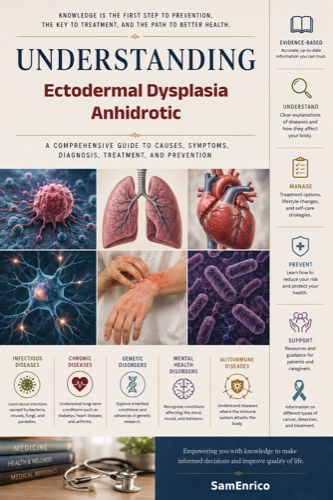
Non-FictionInformativeEducational
Understanding Ectodermal Dysplasia Anhidrotic eBook
This disease publication, published by SamEnrico,
by Ebert Kasie
This disease publication, published by SamEnrico, covers Understanding Ectodermal Dysplasia Anhidrotic
Formats
Free sample
Chapter 1: The Warmth That Kills...--The first time Liam’s mother felt real terror, it was not in a dark alley or on a highway at high speed. It was in a well-lit, air-conditioned hospital nursery, three days after his birth, watching a digital thermometer climb past 104°F while her newborn son lay limp and silent in a plastic bassinet. The nurses had drawn blood. They had started antibiotics. They had called the attending physician, who studied Liam’s fine, sparse hair and then asked a question that, at the time, made no sense at all: “Has anyone looked at his teeth?”This is a book about a genetic condition that most people have never heard of, yet it affects approximately one in every 17,000 live births worldwide—roughly the same frequency as cystic fibrosis in some populations.
It is a condition that has been described in medical literature for nearly two centuries under various names: Christ-Siemens-Touraine syndrome, anhidrotic ectodermal dysplasia, hypohidrotic ectodermal dysplasia. But names, no matter how precise, cannot capture what it means to live inside a body that cannot sweat. They cannot capture the mother who checks the weather forecast before letting her child play outside, the teenager who wears a cooling vest under a hoodie so classmates will not stare, the adult who has learned to read the subtle signs of overheating—a metallic taste in the mouth, a sudden headache, a wave of nausea—that signal danger before the thermometer rises.This chapter is the foundation. It will explain what ectodermal dysplasia anhidrotic (or hypohidrotic ectodermal dysplasia, HED) actually is, where it comes from, and why the history of its discovery matters for patients and families today. It will clarify terminology that has confused clinicians and laypeople alike.
Most importantly, it will introduce the central framework that organizes everything in this book: the understanding that HED is not a single disease with a fixed set of symptoms but a specific genetic pattern that produces predictable abnormalities in structures derived from a single embryonic layer called the ectoderm.If you are reading this because you or someone you love has received this diagnosis, you may be feeling a range of emotions: confusion about what the future holds, fear about complications you have heard about, or even relief—relief that a lifetime of unexplained symptoms finally has a name. All of these responses are normal. And all of them will be addressed in the pages that follow.Before we dive into genetics, clinical features, and management strategies, we must start with a story—not just Liam’s story, but the story of how the medical community came to understand this condition, and why the language we use to describe it matters more than you might think.The Ectoderm: Where It All Begins To understand HED, you must first understand something about how a human body is built. Approximately three weeks after conception, the human embryo consists of three distinct layers of cells: the endoderm (which will become the lining of the gut and lungs), the mesoderm (which will become muscles, bones, blood vessels, and the heart), and the ectoderm. The ectoderm is the outermost layer, and it gives rise to structures that many people do not immediately associate with one another: the entire nervous system (brain, spinal cord, nerves), the epidermis (the outer layer of skin), hair follicles, nails, the lenses of the eyes, the inner ear, the enamel of the teeth, and the sweat glands.This is the critical insight that unlocks everything else.
When a genetic mutation disrupts the development of the ectoderm, the effects are not random. They are systematic. They affect every structure derived from that embryonic layer, which explains why a person with HED may have sparse hair, missing teeth, and an inability to sweat—all at the same time. These are not three separate problems that coincidentally occur together. They are three manifestations of a single underlying disruption.The ectoderm begins forming around day 16 of embryonic development.
By day 21, the neural plate—the precursor to the nervous system—has appeared. By week eight, the basic architecture of the skin, hair follicles, and teeth has been established. The window for normal ectodermal development is remarkably narrow, which is why genetic mutations that interfere with signaling pathways during this period can have profound and lifelong consequences.For most people, the ectoderm develops without incident. But for those with mutations in genes that control ectodermal development—genes like EDA, EDAR, EDARADD, and WNT10A—the result is a spectrum of ectodermal dysplasias. Among these, HED is the most common and the most thoroughly studied.A Brief History of a Mysterious Condition Long before anyone understood genetics or embryology, physicians observed children who seemed unable to tolerate heat, who had few teeth, and whose hair grew slowly or not at all.
The first formal description of what we now call HED is attributed to the Danish physician Carl Eduard Marius Christensen, who in 1836 reported a case of a man with sparse hair, missing teeth, and dry skin. But the condition was most famously described by three physicians working independently in the late nineteenth and early twentieth centuries: the German dermatologist Hermann Siemens, the French physician Louis-Marie Touraine, and again Christensen, whose earlier work was later recognized.The eponym Christ-Siemens-Touraine syndrome emerged from this history, and you may still encounter it in older medical textbooks or in discussions among older clinicians. However, modern practice favors descriptive names—anhidrotic ectodermal dysplasia or hypohidrotic ectodermal dysplasia—because eponyms honor individuals rather than describe conditions, and they offer no clues about what the condition actually is.The distinction between “anhidrotic” and “hypohidrotic” requires careful attention. Anhidrosis means a complete inability to sweat. Hypohidrosis means reduced sweating.
The original descriptions of the condition emphasized anhidrosis, and the term “anhidrotic ectodermal dysplasia” became entrenched in the medical literature. However, as diagnostic tools improved and more patients were studied, it became clear that true, complete anhidrosis is actually quite rare. Most individuals with HED have residual sweat gland function, though it is significantly reduced compared to unaffected individuals.This book retains “anhidrotic” in its title because that remains the traditional term used in patient communities and many medical references. But throughout these pages, we will use the more accurate term “hypohidrotic” or simply “HED” when discussing the condition itself. For the reader who has been told they or their child have anhidrotic ectodermal dysplasia, please understand: you almost certainly have some ability to sweat, even if it is minimal.
And that distinction matters for management, as we will explore in Chapter 4.The Heterogeneity Problem: One Condition or Many?One of the most confusing aspects of ectodermal dysplasias for newly diagnosed families is the sheer number of subtypes. At the time of this writing, the Ectodermal Dysplasia Society and the National Foundation for Ectodermal Dysplasias recognize more than 150 distinct forms of ectodermal dysplasia. Some affect only hair and nails. Some affect teeth and skin. Some involve cleft lip or palate.
Some include limb abnormalities.HED occupies a specific place within this spectrum. It is defined by the triad of abnormalities affecting hair (hypotrichosis), teeth (hypodontia or oligodontia), and sweat glands (hypohidrosis or anhidrosis). Other ectodermal…
This is the end of the free sample. Get the eBook to keep going. Buy now
About this book
Details
- Author
- Ebert Kasie
- Publisher
- SamEnrico
- Language
- English
- Genre
- Non-Fiction, Informative, Educational
- Released
- 2026-05-18
- Pages (approx.)
- 155
- Available as
- eBook, Audiobook

Read better in the ZLOADR app
Your eBooks on your phone or tablet. Sign in with your SamEnrico account and start reading.
More by Ebert Kasie
 Mentoring Relationship BuildingEbert Kasie$11.99
 Hypnotic Confusion TechniqueEbert Kasie$11.99
 Holistic PMS Management GuideEbert Kasie$11.99
 Personal Ing For Success ConsultingEbert Kasie$11.99
 Study Life Balance for StudentsEbert Kasie$11.99
 The Silent Traders of the New World: Hudson Bay’s Forgotten Spice Route PioneersEbert Kasie$11.99
 Voiceover Rush Fee GuideEbert Kasie$12.99
 South Korean Data Breach GuideEbert Kasie$12.99
 How to Become a Cardroom Attendant IEbert Kasie$11.99
 Davidite MiningEbert Kasie$11.99
You may also like
 Hong Kong Handover 1997Dunn Johnnie$11.99
 Zumba For Postnatal Recovery CourseNeal Christian$11.99
 Zumba for BeginnersLadner Nikia$11.99
 YouTube Comment Mining GuideHumes Pandora$12.99
 Worry Box MeditationCarlin Rudy$11.99
 Workplace Stress MeditationNguyen Lynn$11.99
 Workplace Stress and Sleep RepairHawley Ivory$11.99
 Workplace Perfectionism CureDelaney Jeffry$11.99
 Workplace Injustice Anger GuideWallen Isabelle$11.99
 Work Addiction and Burnout LinkGreenwood Ester$11.99
 Women in Yoga and WellnessBeattie Galina$11.99
 Women in Stand Up ComedyChun Evangeline$11.99