
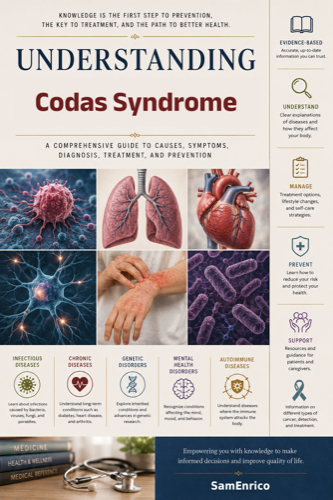
Understanding Codas Syndrome
This disease publication, published by SamEnrico,
by Carmona Mimi
This disease publication, published by SamEnrico, covers Understanding Codas Syndrome
Formats
About this book
Free sample
Chapter 1: The Diagnostic Odyssey...--The first time a parent suspects something is wrong with their child, it rarely arrives as a thunderclap. More often, it comes as a whisper—a subtle unease that something is off. The baby who does not track a rattle with their eyes. The infant whose body feels like a ragdoll when lifted from the crib. The toddler who sits placidly while peers crawl, then cruise, then run.
For the families who will eventually receive a diagnosis of CODAS syndrome, that whisper almost always arrives in the first year of life. What follows is a journey that can last five, ten, or even fifteen years—a diagnostic odyssey through pediatricians, neurologists, geneticists, and well-meaning relatives who insist that “all babies develop at their own pace.”This chapter is about that journey. It is about the 1991 discovery that gave CODAS its name, the meaning hidden within each letter of the acronym, the communities where the syndrome first came to light, and the hard-won wisdom of families who walked the path before you. More than anything, this chapter is a map. You are not lost, even if it feels that way.
And you are not alone.The Birth of a Name: Dr. Shebib and the 1991 Discovery In 1991, a Canadian geneticist named Dr. Sami Shebib published a case report that would, decades later, become the foundation for everything known about CODAS syndrome. The report described two sisters from a Mennonite family who shared a remarkable constellation of medical findings. Both children had significant developmental delay.
Both had congenital cataracts that required surgery in infancy. Both had unusual facial features, dental anomalies, and misshapen ears. Their skeletons showed characteristic changes on X-ray—delayed bone age, hip dysplasia, and abnormal vertebrae. And strikingly, both had the same combination of problems, suggesting a genetic cause.Dr. Shebib did something that seems obvious now but was innovative at the time: he created an acronym from the five major systems involved.
He called it C-O-D-A-S.C – Cerebral (brain and neurological involvement)O – Ocular (eyes)D – Dental (teeth)A – Auricular (ears)S – Skeletal (bones and…
This is the end of the free sample. Get the eBook to keep going. Buy now
Contents
- Chapter 1
- Chapter 2
- Chapter 3
- Chapter 4
- Chapter 5
- Chapter 6
- Chapter 7
- Chapter 8
- Chapter 9
- Chapter 10
- Chapter 11
- Chapter 12
Details
- Author
- Carmona Mimi
- Publisher
- SamEnrico
- Language
- English
- Genre
- Non-Fiction, Informative, Educational
- Released
- 2026-05-11
- Pages (approx.)
- 144
- Available as
- eBook, Audiobook

Read better in the ZLOADR app
Your eBooks on your phone or tablet. Sign in with your SamEnrico account and start reading.
More by Carmona Mimi
 Digital Communication CertificationCarmona Mimi$11.99
 The 30 Second Meeting ExitCarmona Mimi$11.99
 Pinterest VA Client Onboarding SystemsCarmona Mimi$11.99
 Breast Density Screening GuideCarmona Mimi$11.99
 Weekly Time Blocking SystemCarmona Mimi$12.99
 Data Leak Live Chat Response ScriptsCarmona Mimi$11.99
 Beanie Baby Bonanza: The Rise and Fall of a Collectible EmpireCarmona Mimi$11.99
 The Vanishing Highway: The Unsolved Mystery of the 1971 Michigan MurdersCarmona Mimi$11.99
 Biomedical EngineeringCarmona Mimi$11.99Weekly Time Blocking SystemCarmona Mimi$12.99
 Sokowatch YC ApplicationCarmona Mimi$12.99