
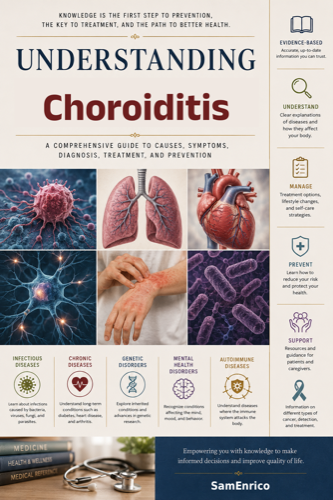
Non-FictionInformativeEducational
Understanding Choroiditis eBook
This disease publication, published by SamEnrico,
This disease publication, published by SamEnrico, covers Understanding Choroiditis
Formats
Free sample
Chapter 1: The Silent Layer...--–- The human eye is a masterpiece of biological engineering, a organ so finely tuned that it can detect a single photon of light in darkness and yet so resilient that it withstands thousands of blinks, countless exposures to pathogens, and a lifetime of metabolic stress. But beneath the retina, hidden from the view of a standard eye exam, lies a structure that most patients—and even some general ophthalmologists—rarely think about until something goes terribly wrong. This is the choroid. And when it becomes inflamed, the consequences can be devastating, swift, and irreversible.The choroid is the eye's hidden layer. Sandwiched between the white outer coat of the eye (the sclera) and the light-sensitive retina, the choroid is a densely vascular bed of blood vessels, connective tissue, and immune cells.
Its primary job is to nourish the outer retina, particularly the photoreceptors—the rods and cones that allow us to see in dim light and perceive color. The choroid delivers more oxygen to the retina than any other tissue in the body relative to its thickness. It also helps regulate temperature, absorbs scattered light (much like the matte black paint inside a camera), and contains a rich population of immune cells that stand guard against infection and injury.But the very features that make the choroid essential for vision also make it uniquely vulnerable to inflammation. Its blood vessels are fenestrated—meaning they have tiny pores that allow fluid and molecules to pass through easily. This design is perfect for delivering nutrients quickly, but it also allows immune complexes, infectious organisms, and inflammatory cells to escape from the bloodstream and settle within the choroidal tissue.
The choroid also has relatively slow blood flow compared to the retina, which means that once inflammatory cells arrive, they tend to linger. And because the choroid is immunologically "privileged" in some ways but not others, it can become a battleground where the immune system attacks not only pathogens but also, in some cases, the body's own healthy tissue.When this happens, the result is choroiditis—inflammation of the choroid. The term itself is straightforward, but the reality is anything but. Choroiditis is not a single disease but a final common pathway for dozens of different conditions, each with its own cause, treatment, and prognosis. Some forms of choroiditis are caused by infections that can be cured with antibiotics.
Others are autoimmune disorders in which the immune system mistakenly attacks the choroid. Still others are the first sign of a systemic disease like sarcoidosis or tuberculosis. And in some patients, despite the most advanced imaging and laboratory testing available, no cause is ever found.This chapter is not a dry recitation of anatomical facts. It is an invitation to understand the terrain on which the battle for vision is fought. Whether you are a patient newly diagnosed with choroiditis, a medical student encountering this condition for the first time, or an ophthalmologist seeking to refresh your knowledge, what follows will change how you see the eye.
Because once you understand the choroid—its structure, its vulnerabilities, and its critical role in vision—you will never again dismiss a complaint of floaters, flashes, or blurred vision as "just another benign finding."The Architecture of the Choroid: Three Layers Deep To understand choroiditis, one must first understand the choroid's anatomy. And the most important thing to know is that the choroid is not a uniform sheet of tissue. It is organized into three distinct layers, each with a different structure and function.The outer layer: Haller's layer. Named after the German anatomist Albrecht von Haller, this is the largest-caliber blood vessels in the choroid. These vessels are wide, thin-walled, and slow-flowing.
They are the main conduits for blood entering the choroid from the short posterior ciliary arteries. In patients with choroiditis, Haller's layer often shows perivascular inflammation—inflammatory cells clustering around these large vessels like wasps around a nest.The middle layer: Sattler's layer. This is the intermediate vascular layer, composed of medium-sized arterioles and venules. Sattler's layer is where most of the oxygen exchange occurs. It is also the layer most commonly affected in diseases like serpiginous choroiditis, where inflammation destroys patches of this layer, leading to characteristic geographic lesions.The inner layer: The choriocapillaris.
This is the business end of the choroid. The choriocapillaris is a dense network of the smallest blood vessels, capillaries so narrow that red blood cells must pass through in single file. This layer sits directly against Bruch's membrane, which in turn sits against the retinal pigment epithelium (RPE). The choriocapillaris delivers oxygen and nutrients to the RPE and the outer third of the retina, including the all-important photoreceptors. Damage to the choriocapillaris is catastrophic because photoreceptors begin to die within minutes of losing their blood supply.
In many forms of choroiditis, the choriocapillaris is the primary target of inflammation.Between these three layers lies the choroidal stroma, a loose connective tissue that contains fibroblasts, collagen, elastic fibers, and—crucially—a wide variety of immune cells. In a healthy choroid, these immune cells are present but quiescent, patrolling for threats without causing damage. In choroiditis, they become activated, multiply, and release inflammatory chemicals that damage the surrounding tissue.One final anatomical feature deserves mention: the choroid is not attached tightly to the sclera. In fact, it is separated by a potential space called the suprachoroidal space. This space can fill with fluid or blood in various diseases, and it is sometimes used by surgeons to deliver medications.
In choroiditis, the suprachoroidal space may accumulate serous fluid, contributing to retinal detachments in conditions like Vogt-Koyanagi-Harada (VKH) disease.The Blood Supply: Why Flow Matters The choroid receives the highest blood flow per unit weight of any tissue in the human body. Approximately 85% of the eye's total blood flow goes to the choroid, despite the choroid accounting for only a small fraction of the eye's volume. This high flow rate serves two purposes: it delivers massive amounts of oxygen and glucose to the photoreceptors, and it helps regulate intraocular temperature by carrying away heat generated by light absorption.But high blood flow is a double-edged sword. The same vessels that bring life-sustaining nutrients can also bring inflammatory cells, antibodies, and infectious organisms. And because the choroidal vessels are fenestrated—porous—these inflammatory elements can exit the bloodstream and enter the choroidal tissue with ease.The fenestrations of the choriocapillaris deserve special attention.
Unlike the tight junctions found in retinal blood vessels (which form the blood-retinal barrier), the choriocapillaris has open pores ranging from 50 to 100 nanometers in diameter. These pores allow small molecules, including inflammatory mediators like histamine and complement proteins, to pass freely. In inflammation, these pores can enlarge further, allowing larger cells like macrophages and lymphocytes to migrate into the choroid.This is why uveitis specialists often say that the choroid is "where the immune system meets the retina." The choroid acts as a filter, trapping immune complexes and inflammatory cells that might otherwise damage the delicate neural tissue of the retina. But when the inflammatory load exceeds the choroid's capacity to contain it, the result is tissue damage, scarring, and vision loss.The Immune Environment…
This is the end of the free sample. Get the eBook to keep going. Buy now
About this book
Details
- Author
- Mueller Dannielle
- Publisher
- SamEnrico
- Language
- English
- Genre
- Non-Fiction, Informative, Educational
- Released
- 2026-05-07
- Pages (approx.)
- 147
- Available as
- eBook, Audiobook

Read better in the ZLOADR app
Your eBooks on your phone or tablet. Sign in with your SamEnrico account and start reading.
More by Mueller Dannielle
 Navigating Fertility StrugglesMueller Dannielle$11.99
 Polish Zegota Rescue NetworkMueller Dannielle$11.99
 Value Curve Overlay HandbookMueller Dannielle$11.99
 Remote Retreats for Remote First CompaniesMueller Dannielle$11.99
 Willpower Conservation for FocusMueller Dannielle$11.99
 Hops & Revolutions: The Untold Story of Brewing in the Cold WarMueller Dannielle$11.99
 The Golden Record Heist: Humanity's Cosmic Message to the StarsMueller Dannielle$11.99
 Postage Meter OperationMueller Dannielle$11.99
 Multi Year Department BudgetingMueller Dannielle$12.99
 JEE Electromagnetism GuideMueller Dannielle$12.99
 10 Ways to Use Chendol (Recipe Book)Mueller Dannielle$11.99
You may also like
 Hong Kong Handover 1997Dunn Johnnie$11.99
 Zumba For Postnatal Recovery CourseNeal Christian$11.99
 Zumba for BeginnersLadner Nikia$11.99
 YouTube Comment Mining GuideHumes Pandora$12.99
 Worry Box MeditationCarlin Rudy$11.99
 Workplace Stress MeditationNguyen Lynn$11.99
 Workplace Stress and Sleep RepairHawley Ivory$11.99
 Workplace Perfectionism CureDelaney Jeffry$11.99
 Workplace Injustice Anger GuideWallen Isabelle$11.99
 Work Addiction and Burnout LinkGreenwood Ester$11.99
 Women in Yoga and WellnessBeattie Galina$11.99
 Women in Stand Up ComedyChun Evangeline$11.99