
Non-FictionInformativeEducational
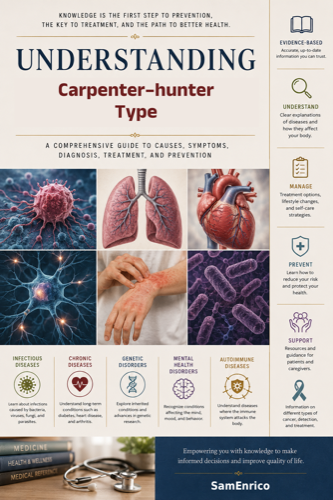
Understanding Carpenter–hunter Type eBook
This disease publication, published by SamEnrico,
by William Kip
This disease publication, published by SamEnrico, covers Understanding Carpenter–hunter Type
Formats
Free sample
Chapter 1: The Cellular Landfill--–- The first time a parent hears the words “lysosomal storage disorder,” the brain does what it was designed to do: it searches for familiar landmarks. Lysosome. Storage. Disorder. Perhaps you picture a biology classroom diagram, a forgotten Power Point slide about cell organelles.
Perhaps you imagine a closet overflowing with boxes, or a hard drive clogged with duplicate files. None of these images are wrong, exactly, but none of them capture the terrifying elegance of what is happening inside your child’s body. To understand Carpenter–Hunter Type—which for the remainder of this book we will refer to by its modern, precise name, Hunter Syndrome (Mucopolysaccharidosis Type II, or MPS II)—you must first understand a world you cannot see. You must shrink yourself down to the width of a human hair, then a thousand times smaller, until you stand at the gate of a single cell. This is the stage upon which your child’s story is being written.
And the lead actor is a tiny sac of digestive enzymes called the lysosome.The Factory Floor: A Parable of Cellular Life Imagine a city. This city is called Cellville, and it operates twenty-four hours a day, seven days a week, without holidays or breaks. The city has power plants (mitochondria), a postal service (endoplasmic reticulum), and a government (the nucleus, where DNA issues all executive orders). Every citizen of Cellville—every protein, every lipid, every carbohydrate—has a job to do. They build things.
They transport things. They send messages. They fight invaders. And then, like all workers in any bustling metropolis, they eventually wear out. Their tools break.
Their forms become ragged. They are replaced by younger, sharper versions, and the old ones must be disposed of. This is where the lysosome enters. The lysosome is the city’s sanitation department, its recycling center, its landfill, and its hazardous waste disposal team all rolled into one. It is a membrane-bound sac—a kind of stomach within the cell—filled with powerful digestive enzymes capable of breaking down almost any biological molecule into its component parts: sugars, fats, amino acids.
Once broken down, these raw materials are released back into the cell to be built into something new. Nothing is wasted. The lysosome is the original circular economy, and in a healthy cell, it works with silent, relentless efficiency.Now change one thing. Imagine that the sanitation department’s chief demolition expert—the enzyme responsible for breaking down a specific type of cellular garbage—does not show up for work. He is not late.
He is not on vacation. He does not exist. His blueprints (the gene that should have built him) are corrupted, and so he was never manufactured. The garbage he was supposed to handle begins to pile up. At first, the cell does not notice.
The pile is small, tucked in a corner of the lysosome. But the garbage is not ordinary trash. It is a family of long, chain-like sugar molecules called glycosaminoglycans, or GAGs (pronounced “gags”). In healthy cells, GAGs are constantly being built, used, and demolished. They are the scaffolding of connective tissue, the lubricant in your joints, the resilience in your skin.
But when the demolition enzyme is missing, GAGs accumulate inside the lysosome like uncollected recycling on a city street. The lysosome swells. The cell begins to bulge. The garbage spills out. And because the cell is not designed to store garbage indefinitely, the entire system begins to break down.This is not a metaphor.
This is the literal, molecular reality of Hunter Syndrome.The Missing Worker: Iduronate-2-Sulfatase Let us name the missing worker. His name is iduronate-2-sulfatase, and for the sake of your sanity, we will call him I2S. I2S is an enzyme—a protein machine that accelerates chemical reactions. His specific job is to break a particular bond in two specific GAG molecules: dermatan sulfate and heparan sulfate. Think of these GAGs as long, tangled necklaces.
I2S is the scissors that snips a specific clasp. Without I2S, the necklaces cannot be taken apart. They accumulate inside the lysosome, forming microscopic tangles that eventually crowd out the cell’s normal functions. The cell swells, then dies, or worse, it survives in a dysfunctional state, poisoning the tissues around it.Where does I2S come from? He is built according to instructions encoded in a gene on the X chromosome called the IDS gene.
This gene is a stretch of DNA approximately 24,000 base pairs long, containing nine exons (the coding regions) and eight introns (the non-coding spacers). When the IDS gene is working properly, it produces a messenger RNA molecule that travels from the nucleus to the cell’s protein-building machinery, which then assembles the I2S enzyme from 550 amino acids. The entire process takes minutes. When it is working, you never notice it. When it breaks, your child’s entire body notices.Mutations in the IDS gene can take many forms.
Some are point mutations—a single incorrect letter in the DNA code that changes one amino acid, rendering the enzyme misshapen and useless. Others are deletions—larger missing chunks of the gene that may eliminate the enzyme entirely. Still others are rearrangements or insertions that scramble the instructions beyond recognition. There are over 700 known mutations in the IDS gene associated with Hunter Syndrome, and the specific mutation your child carries helps determine whether they will experience the neuropathic (severe) form or the attenuated (mild) form of the disease. We will explore that distinction in Chapter 4.
For now, understand this: the IDS gene is broken, and because it is broken, I2S does not exist, and because I2S does not exist, GAGs accumulate, and because GAGs accumulate, cells die, and because cells die, your child’s body is slowly, silently being poisoned from the inside out.The X Factor: Why Boys and Men Bear the Brunt Now we arrive at a question that every parent asks, usually in the dark of night, after the diagnosis has settled into the bones: Why my child? And why mostly boys?The answer lies in the X chromosome. Humans have 23 pairs of chromosomes. The 23rd pair determines biological sex: females have two X chromosomes (XX), while males have one X and one Y (XY). The IDS gene resides on the X chromosome.
This single fact shapes everything about how Hunter Syndrome is inherited, who gets it, and how carriers are identified.Let us start with a boy. A boy inherits his single X chromosome from his mother and his Y chromosome from his father. If the X chromosome he receives from his mother carries a mutated IDS gene, he has no backup. The Y chromosome does not contain an IDS gene. He has exactly one copy of the gene, and if that copy is broken, he will develop Hunter Syndrome.
There is no second chance, no spare tire. This is why Hunter Syndrome is called an X-linked recessive disorder. The “recessive” means that the disease only manifests when there is no working copy of the gene. In a boy, one broken copy is enough.Now consider a girl. A girl inherits an…
This is the end of the free sample. Get the eBook to keep going. Buy now
About this book
Details
- Author
- William Kip
- Publisher
- SamEnrico
- Language
- English
- Genre
- Non-Fiction, Informative, Educational
- Released
- 2026-06-02
- Pages (approx.)
- 138
- Available as
- eBook, Audiobook

Read better in the ZLOADR app
Your eBooks on your phone or tablet. Sign in with your SamEnrico account and start reading.
More by William Kip
 HIIT for Pilates LoversWilliam Kip$11.99
 Vision Loss Writing GuideWilliam Kip$11.99
 Parental Addiction and LyingWilliam Kip$11.99
 Unprosecuted Heist PlayersWilliam Kip$11.99
 Smoking Cessation Menopause SymptomsWilliam Kip$11.99
 The Silent Revolution: How a 1997 Tesla Prototype Nearly Changed the WorldWilliam Kip$11.99
 Desk Clearance ChecklistWilliam Kip$12.99
 Startup Business Credit PlaybookWilliam Kip$12.99
 Accounts Receivable SpecialistWilliam Kip$11.99
 How to Become a Button-facing-machine OperatorWilliam Kip$11.99
You may also like
 Hong Kong Handover 1997Dunn Johnnie$11.99
 Zumba For Postnatal Recovery CourseNeal Christian$11.99
 Zumba for BeginnersLadner Nikia$11.99
 YouTube Comment Mining GuideHumes Pandora$12.99
 Worry Box MeditationCarlin Rudy$11.99
 Workplace Stress MeditationNguyen Lynn$11.99
 Workplace Stress and Sleep RepairHawley Ivory$11.99
 Workplace Perfectionism CureDelaney Jeffry$11.99
 Workplace Injustice Anger GuideWallen Isabelle$11.99
 Work Addiction and Burnout LinkGreenwood Ester$11.99
 Women in Yoga and WellnessBeattie Galina$11.99
 Women in Stand Up ComedyChun Evangeline$11.99