
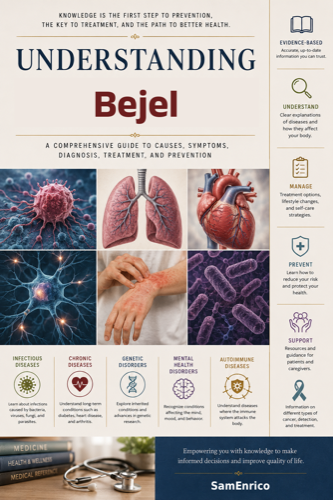
Non-FictionInformativeEducational
Understanding Bejel eBook
This disease publication, published by SamEnrico,
This disease publication, published by SamEnrico, covers Understanding Bejel
Formats
Free sample
Chapter 1: The Forgotten Spirochete...–- In the remote desert villages of the African Sahel, where the sun bakes the earth and water is carried in plastic jugs from wells miles away, a mother watches her child develop sores at the corners of his mouth. She thinks it is nothing—perhaps a reaction to the heat, perhaps a vitamin deficiency from their limited diet. The sores heal on their own after a few weeks, and she forgets about them. Months later, the same child develops a rash across his chest and back, followed by swelling in his legs that makes him limp when he walks. She takes him to the nearest clinic, a two-day journey by donkey cart.
The clinician runs a rapid test for syphilis, which comes back positive. The mother is confused and ashamed—she has never had syphilis, and her husband works in the city, returning home only twice a year. How could her child have a sexually transmitted infection?The answer is that her child does not have syphilis at all. He has Bejel—one of the most misunderstood, misdiagnosed, and neglected diseases in the world. And in that moment of confusion and shame, the mother represents millions of families across the globe who have encountered this forgotten spirochete without ever learning its name.This is the paradox of Bejel.
It is ancient yet unknown, widespread yet invisible, curable yet neglected. While syphilis—its famous cousin—has inspired centuries of medical literature, art, poetry, and public health campaigns, Bejel remains confined to the footnotes of infectious disease textbooks, known only to a handful of tropical medicine specialists and the impoverished communities where it continues to circulate. This chapter introduces the forgotten spirochete, laying the foundation for everything that follows: its place in the family of human treponematoses, its unique transmission patterns, its diagnostic challenges, and its surprising relevance to modern global health.The Family of Human Treponematoses To understand Bejel, one must first understand its relatives. Bejel belongs to a family of chronic bacterial infections known as the endemic treponematoses—a group that includes four clinically distinct diseases caused by three nearly identical subspecies of the bacterium Treponema pallidum. The family tree looks like this:Venereal Syphilis (Treponema pallidum subsp.
pallidum): The most famous member of the family, syphilis is a sexually transmitted infection that has shaped human history in ways few other diseases can claim. From the alleged Columbian Exchange—the theory that Columbus's crew brought syphilis from the New World to Europe in the 1490s—to the infamous Tuskegee experiments, from the death of Al Capone to the development of the first effective antibiotic treatments, syphilis has left an indelible mark on medicine, culture, and society. It is a disease of adults, transmitted through sexual contact, capable of causing congenital infection (transmission from mother to fetus) and, in its tertiary stage, devastating the cardiovascular and central nervous systems.Yaws (Treponema pallidum subsp. pertenue): Yaws is the tropical cousin of Bejel, found in hot, humid regions near the equator—the rainforests of Central and West Africa, the islands of the South Pacific, and parts of Southeast Asia. Unlike Bejel, which prefers the mouth as its primary site, yaws begins with a "mother yaw": a highly visible, raspberry-like papule on the lower extremities, usually the legs or feet.
Yaws is transmitted through direct skin contact and primarily affects children in rural, impoverished communities with poor hygiene. Like Bejel, yaws does not cause cardiovascular or neurological disease, and it responds to the same single-dose penicillin treatment.Pinta (Treponema carateum—a distinct but closely related species): Pinta is the most dermatologically limited of the treponematoses, affecting only the skin. It causes depigmented lesions (hence the name "pinta," Spanish for "paint") and never invades the bones, joints, or internal organs. Found primarily in Central and South America, particularly among indigenous populations in Mexico, Colombia, and Brazil, pinta is transmitted through direct skin contact and responds to the same antibiotics as the other treponematoses. However, because it does not progress beyond the skin, it is generally considered the least medically serious of the four.Bejel (Treponema pallidum subsp.
endemicum): And then there is Bejel—the forgotten member of the family. Bejel occupies an intermediate position between yaws and syphilis in both geography and clinical presentation. It is found in hot, dry climates, not the humid tropics. Its primary lesions are oral, not cutaneous or genital. It affects children primarily, but unlike yaws, it has a distinct secondary and tertiary stage that can involve bone destruction.
And compared to syphilis, it lacks cardiovascular and neurological involvement but can cause severe facial and skeletal deformities.The clinical and epidemiological differences among these four diseases are striking—but the genetic similarities are even more remarkable. Treponema pallidum subsp. endemicum (Bejel), T. p. subsp.
pallidum (syphilis), and T. p. subsp. pertenue (yaws) share approximately 99.8 percent genetic identity. To put that in perspective, humans share about 98.8 percent of our DNA with chimpanzees.
The genetic distance between Bejel and syphilis is smaller than the genetic distance between a human and a chimp. And yet, these 0.2 percent differences—a handful of genes scattered across the bacterial genome—produce diseases that look, behave, and spread in dramatically different ways.This is the first great mystery of Bejel: how can two bacteria that are genetically almost identical produce one disease that is sexually transmitted, congenital, and neurotropic (syphilis), and another that is non-venereal, non-congenital, and restricted to skin, mucous membranes, and bone (Bejel)? The answer, as we will explore in Chapter 3, lies in small genetic differences in key genes related to lipid and amino acid biosynthesis, pathogenicity islands, and the bacterium's ability to interact with the human immune system. But for now, the important takeaway is this: the genetic similarity means that standard blood tests cannot distinguish Bejel from syphilis. This fact alone explains why Bejel is so frequently misdiagnosed, mismanaged, and overlooked.The Nomenclature Problem: What's in a Name?Before proceeding further, we must address a persistent source of confusion: what exactly do we call this disease?
The medical literature is filled with competing terms, each reflecting a different historical perspective, geographic focus, or clinical emphasis."Bejel" is the Arabic word for the disease, derived from the Bedouin communities of the Arabian Peninsula and the Levant, where the disease was first formally described by Western physicians in the 1920s and 1930s. The term was popularized by Dr. Édouard Arning, a French dermatologist working in Lebanon and Syria, who recognized that the disease he was seeing in children and families was not syphilis despite its serologic similarities. "Bejel" has since become the preferred term in English-language medical literature, largely because it is specific to this particular treponematosis and carries no moral baggage."Endemic syphilis" is an alternative name that emphasizes the disease's relationship to venereal syphilis while distinguishing it by its mode of transmission. The problem with this term is that it can be confusing: is endemic syphilis simply syphilis that happens to be common in a particular region, or is it a distinct disease?
The ambiguity has led many clinicians to mistakenly treat Bejel patients as if they had venereal syphilis, which can lead to inappropriate contact tracing, unnecessary…
This is the end of the free sample. Get the eBook to keep going. Buy now
About this book
Details
- Author
- Braden Sharla
- Publisher
- SamEnrico
- Language
- English
- Genre
- Non-Fiction, Informative, Educational
- Released
- 2026-05-11
- Pages (approx.)
- 154
- Available as
- eBook, Audiobook

Read better in the ZLOADR app
Your eBooks on your phone or tablet. Sign in with your SamEnrico account and start reading.
More by Braden Sharla
 The Parent Death without FuneralBraden Sharla$11.99
 Exercise Microbiome BenefitsBraden Sharla$11.99
 Smoke Free Travel HandbookBraden Sharla$11.99
 Yoga for Driver AngerBraden Sharla$11.99
 Catherine the Great Censorship and Free PressBraden Sharla$11.99
 The Frozen Silk Road: The Forgotten Polar Explorers of Central AsiaBraden Sharla$11.99
 Swipe Right for Democracy: How a Phone App Toppled a DictatorBraden Sharla$11.99
 How to Become a Quarry WorkerBraden Sharla$11.99
 Fixed Asset Depreciation TrackerBraden Sharla$12.99
 De Risking Impact MitigationBraden Sharla$12.99
 Long-Term Brand Equity for CreatorsBraden Sharla$11.99
You may also like
 Hong Kong Handover 1997Dunn Johnnie$11.99
 Zumba For Postnatal Recovery CourseNeal Christian$11.99
 Zumba for BeginnersLadner Nikia$11.99
 YouTube Comment Mining GuideHumes Pandora$12.99
 Worry Box MeditationCarlin Rudy$11.99
 Workplace Stress MeditationNguyen Lynn$11.99
 Workplace Stress and Sleep RepairHawley Ivory$11.99
 Workplace Perfectionism CureDelaney Jeffry$11.99
 Workplace Injustice Anger GuideWallen Isabelle$11.99
 Work Addiction and Burnout LinkGreenwood Ester$11.99
 Women in Yoga and WellnessBeattie Galina$11.99
 Women in Stand Up ComedyChun Evangeline$11.99