
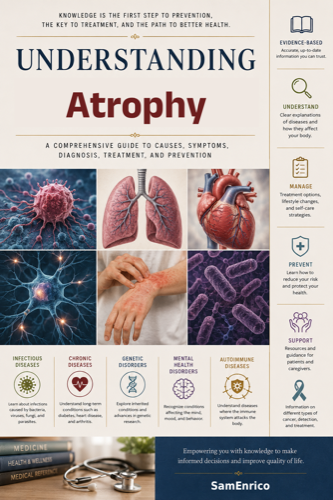
Non-FictionInformativeEducational
Understanding Atrophy eBook
This disease publication, published by SamEnrico,
by Weddle Audie
This disease publication, published by SamEnrico, covers Understanding Atrophy
Formats
Free sample
Chapter 1: The Silent Thief--Every morning, Maria stood in front of her bathroom mirror and noticed something she couldn't quite name. At fifty-seven, she expected wrinkles and gray hairs. What she didn't expect was the way her thighs had softened despite walking her dog two miles daily. She didn't expect the difficulty rising from her desk chair after an hour of work—that stiff, wobbly sensation that made her feel eighty instead of fifty-seven. And she certainly didn't expect the moment last Tuesday when she dropped her coffee mug for no reason at all.
Her grip had simply let go.Maria is not old. She is not bedridden. She does not have a degenerative disease. Yet Maria is experiencing atrophy—the slow, quiet, and almost invisible process of her own body breaking itself down.This chapter is about why Maria's story matters to you. Because if you have ever felt weaker than you were last year, foggier than you were last month, or older than your chronological age, you are likely experiencing some form of atrophy right now.
The purpose of this chapter is to reframe atrophy from a distant, clinical concern into an immediate, personal reality—and then to give you hope by showing you how much of this process is within your control.The Invisible Epidemic Atrophy comes from the Greek words "a" (without) and "trophe" (nourishment). Literally, it means "without nourishment." But that translation misses the active, predatory nature of what actually happens inside your body. Atrophy is not merely the absence of growth. It is the presence of destruction—a carefully orchestrated biological program that dismantles your own tissues when your body perceives that those tissues are no longer needed.Here is what most people get wrong about atrophy: they think it only happens to the very old, the very sick, or the very sedentary. They imagine a frail nursing home resident or a patient bedbound after a stroke.
But atrophy begins much earlier and affects a much broader population than anyone realizes.Consider these facts, drawn from the scientific literature synthesized in this book's research base:Muscle loss begins around age thirty. By the time you turn forty, you have likely lost 5 to 10 percent of your peak muscle mass. By sixty, that number reaches 15 to 20 percent. By eighty, 30 to 40 percent. This is not aging in the sense of inevitable decay.
This is disuse—a slow withdrawal of the mechanical stimulus that muscles require to survive.Brain volume follows a similar trajectory. After age thirty-five, the human brain loses approximately 0.5 to 1 percent of its volume annually. The hippocampus—your memory center—shrinks even faster under conditions of chronic stress. This is not Alzheimer's disease. This is neural atrophy: the pruning of connections your brain has decided you no longer need because you are not using them.And here is the most unsettling fact: these processes are happening to you right now, while you read this page, unless you are actively fighting them.But this book is not written to frighten you.
It is written to arm you. Because the central thesis of "Understanding Atrophy" is this: for the vast majority of people, the majority of atrophy is preventable, and much of it is reversible. The exceptions—neurodegenerative diseases like Multiple System Atrophy and ALS—are clearly marked in this text, and they do not apply to most readers. For the rest of you, atrophy is feedback, not fate.The Biology of Breaking Down Before we can understand how to reverse atrophy, we must understand how it works at the most basic level. Your body is in a constant state of renovation.
Every day, your cells break down old or damaged proteins and replace them with new ones. This process is called protein turnover, and it operates like a construction crew that is simultaneously demolishing an old building and erecting a new one on the same site.The demolition crew is called the ubiquitin-proteasome pathway. Ubiquitin is a small protein that acts like a tag—it attaches to damaged, misfolded, or unnecessary proteins and marks them for destruction. The proteasome is the cellular machine that reads these tags and chops the marked proteins into small peptides and amino acids, which can then be recycled.Under normal conditions, the demolition crew works at a steady, manageable pace. But under conditions of inactivity, inflammation, or chronic stress, the crew goes into overdrive.
More ubiquitin tags are attached. More proteasomes are activated. And the construction crew—the ribosomes and amino acid transporters that build new proteins—cannot keep up.The result is net protein loss. Your muscle fibers shrink. Your neurons retract their dendrites.
Your cells literally become smaller because they are being dismantled faster than they can be rebuilt.This is the ubiquitin-proteasome pathway in action. It is the primary mechanism of atrophy across nearly all tissues, and understanding it is your first step toward controlling it.But the proteasome is not alone. Two other processes accelerate atrophy:Mitochondrial dysfunction. Mitochondria are your cells' power plants. They convert glucose and fatty acids into ATP, the energy currency of life.
When mitochondria become damaged or dysfunctional—a common consequence of aging, inactivity, and poor diet—they produce less energy and more oxidative stress. Oxidative stress is the cellular equivalent of rust: free radicals damage cell membranes, DNA, and proteins, triggering further inflammation and further proteasome activation. It is a vicious cycle that drives atrophy from within.Inflammation. When your body detects injury, infection, or stress, it releases inflammatory molecules called cytokines—most notably tumor necrosis factor alpha (TNF-α) and interleukin-6 (IL-6). These cytokines serve useful purposes in the short term: they recruit immune cells, increase blood flow, and promote healing.
But when inflammation becomes chronic—as it does with sedentary living, poor diet, obesity, sleep deprivation, and psychological stress—these same cytokines directly activate the ubiquitin-proteasome pathway. They also interfere with insulin signaling, making it harder for your muscles to take up amino acids and glucose. Inflammation is the gas pedal for atrophy, and for most modern humans, that pedal is pressed to the floor.A Word on Cortisol You will encounter the hormone cortisol repeatedly throughout this book, so it is worth introducing it properly here. Cortisol is produced by your adrenal glands in response to stress—physical stress (injury, illness, exercise), psychological stress (work pressure, relationship conflict, financial worry), and metabolic stress (low blood sugar, sleep deprivation, calorie restriction).Cortisol has earned a reputation as a villain in popular health culture, but that reputation is incomplete. In short bursts, cortisol is essential and life-saving.
It mobilizes glucose from your liver, increases blood pressure to deliver oxygen to your muscles, and temporarily suppresses non-essential functions like digestion and reproduction. This is the fight-or-flight response, and it has kept humans alive for millions of years.The problem is not cortisol itself. The problem is chronically elevated cortisol—the kind that comes from waking up at 6 AM to a stressful commute, spending eight hours at a desk under deadline pressure, eating a processed lunch that spikes your blood sugar, skipping exercise because you are exhausted, and then lying awake at night worrying about tomorrow. That pattern keeps cortisol high for weeks, months, and…
This is the end of the free sample. Get the eBook to keep going. Buy now
About this book
Details
- Author
- Weddle Audie
- Publisher
- SamEnrico
- Language
- English
- Genre
- Non-Fiction, Informative, Educational
- Released
- 2026-06-02
- Pages (approx.)
- 156
- Available as
- eBook, Audiobook

Read better in the ZLOADR app
Your eBooks on your phone or tablet. Sign in with your SamEnrico account and start reading.
More by Weddle Audie
 Twelve Step for Internet and Gaming AddictionWeddle Audie$11.99
 Family Secret Keeping ChildhoodWeddle Audie$11.99
 The Cowboy StanceWeddle Audie$11.99
 Binge Eating Mindfulness Approach GuideWeddle Audie$11.99
 Remote Consulting CommunicationWeddle Audie$11.99
 Anticipatory Grief and HospiceWeddle Audie$11.99
 The Marine Corps OverdoseWeddle Audie$11.99
 Wrist and Forearm Stretching for GamersWeddle Audie$11.99
 Hearst San FranciscoWeddle Audie$11.99
 The Quantum Pioneers of Almaty: Unveiling the Mysteries of the Invisible WorldWeddle Audie$11.99
 The Troll King's Exile: A Saga of Ice and StoneWeddle Audie$11.99
 The Complete Guide to This Is Why You're FatWeddle Audie$11.99
You may also like
 Hong Kong Handover 1997Dunn Johnnie$11.99
 Zumba For Postnatal Recovery CourseNeal Christian$11.99
 Zumba for BeginnersLadner Nikia$11.99
 YouTube Comment Mining GuideHumes Pandora$12.99
 Worry Box MeditationCarlin Rudy$11.99
 Workplace Stress MeditationNguyen Lynn$11.99
 Workplace Stress and Sleep RepairHawley Ivory$11.99
 Workplace Perfectionism CureDelaney Jeffry$11.99
 Workplace Injustice Anger GuideWallen Isabelle$11.99
 Work Addiction and Burnout LinkGreenwood Ester$11.99
 Women in Yoga and WellnessBeattie Galina$11.99
 Women in Stand Up ComedyChun Evangeline$11.99