
Non-FictionInformativeEducational
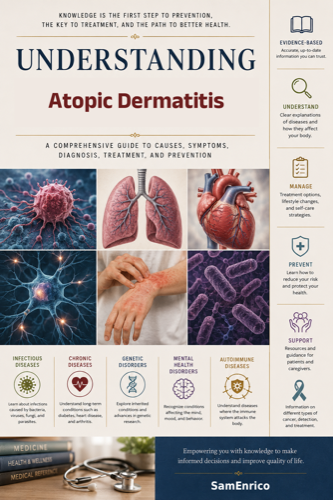
Understanding Atopic Dermatitis eBook
This disease publication, published by SamEnrico,
by Petit Hayley
This disease publication, published by SamEnrico, covers Understanding Atopic Dermatitis
Formats
Free sample
Chapter 1: The Invisible Epidemic...--–- The first time four-year-old Liam was sent home from preschool, his teacher cited "a possible contagious rash." The second time, she used the word "neglect." His mother, Sarah, stood in the school lobby, clutching Liam's hand, watching the other parents pull their children closer as they passed. Liam's arms were covered in dry, red, weeping patches. His cheeks were raw from scratching. He had not slept through the night in eighteen months. Neither had Sarah."Have you tried lotion?" the preschool director asked.Sarah did not scream.
She did not explain that she had tried seventeen different lotions. She did not describe the 2 AM baths, the wet wrap bandages, the steroid creams applied with measuring precision, the diet eliminations, the allergy tests, the $400 tub of ceramide cream that made no difference, or the dermatologist who spent exactly seven minutes with them before prescribing the same steroid they had already tried. She simply nodded, took Liam's hand, and walked out.This book is for Sarah. It is for Liam. It is for the teenager hiding her arms in a hoodie in July, the executive taking conference calls from the bathtub because sitting in a chair is unbearable, the parent reading yet another online forum at 3 AM searching for anything that might work.
It is for the millions of people living with atopic dermatitis—a condition that medicine has only recently begun to truly understand and properly treat.What This Chapter Will Accomplish By the time you finish this chapter, you will understand what atopic dermatitis actually is (and what it is not), why it has been so poorly understood for so long, and why reframing it as a systemic disease rather than a simple skin rash changes everything about how you should approach treatment. You will learn the language of AD—terms like the atopic march, transepidermal water loss, and the itch-scratch cycle—not as abstract concepts but as practical tools for understanding your own body or your child's. Most importantly, you will emerge with a clear roadmap for the rest of this book, knowing exactly which chapters to read first based on your specific situation.The Most Misunderstood Disease in Dermatology Let us begin with a simple definition. Atopic dermatitis is a chronic, relapsing, inflammatory disorder of the skin. Those four words—chronic, relapsing, inflammatory, skin—each carry enormous weight.Chronic means it does not just go away.
Unlike a poison ivy rash or a fungal infection, AD is not something you "catch" and then "clear." It is a fundamental property of how your skin and immune system function. Some children will outgrow it. Many will not. Even those who achieve long remissions carry the genetic and immunological markers that can reactivate under the right (or wrong) conditions.Relapsing means it comes and goes. AD follows a pattern of flares (active inflammation, itching, redness, weeping) and remissions (quiet skin that may look normal or may remain dry and rough).
This on-again, off-again nature has led to more misunderstanding than perhaps any other feature. Patients who look fine at their dermatology appointment are told "you're doing great," only to flare violently the next day. Parents are assured that "most kids outgrow it," which offers no comfort at 3 AM with a bleeding toddler. The relapsing pattern is not a sign that treatment is failing. It is the nature of the disease.Inflammatory means the immune system is involved.
This is not simply dry skin that needs more lotion. Inflammation is a biological process involving specialized cells (T-cells, dendritic cells, mast cells), signaling molecules (cytokines like IL-4, IL-13, and IL-31), and blood vessel changes that bring more immune cells to the skin. The redness of AD is not irritation—it is a controlled (or rather, poorly controlled) immune response.Skin means it manifests on the skin, but as we will see throughout this book, the disease does not stay there.The Historical Journey: How We Got It Wrong To understand where we are now, it helps to understand how we got here. The medical understanding of atopic dermatitis has gone through four distinct phases, each leaving behind misconceptions that persist to this day.Phase One: The Psychosomatic Era (1930s-1960s)For decades, AD was considered a psychosomatic disorder. Influential textbooks described "the eczema personality"—a child with overbearing parents, internalized anger, and a tendency to scratch as a form of self-punishment.
Mothers were blamed for "rejection" of their children. The treatment of choice was psychoanalysis and removing the child from the home. This era produced lasting damage: generations of parents were made to feel responsible for their child's suffering, and patients were dismissed as "neurotic" when they described their symptoms.Phase Two: The Allergic Era (1960s-1990s)The discovery of Ig E antibodies shifted the paradigm. AD was reclassified as an allergic disease, fundamentally the same as hay fever or asthma but manifesting on the skin. This led to the widespread use of allergy testing, elimination diets, and antihistamines.
The problem? Most AD is not driven by Ig E-mediated allergy. Antihistamines barely work for AD itch (as we will explore in Chapter 5). Elimination diets rarely produce dramatic improvement unless there is a true food allergy—and true food allergies are far less common than most parents believe. The allergic era gave us the term "atopic march" (which we will discuss shortly) but also gave us a generation of patients on overly restrictive diets, missing essential nutrients, with no improvement in their skin.Phase Three: The Barrier Era (2000-2010)The discovery of filaggrin gene mutations changed everything.
Suddenly, AD was understood as primarily a barrier defect—the skin was "leaky," allowing water out and allergens in. This explained why moisturizers worked (they temporarily patch the leak), why AD often started in infancy (when the barrier is still developing), and why patients with ichthyosis vulgaris (a pure barrier disorder) almost always developed AD. The barrier paradigm led to the "outside-in" theory: that inflammation in AD begins with barrier breakdown, not immune dysregulation. As we will see in Chapter 3, the current consensus is that both are correct—barrier defects and immune activation reinforce each other in a vicious cycle.Phase Four: The Integrated Era (2010-Present)Today, we understand AD as a disease of the atopic immune system interacting with a compromised barrier in a genetically susceptible person, all modulated by environmental factors. This integrated model has produced the first mechanism-specific treatments: biologics that block IL-4 and IL-13 (Chapter 10), JAK inhibitors that interrupt cytokine signaling (Chapter 10), and topical products designed to repair the barrier (Chapter 8).
For the first time in history, we have treatments that target the underlying disease process rather than just suppressing symptoms.Why Your Dermatologist May Still Be Behind Medical knowledge takes approximately 17 years to move from research discovery to routine clinical practice. The filaggrin discovery was published in 2006. The first biologic for AD was approved in 2017. Many dermatologists trained before these advances and have not kept current. This is not a criticism of individual doctors—the volume of new medical literature is overwhelming—but it is a reality that patients must navigate.
You may encounter dermatologists who still rely primarily on steroid creams and antihistamines, who dismiss the role of the microbiome…
This is the end of the free sample. Get the eBook to keep going. Buy now
About this book
Details
- Author
- Petit Hayley
- Publisher
- SamEnrico
- Language
- English
- Genre
- Non-Fiction, Informative, Educational
- Released
- 2026-05-11
- Pages (approx.)
- 154
- Available as
- eBook, Audiobook

Read better in the ZLOADR app
Your eBooks on your phone or tablet. Sign in with your SamEnrico account and start reading.
More by Petit Hayley
 The Marketing Executive ODPetit Hayley$11.99
 Anticipatory Grief and TeensPetit Hayley$11.99
 Step Three Surrender StoriesPetit Hayley$11.99
 Feynman Brazilian PhysicsPetit Hayley$11.99
 DoorDash Delivery PlaybookPetit Hayley$11.99
 Giving Feedback in Remote SettingsPetit Hayley$11.99
 Golf Flexibility Improvement HandbookPetit Hayley$11.99
 Road Trip Eating PlanPetit Hayley$11.99
 The Forgotten Regiment: The 1st Rhode Island Regiment’s Fight for FreedomPetit Hayley$11.99
 Bones, Bullets, and the Bloodhound: The Unsolved Case of the Green River KillerPetit Hayley$11.99
 The Phantom of the Kremlin: How a Soviet Defector Exposed the West’s Greatest SpyPetit Hayley$11.99
 Creating Demand Through AuthorityPetit Hayley$11.99
You may also like
 Hong Kong Handover 1997Dunn Johnnie$11.99
 Zumba For Postnatal Recovery CourseNeal Christian$11.99
 Zumba for BeginnersLadner Nikia$11.99
 YouTube Comment Mining GuideHumes Pandora$12.99
 Worry Box MeditationCarlin Rudy$11.99
 Workplace Stress MeditationNguyen Lynn$11.99
 Workplace Stress and Sleep RepairHawley Ivory$11.99
 Workplace Perfectionism CureDelaney Jeffry$11.99
 Workplace Injustice Anger GuideWallen Isabelle$11.99
 Work Addiction and Burnout LinkGreenwood Ester$11.99
 Women in Yoga and WellnessBeattie Galina$11.99
 Women in Stand Up ComedyChun Evangeline$11.99