
Non-FictionInformativeEducational
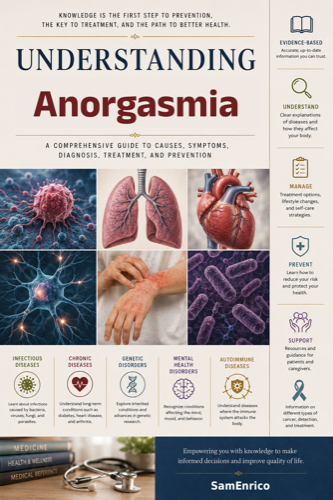
Understanding Anorgasmia eBook
This disease publication, published by SamEnrico,
by Wheat Allene
This disease publication, published by SamEnrico, covers Understanding Anorgasmia
Formats
Free sample
Chapter 1: The Silent Epidemic...--You have likely picked up this book for one of three reasons. Either you have struggled to reach orgasm yourself, perhaps for years or even decades, and you are exhausted by the silence and the shame. Or you love someone who struggles, and you have run out of ways to help, your well-meaning encouragement somehow making things worse. Or you are a professional—therapist, physician, nurse, coach—who has realized that your training left you ill-equipped to address the single most common sexual complaint you hear, the one your patients whisper about in the final three minutes of an appointment, or never mention at all.Whoever you are, welcome. You are about to learn that anorgasmia—the clinical term for persistent difficulty reaching orgasm despite adequate stimulation and desire—is not a niche problem affecting a small, unfortunate minority.
It is a silent epidemic, hiding in plain sight, affecting tens of millions of people in the United States alone. And almost everyone affected believes they are the only one.Let me say this as clearly as I can, before we go any further: You are not broken.That sentence will appear throughout this book, not as a hollow platitude but as a scientific fact. The inability to orgasm is almost never a sign that your body is fundamentally defective. It is a sign that something—a medication, a nerve, a thought pattern, a relationship dynamic, a cultural message—is getting in the way. And almost everything that gets in the way can be understood, addressed, and often removed.But first, we have to stop pretending this isn't happening.The Numbers That Demand Attention Let us begin with the data, because data cuts through shame.
Data tells us that our individual suffering is not an isolated freak occurrence but a shared human experience with predictable patterns.Approximately 10 to 15 percent of women report lifelong anorgasmia. That means they have never experienced orgasm under any circumstance—not alone, not with a partner, not with a vibrator, not in their dreams. For these women, orgasm is not something they have lost; it is something they have never found. The number varies across studies, but the consistency is striking: roughly one in every eight to ten women has never orgasmed.But that number, while significant, tells only part of the story. A much larger group—up to 50 percent of women—report situational anorgasmia.
These are women who can orgasm under some conditions (typically alone, with a vibrator, or in very specific contexts) but cannot orgasm under others (typically during partnered intercourse, or with a new partner, or when they feel pressured). Situational anorgasmia is not a lifelong condition; it is a context-dependent one. And because it is context-dependent, it is often highly treatable.For men, the numbers look different, and the terminology shifts. Lifelong anorgasmia in men—the complete inability to reach orgasm under any circumstance—is rare, affecting approximately 1 to 4 percent of the male population. However, delayed ejaculation (taking more than twenty to thirty minutes of sustained, high-intensity stimulation to reach orgasm, or being unable to reach orgasm at all despite normal erection and desire) is more common.
Up to 30 percent of men taking SSRI antidepressants experience delayed ejaculation as a side effect. In the general male population (excluding medication effects), delayed ejaculation affects approximately 1 to 4 percent of men, similar to the rate of lifelong anorgasmia.A separate condition, anejaculation (the absence of fluid expulsion during orgasm), affects many men after prostate surgery and some men with neurological conditions. Critically, as we will explore in Chapter 11, a man can experience the sensation of orgasm without ejaculating fluid, and conversely, a man can ejaculate fluid without the subjective pleasure of orgasm. The two are not the same thing, though they usually occur together.These numbers mean that if you are reading this book in a coffee shop, on a train, or in your living room, statistically speaking several people within your line of sight share your struggle. You just cannot see them.
That is the nature of silent epidemics.The Four Subtypes That Shape Everything Before we can understand why anorgasmia happens, we need a common language for describing what is happening. Clinicians classify anorgasmia along two axes, creating four primary subtypes.The first axis is lifelong versus acquired. Lifelong anorgasmia means you have never experienced orgasm, not once, not under any circumstances. Your body has simply never crossed that threshold. Acquired anorgasmia means you once could orgasm—perhaps easily, perhaps with some difficulty—and now you cannot.
Something changed. The distinction matters enormously because the causes and treatments differ. Lifelong anorgasmia often involves developmental factors, anatomical variations, or deeply embedded psychological blocks. Acquired anorgasmia often points to a specific trigger: a new medication, a surgery, an illness, a trauma, a relationship change, or the natural hormonal shifts of menopause.The second axis is generalized versus situational. Generalized anorgasmia means you cannot orgasm in any context—alone or with a partner, with manual stimulation or a vibrator, in any position, at any time of day.
Situational anorgasmia means you can orgasm in some contexts but not others. The most common presentation of situational anorgasmia in women is the ability to orgasm during solo masturbation but not during partnered sex. This pattern is so common that it has its own clinical shorthand: "masturbatory orgasm, coital anorgasmia." For men, situational anorgasmia might look like the ability to orgasm during masturbation or oral sex but not during vaginal or anal intercourse.These two axes combine to create four clinical pictures: lifelong generalized (never orgasmed, anywhere), lifelong situational (never orgasmed in partnered sex but can alone), acquired generalized (lost the ability to orgasm anywhere), and acquired situational (lost the ability to orgasm in specific contexts). Each picture points toward different root causes and different treatment pathways.The Most Important Question: Does It Bother You?Here is where many clinical texts get it wrong, and where this book deliberately parts company with the medical establishment's reflexive pathologizing of human variation.Anorgasmia is only a disorder if it causes clinically significant distress. This is not a loophole or a technicality.
It is a fundamental recognition that human sexuality is diverse, and not everyone prioritizes orgasm in the same way. Some people who have never orgasmed feel perfectly fine about it. They enjoy sex. They experience pleasure, intimacy, connection, and physical satisfaction. They simply do not experience the specific muscular contractions and subjective rush we call orgasm.
For these individuals, anorgasmia is not a problem. It is a variation.If that describes you, and you are reading this book only because someone else told you that you "should" want to orgasm, you have my permission to close this book and walk away. Or, better yet, keep reading for the sole purpose of reinforcing your confidence that your sex life is valid exactly as it is. The distress criterion is not an afterthought; it is the ethical center of any responsible discussion of sexual function.For everyone else—for those of you who are distressed, who feel broken, who have faked orgasms to end encounters or protect partners' feelings, who avoid sex altogether because the pressure to perform has drained it of…
This is the end of the free sample. Get the eBook to keep going. Buy now
About this book
Details
- Author
- Wheat Allene
- Publisher
- SamEnrico
- Language
- English
- Genre
- Non-Fiction, Informative, Educational
- Released
- 2026-05-18
- Pages (approx.)
- 137
- Available as
- eBook, Audiobook

Read better in the ZLOADR app
Your eBooks on your phone or tablet. Sign in with your SamEnrico account and start reading.
More by Wheat Allene
 Career Pivot After Job Loss GuideWheat Allene$11.99
 Coogan Law Child Star GuideWheat Allene$11.99
 The Freelance Weekend WarriorWheat Allene$11.99
 Indian GST Voluntary Registration Action GuideWheat Allene$11.99
 Interruption Free Zones Blueprint GuideWheat Allene$11.99
 Walmart SupercenterWheat Allene$11.99
 Modesto House Search DetailsWheat Allene$11.99
 Assertiveness in Emergency SituationsWheat Allene$11.99
 Teen Self Esteem Coloring BookWheat Allene$11.99
 The Star Keepers of Nubia: How Ancient Kushite Astronomers Mapped the CosmosWheat Allene$11.99
 The Clockwork Oracle: How a 17th-Century Android Foretold the FutureWheat Allene$11.99
 Silent Sabotage: The Secret War of the 1980s Olympic SkatesWheat Allene$11.99
You may also like
 Hong Kong Handover 1997Dunn Johnnie$11.99
 Zumba For Postnatal Recovery CourseNeal Christian$11.99
 Zumba for BeginnersLadner Nikia$11.99
 YouTube Comment Mining GuideHumes Pandora$12.99
 Worry Box MeditationCarlin Rudy$11.99
 Workplace Stress MeditationNguyen Lynn$11.99
 Workplace Stress and Sleep RepairHawley Ivory$11.99
 Workplace Perfectionism CureDelaney Jeffry$11.99
 Workplace Injustice Anger GuideWallen Isabelle$11.99
 Work Addiction and Burnout LinkGreenwood Ester$11.99
 Women in Yoga and WellnessBeattie Galina$11.99
 Women in Stand Up ComedyChun Evangeline$11.99