
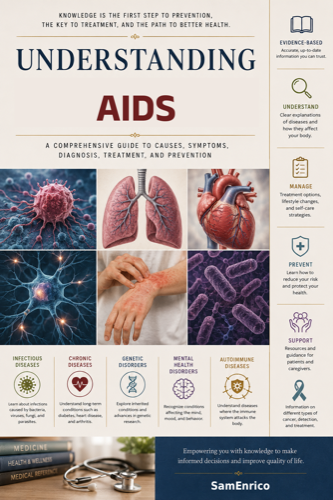
Non-FictionInformativeEducational
Understanding AIDS eBook
This disease publication, published by SamEnrico,
This disease publication, published by SamEnrico, covers Understanding AIDS
Formats
Free sample
Chapter 1: The Shadow Pandemic...-- On a humid June morning in 1981, a young gay man in Los Angeles checked into a hospital with purple lesions on his leg and a fever that would not break. The lesions were Kaposi's sarcoma—a previously rare cancer seen mostly in elderly Mediterranean men. He also had Pneumocystis carinii pneumonia, a fungal lung infection that, until that moment, had been virtually unheard of in anyone with a functioning immune system. Within weeks, similar cases appeared in New York, San Francisco, and Miami. Young men—previously healthy, vibrant, and in the prime of their lives—were suddenly dying of diseases that should have been easily controlled.
Something was systematically dismantling their immune systems. No one knew what it was. No one knew how it spread. And for the first two years of the emerging crisis, no one in power seemed to care.This is not a story about a virus alone. It is a story about fear, prejudice, scientific hubris, and the catastrophic cost of delay.
The pathogen that would come to be called HIV did not emerge into a vacuum. It emerged into a world that was deeply uncomfortable with homosexuality, deeply skeptical of sex workers and people who injected drugs, and deeply reluctant to fund research into diseases that seemed to affect only marginalized communities. The result was the single most botched public health response in modern history—not because the science was impossible, but because the politics were poisonous.To understand AIDS—to truly understand the virus, the epidemic, and the ongoing struggle—you must first understand how it began. Because the mistakes of 1981 are still being paid for with lives today.The First Clusters: Clues That Went Unnoticed The official start of the AIDS epidemic is usually dated to June 5, 1981, when the Centers for Disease Control (CDC) published a dry, clinical report titled "Pneumocystis Pneumonia—Los Angeles." The report described five young gay men, all previously healthy, who had been treated for biopsy-confirmed Pneumocystis carinii pneumonia at three different Los Angeles hospitals. Two of them were already dead.
The report noted, with a clinical detachment that now seems almost grotesque, that "the fact that these patients were all homosexuals suggests an association between some aspect of a homosexual lifestyle or disease acquired through sexual contact and Pneumocystis pneumonia in this population."That cautious sentence was the first public acknowledgment of something wrong. But the evidence had been accumulating for much longer. Retrospective studies later identified a handful of earlier cases. In 1959, a man in the Belgian Congo (now the Democratic Republic of Congo) died of what was almost certainly AIDS-related complications; preserved blood samples later tested positive for HIV. In 1969, a sixteen-year-old American teenager named Robert Rayford died of a mysterious illness in St.
Louis; decades later, his tissues tested positive for HIV. In 1977, a Danish surgeon named Grethe Rask, who had worked in what is now the DRC, died of what her colleagues called "a strange immunological collapse."These scattered cases were not connected at the time. No one was looking for a pattern. And by the time the CDC published its report in 1981, the virus had already been spreading silently for decades. The first official cases were not the first cases at all.
They were simply the first ones noticed.The Terror of the Unknown: Naming the Disease In the absence of a known cause, the disease was defined by its victims. The CDC initially used the cumbersome label "Kaposi's Sarcoma and Opportunistic Infections." But in the popular press and even within medical circles, a more common—and more damaging—name took hold: GRID, or Gay-Related Immune Deficiency. The implications of that name were devastating. If the disease was "gay-related," then it was not a threat to straight people. It was not a public health priority.
It was a niche problem affecting a stigmatized minority.The name GRID was not merely inaccurate; it was actively harmful. It obscured the fact that the disease was also appearing in other populations. By 1982, doctors had identified cases among people who had received blood transfusions, among infants born to mothers with the disease, and among heterosexual partners of people with the disease. In one particularly revealing cluster, three elderly women in a small New England town all developed mysterious immune deficiencies. The only connection: they had all received blood transfusions from the same donor, a young man who later died of what was then called GRID.The name also blinded researchers to the possibility of a single infectious agent.
If the disease was "gay-related," perhaps it was caused by a combination of factors unique to gay male subcultures—amyl nitrite ("poppers") use, multiple sexual partners, exposure to various sexually transmitted infections. Some researchers spent years chasing these dead-end hypotheses while the virus continued to spread.It was not until 1982, more than a year after the first CDC report, that the name was officially changed to AIDS—Acquired Immune Deficiency Syndrome. The word "acquired" signaled that the disease was not genetic; "immune deficiency" described what it did; "syndrome" acknowledged that it presented as a collection of symptoms rather than a single disease. This was progress. But the damage of the GRID label had already been done.
The association between AIDS and homosexuality was seared into the public consciousness, and it would take years—decades, really—to undo.The Scientific Race: Gallo vs. Montagnier While the public panicked, scientists raced to find the cause. The leading contender was a retrovirus—a family of viruses that reverse-transcribe their RNA into DNA, inserting themselves permanently into the host's genome. Retroviruses were already known to cause immune deficiency in animals. Feline leukemia virus (Fe LV) causes cancer and immune suppression in cats.
Simian T-lymphotropic virus (STLV) causes similar problems in monkeys. It was entirely plausible that a human version existed.The race to isolate the virus pitted two scientific giants against each other. On one side was Dr. Robert Gallo of the National Cancer Institute in Bethesda, Maryland. Gallo was a brash, ambitious, and brilliant virologist who had already co-discovered the first human retrovirus (HTLV-1, which causes a rare form of leukemia).
He was convinced that AIDS was caused by a retrovirus, and he had the tools and the team to find it.On the other side was Dr. Luc Montagnier of the Pasteur Institute in Paris. Montagnier was quieter, more methodical, and less interested in publicity. But he had access to something Gallo did not: tissue samples from a patient with early signs of AIDS. In January 1983, Montagnier's team isolated a virus from the swollen lymph node of a French airline steward who had extensive international travel and multiple sexual partners.
They named it LAV—Lymphadenopathy-Associated Virus—and submitted their findings to the journal Science.What followed was one of the ugliest scientific disputes of the twentieth century. Gallo's team announced their own isolation of a retrovirus from AIDS patients in 1984, naming it HTLV-III. For the next several years, the two scientists fought over who had discovered the virus first, who deserved the credit, and who would control the lucrative patent for the blood test. The dispute was eventually resolved by a high-level political agreement brokered by the French…
This is the end of the free sample. Get the eBook to keep going. Buy now
About this book
Details
- Author
- Mcneill Serafina
- Publisher
- SamEnrico
- Language
- English
- Genre
- Non-Fiction, Informative, Educational
- Released
- 2026-06-02
- Pages (approx.)
- 156
- Available as
- eBook, Audiobook

Read better in the ZLOADR app
Your eBooks on your phone or tablet. Sign in with your SamEnrico account and start reading.
More by Mcneill Serafina
 Opioid Overdose Prevention GuideMcneill Serafina$11.99
 Road Rage and SpeedingMcneill Serafina$11.99
 Ayurvedic Anxiety GuideMcneill Serafina$11.99
 Loving Kindness for an Ex SpouseMcneill Serafina$11.99
 Anki For Daily To Do ListsMcneill Serafina$11.99
 Immigrant Founder Capital Raising CourseMcneill Serafina$11.99
 Feelings Inventory GuideMcneill Serafina$11.99
 Verbal Working MemoryMcneill Serafina$11.99
 Stress And Temperature RegulationMcneill Serafina$11.99
 The Stanford Prison Experiment: The Hidden TapesMcneill Serafina$11.99The Stanford Prison Experiment: The Hidden TapesMcneill Serafina$11.99
 The Great Unplug: How a Single Union Walkout Shut Down the InternetMcneill Serafina$11.99
You may also like
 Hong Kong Handover 1997Dunn Johnnie$11.99
 Zumba For Postnatal Recovery CourseNeal Christian$11.99
 Zumba for BeginnersLadner Nikia$11.99
 YouTube Comment Mining GuideHumes Pandora$12.99
 Worry Box MeditationCarlin Rudy$11.99
 Workplace Stress MeditationNguyen Lynn$11.99
 Workplace Stress and Sleep RepairHawley Ivory$11.99
 Workplace Perfectionism CureDelaney Jeffry$11.99
 Workplace Injustice Anger GuideWallen Isabelle$11.99
 Work Addiction and Burnout LinkGreenwood Ester$11.99
 Women in Yoga and WellnessBeattie Galina$11.99
 Women in Stand Up ComedyChun Evangeline$11.99