
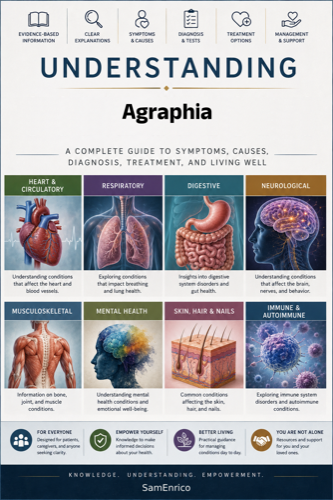
Understanding Agraphia
This condition publication, published by SamEnrico
This condition publication, published by SamEnrico, covers Understanding Agraphia
Formats
About this book
Free sample
Chapter 1: The Missing Words--–- The moment Helen first realized something was wrong, she was sitting at her kitchen table with a thank-you note to her granddaughter. The note should have been simple. “Dear Sophie, thank you for the beautiful scarf. It matches my winter coat perfectly. Love, Grandma.” But after writing “Dear Sophie,” Helen’s hand stopped.
She knew what she wanted to say. The words were perfectly clear in her mind. She could hear the sentence: “thank you for the beautiful scarf.” But when she tried to write the word “thank,” the pen produced “thak.” She tried again. “thnk.” A third time. “thankk.” Her hand was not shaking.
Her eyesight was fine. She had written thousands of thank-you notes over seventy years. But now, something in her brain had simply forgotten how to spell one of the most common words in the English language. Helen had agraphia, and her story is not unusual.The loss of the ability to write—truly write, not just physically struggle with a pen—is one of the most disorienting and misunderstood consequences of brain injury and neurological disease. Unlike the loss of speech, which is immediately recognized as catastrophic, the loss of writing is often dismissed, minimized, or misattributed to normal aging, carelessness, or lack of effort.
Patients are told to “slow down,” “pay more attention,” or “just practice more.” Family members assume the patient is being lazy or difficult. Even some physicians fail to appreciate that writing is a distinct neurological function that can be selectively impaired while every other cognitive and motor ability remains perfectly intact. This chapter exists to correct those misconceptions.Understanding agraphia begins with a deceptively simple question: what does it mean to write? For most people, writing feels automatic—a direct pipeline from thought to page that requires no conscious effort. But this feeling of automaticity is an illusion, a trick the brain plays on itself after decades of practice.
In reality, writing is one of the most cognitively demanding tasks humans ever perform, requiring the split-second coordination of language systems, memory systems, motor planning systems…
This is the end of the free sample. Get the eBook to keep going. Buy now
Contents
- Chapter 1
- Chapter 2
- Chapter 3
- Chapter 4
- Chapter 5
- Chapter 6
- Chapter 7
- Chapter 8
- Chapter 9
- Chapter 10
- Chapter 11
- Chapter 12
Details
- Author
- Marshall Jaime
- Publisher
- SamEnrico
- Language
- English
- Genre
- Non-Fiction, Informative, Educational
- Released
- 2026-06-02
- Pages (approx.)
- 149
- Available as
- eBook, Audiobook

Read better in the ZLOADR app
Your eBooks on your phone or tablet. Sign in with your SamEnrico account and start reading.
More by Marshall Jaime
 Body Image for Facial Hair WomenMarshall Jaime$11.99
 Emotional Envy RegulationMarshall Jaime$11.99
 Craving Survival KitMarshall Jaime$11.99
 Charity Fundraising PersuasionMarshall Jaime$11.99
 Silverstone British GP GuideMarshall Jaime$11.99
 Murder on Social MediaMarshall Jaime$11.99
 Divorce Post Traumatic GrowthMarshall Jaime$11.99
 Mendeleev Periodic Table PredictionsMarshall Jaime$11.99
 Love Letters from the Silver Screen: The Wartime Romance That Won the OscarMarshall Jaime$11.99
 The Enchanted Scores: Erich Wolfgang Korngold and the Birth of Hollywood's Golden AgeMarshall Jaime$11.99
 How to Produce Food Mixers and BlendersMarshall Jaime$11.99
 Ultimate Handbook Guide to Jamshedpur : (India) Travel GuideMarshall Jaime$11.99