
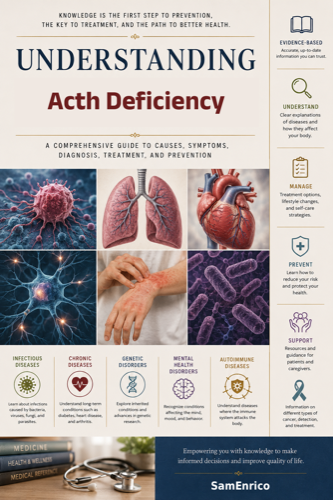
Non-FictionInformativeEducational
Understanding Acth Deficiency eBook
This disease publication, published by SamEnrico,
by Kohn Eloisa
This disease publication, published by SamEnrico, covers Understanding Acth Deficiency
Formats
Free sample
Chapter 1: The Silent Crash...--The first time I thought I was dying, I was standing in line at a grocery store, holding a carton of milk that suddenly felt like it weighed fifty pounds. My heart was pounding, not fast, but hard – each beat a dull thud against my ribs. My vision narrowed to a tunnel, the fluorescent lights bleaching out the colors of cereal boxes and produce until everything was a hazy white-gray. I remember thinking, very calmly, "This is it. This is a heart attack." I was thirty-four years old.The second time I thought I was dying, I was lying on my bathroom floor at 2 AM, too weak to lift my head off the cold tile, vomiting nothing but bile into a toilet bowl I couldn't quite reach.
My husband found me there, called an ambulance, and watched as the paramedics ran an EKG, took my blood pressure – 78/42 – and told him, "She's dehydrated. Probably a stomach bug."The third time, I didn't think I was dying. I wished I was.Over the course of eighteen months, I would see nine doctors. I would be diagnosed with anxiety, depression, chronic fatigue syndrome, irritable bowel syndrome, orthostatic hypotension (which is a symptom, not a disease), "maybe a mild eating disorder," long COVID (before long COVID was a thing), and, memorably, "just being a busy working mom." I would be prescribed antidepressants, anti-nausea medication, beta-blockers for my "anxiety-induced tachycardia," and sleeping pills for my "circadian rhythm disruption." I would be told to exercise more, exercise less, eat more, eat less, drink more water, drink less coffee, try yoga, try meditation, try essential oils, try "just getting more rest."What I actually had was isolated ACTH deficiency. It took a tenth doctor – an endocrinologist I saw only because my neurologist happened to order a random 8 AM cortisol test as a "maybe we should rule out something organic" – to figure it out.
My cortisol came back at 1.8 mcg/d L. Normal for 8 AM is 10-20. My ACTH came back at 3 pg/m L. Normal is 9-50. The combination – low cortisol AND low ACTH – meant my pituitary gland had, for reasons unknown, simply stopped sending the signal that tells my adrenal glands to wake up and do their job.When the endocrinologist called me with the results, I was sitting in my car in a pharmacy parking lot, picking up my third round of antidepressants.
"You don't need those," she said. "You need hydrocortisone. You have secondary adrenal insufficiency – ACTH deficiency."I started crying. Not because I was sad. Because I had been telling doctors for eighteen months that I was tired in a way that sleep couldn't fix, nauseous in the morning for no reason, dizzy when I stood up, and prone to "crashes" after even minor stress like a cold or a long day at work.
I had been told, again and again, that my lab work was normal, my thyroid was fine, my blood counts were fine, my electrolytes were "a little low but nothing to worry about." No one had ever explained to me that low sodium – hyponatremia – was a classic sign of adrenal insufficiency. No one had ever asked about my morning nausea or my inability to tolerate fasting.That endocrinologist saved my life. Not dramatically – no crash cart, no code blue – but she saved it just the same. Because ACTH deficiency, left untreated, does not kill you quickly. It kills you slowly, in pieces.
It erodes your energy until you cannot work. It erodes your joy until you cannot remember what happiness felt like. It erodes your body until a simple stomach flu becomes a week in the ICU. And then, one day, it kills you outright – adrenal crisis, shock, cardiac arrest – and everyone says, "We had no idea."This book is written for everyone who is living through what I lived through. For the person who has been told "it's all in your head." For the parent watching their child waste away with normal lab work.
For the spouse who doesn't know how to help. For the doctor who wants to understand why their patient isn't getting better. And for the patient who has finally received a diagnosis of ACTH deficiency and needs to know: what now?We need to start with a story. Not mine – mine is just one of thousands. Let me tell you about Sarah.The Woman Who Almost Died of Tiredness Sarah was a forty-one-year-old high school biology teacher.
She ran half-marathons, coached the debate team, and made homemade birthday cakes for every student in her homeroom. She had never missed a day of work in fifteen years – not for a cold, not for the flu, not for her own children's sick days.Then, over the course of six months, she fell apart.It started with fatigue. Not the "I need more coffee" kind, but the "I cannot lift my arms to brush my teeth" kind. Sarah's husband, Mark, would find her sitting on the edge of the bed at 7 AM, fully dressed, staring at the wall. "I'm just so tired," she would say.
"I can't explain it."Her primary care doctor ran blood work. Complete blood count: normal. Thyroid panel: normal. Metabolic panel: sodium 131 m Eq/L (borderline low, but "probably just drinking too much water"). The doctor said, "You're under a lot of stress.
Let's check your vitamin D." Vitamin D was normal. "Let's try an antidepressant." Sarah tried it. She felt no better. "Let's try a different one." Same result.Then came the nausea. Every morning, like clockwork.
Sarah would wake up, stand up, and immediately feel like she was going to vomit. She learned to keep crackers on her nightstand, to eat before getting out of bed. Sometimes it worked. Sometimes she spent the first hour of her day leaning over the toilet.Then came the dizziness. Standing up from a chair made the room spin.
Walking to the mailbox made her heart race. One day, in the middle of a lecture on cellular respiration, she felt her vision go black around the edges. She grabbed the podium, waited ten seconds, and finished the class. She did not tell anyone.Then came the weight loss. Sarah had always been lean – 135 pounds at 5'6".
Over four months, she dropped to 112 pounds, then 106, then 98. Her students started whispering. A concerned colleague pulled Mark aside at a school event. "Is Sarah... okay?
She looks like a skeleton."Her primary care doctor ordered more tests. Celiac panel: negative. Inflammatory markers: normal. Chest X-ray: normal. Abdominal ultrasound: normal.
Colonoscopy: normal. Endoscopy: normal. "Have you considered," the doctor said gently, "that you might have an eating disorder?"Sarah was not angry. She was too tired to be angry. She was too tired to be anything.The crisis came on a Tuesday night.
Sarah had a low-grade fever – 100.1°F – and what she thought was a stomach bug. She vomited once at 8 PM, twice at 10 PM, then every hour through the night. By 4 AM, she was vomiting bile. By 5 AM, she was vomiting blood – just streaks, but enough to scare Mark into calling 911.The paramedics found her in bed, conscious but confused. Her blood pressure was 68/40.
Her pulse was 130. She was pale as paper and couldn't tell them what year it was. They started an…
This is the end of the free sample. Get the eBook to keep going. Buy now
About this book
Details
- Author
- Kohn Eloisa
- Publisher
- SamEnrico
- Language
- English
- Genre
- Non-Fiction, Informative, Educational
- Released
- 2026-05-09
- Pages (approx.)
- 151
- Available as
- eBook, Audiobook

Read better in the ZLOADR app
Your eBooks on your phone or tablet. Sign in with your SamEnrico account and start reading.
More by Kohn Eloisa
 AI Bullet to Slide ConverterKohn Eloisa$11.99
 Summer Lee FrackingKohn Eloisa$11.99
 Pre Sleep Dream Intention GuideKohn Eloisa$11.99
 Polish Nuclear Energy ConstructionKohn Eloisa$11.99
 Recall Communication TemplateKohn Eloisa$11.99
 British East India Company FallKohn Eloisa$11.99
 Latina Body Image GuideKohn Eloisa$11.99
 Waist Circumference ReductionKohn Eloisa$11.99
 Strength Training For Shift WorkersKohn Eloisa$11.99
 The Silent Siege of 1972: When a City Vanished in the DarkKohn Eloisa$11.99
 Lamia’s Lament: The Serpent Queen’s CurseKohn Eloisa$11.99
 The Day the Internet Broke: How a Single Bug Crashed the WorldKohn Eloisa$11.99
You may also like
 Hong Kong Handover 1997Dunn Johnnie$11.99
 Zumba For Postnatal Recovery CourseNeal Christian$11.99
 Zumba for BeginnersLadner Nikia$11.99
 YouTube Comment Mining GuideHumes Pandora$12.99
 Worry Box MeditationCarlin Rudy$11.99
 Workplace Stress MeditationNguyen Lynn$11.99
 Workplace Stress and Sleep RepairHawley Ivory$11.99
 Workplace Perfectionism CureDelaney Jeffry$11.99
 Workplace Injustice Anger GuideWallen Isabelle$11.99
 Work Addiction and Burnout LinkGreenwood Ester$11.99
 Women in Yoga and WellnessBeattie Galina$11.99
 Women in Stand Up ComedyChun Evangeline$11.99