
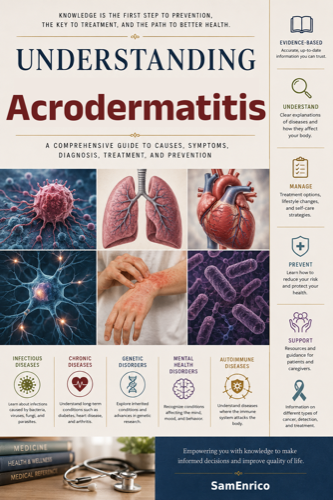
Non-FictionInformativeEducational
Understanding Acrodermatitis eBook
This disease publication, published by SamEnrico,
This disease publication, published by SamEnrico, covers Understanding Acrodermatitis
Formats
Free sample
Chapter 1: The Disease Behind the Rash...--The first time Sarah noticed the rash, she told herself it was just a little drool irritation. Liam was eight weeks old, a happy baby with round cheeks and a toothless grin that could melt the coldest heart. He had just started to discover his hands, staring at them with the intense concentration of a philosopher contemplating the mysteries of existence. Sarah was a first-time mother, and like all first-time mothers, she oscillated between hypervigilance and the desperate desire to be told she was worrying over nothing.The rash began at the corner of Liam's mouth—just a small red patch, slightly raised, slightly scaly. Sarah mentioned it to her pediatrician at Liam's two-month checkup.
The pediatrician, a busy woman with kind eyes and a stack of charts under her arm, glanced at the rash and said, "Probably just a little drool rash. Very common at this age. Keep it dry, put a little barrier cream on it, and it should clear up in a few days."Sarah bought the cream. She applied it three times a day. The rash spread.Over the next two weeks, the small red patch at the corner of Liam's mouth grew outward, circling his lips like a crimson mask.
It spread to his chin, then to his cheeks, then to the area around his nose. His skin became raw, weepy, and cracked. He cried when Sarah touched his face. He cried when she fed him. He cried when she tried to clean the crusted yellow discharge from the corners of his mouth.Sarah called the pediatrician again.
The nurse said it was probably thrush—a common yeast infection in infants—and prescribed an antifungal cream. Sarah applied it. The rash worsened.By three months, the rash had spread to Liam's diaper area. The skin on his bottom was bright red, peeling off in sheets. No amount of diaper cream, no frequency of changes, no brand of disposable wipes made any difference.
The rash also appeared on his hands and feet—small, blister-like lesions between his fingers and toes, on his palms, on the soles of his feet.Sarah took photographs. She sent them to her mother, a retired nurse, who called back within the hour."Sarah, that's not a normal rash," her mother said. "That's not thrush. That's not diaper rash. That's something else entirely.
You need to see a dermatologist."Sarah pushed. The pediatrician referred her to a dermatologist. The dermatologist had a three-month waiting list.Sarah did not wait three months. She called every dermatologist within a hundred-mile radius. She begged, she pleaded, she cried on the phone.
She finally got an appointment with a pediatric dermatologist at a university hospital two hours away. The appointment was in two weeks.Two weeks. Liam was suffering. He had stopped smiling. He had stopped cooing.
He lay in his bassinet, listless, his eyes half-open, his body limp. He was barely eating. His weight had plateaued. His hair, once thick and dark, was thinning. It had taken on a strange reddish tint that Sarah had never seen before.On the morning of the dermatology appointment, Sarah packed Liam into the car and drove two hours through rain and fog.
She held him in the waiting room, rocking him, whispering to him, trying not to cry. Other parents glanced at Liam's rash and looked away quickly. Sarah could not blame them. It was hard to look at.The dermatologist's name was Dr. Patel.
She was a small woman with sharp eyes and quick, efficient movements. She examined Liam from head to toe, taking photographs, dictating notes into a recorder. She asked Sarah questions: When did the rash start? Where did it appear first? Had Liam traveled anywhere?
Was there a family history of skin problems? Inflammatory bowel disease? Cystic fibrosis?"No," Sarah said. "Nothing. We're both healthy.
The baby was full-term. No complications."Dr. Patel sat back in her chair. She looked at Liam. She looked at Sarah.
She said, "I've seen this before. Not often—only a handful of times in my career. But I've seen it. I think your son has Acrodermatitis Enteropathica."Sarah had never heard those words before. "What is that?" she asked."It's a genetic disorder," Dr.
Patel said. "The body cannot absorb zinc properly. Zinc is an essential mineral—we need it for our skin, our hair, our immune system, our growth. Without it, the body falls apart. The rash you're seeing on his face, his hands, his diaper area—that's the hallmark.
The diarrhea, the hair loss, the irritability—those are the other symptoms.""Can it be treated?" Sarah asked."Yes," Dr. Patel said. "With zinc. Oral zinc supplements. For life.""For life?""For life.
But here's the good news: with zinc, he will be normal. The rash will clear. His hair will grow back. He will grow and develop like any other child. He will go to school, play sports, fall in love, have children of his own.
He will live a completely normal life—as long as he takes his zinc every day."Sarah burst into tears. She cried for Liam, who had suffered for months without a diagnosis. She cried for herself, who had been dismissed by doctors who said she was worrying over nothing. And she cried with relief—because there was a treatment, a simple treatment, a cheap treatment, a treatment that would save her son's life.Dr. Patel ordered blood tests: serum zinc, alkaline phosphatase, and genetic testing for the SLC39A4 gene.
She started Liam on zinc sulfate that same day—a tiny dose, crushed and mixed with formula, administered through a syringe.Sarah gave Liam his first dose in the car, in the parking lot of the hospital. She slipped the syringe along the inside of his cheek and depressed the plunger slowly. Liam gagged, coughed, then swallowed.She held her breath.Nothing happened. No allergic reaction. No seizure.
No rash flare. Just a baby swallowing medicine.But over the next few days, everything changed.The Norwegian Discovery To understand what was happening inside Liam's body—to understand the rash that would not heal, the diarrhea that would not stop, the hair that was falling out in clumps—we must first understand the history of Acrodermatitis Enteropathica. This is a story of medical mystery, decades of frustration, and eventually, a simple, elegant solution that transformed a fatal disease into a manageable chronic condition.The story begins in 1942, in Nazi-occupied Norway. Two physicians, Dr. Danbolt and Dr.
Closs, published a case report describing a distinctive and fatal skin condition in infants. The rash was unlike anything they had seen before: it appeared around the mouth, nose, hands, feet, and diaper area. The infants also had diarrhea, hair loss, and failure to thrive. The condition was progressive and, within a few years, universally fatal.Dr. Danbolt named the condition "Acrodermatitis Enteropathica"—from the Greek words "akros" (extremity), "derma" (skin), "enteron" (intestine), and "pathos" (disease).
The name reflected the three hallmarks of the condition: rash on the extremities, rash on the skin, and intestinal involvement.For the next three decades, the cause of AE remained a mystery. Researchers proposed…
This is the end of the free sample. Get the eBook to keep going. Buy now
About this book
Details
- Author
- Myrick Hilaria
- Publisher
- SamEnrico
- Language
- English
- Genre
- Non-Fiction, Informative, Educational
- Released
- 2026-06-02
- Pages (approx.)
- 147
- Available as
- eBook, Audiobook

Read better in the ZLOADR app
Your eBooks on your phone or tablet. Sign in with your SamEnrico account and start reading.
More by Myrick Hilaria
 Assertiveness In Legal ProceedingsMyrick Hilaria$11.99
 The Beginner's Audio GuideMyrick Hilaria$11.99
 Forgiveness Self Esteem GuideMyrick Hilaria$11.99
 The Payphone Was Our PhoneMyrick Hilaria$11.99
 Gamma AI Deck BuilderMyrick Hilaria$11.99
 Relapse Prevention StepsMyrick Hilaria$11.99
 Sleep Anticipatory Grief GuideMyrick Hilaria$11.99
 Lululemon Quality JustificationMyrick Hilaria$11.99
 Reformation Radical Anabaptist ManualMyrick Hilaria$11.99
 The Silent Revolution: How a Blind Engineer Built the First Talking ComputerMyrick Hilaria$11.99
 The Cosmic Whisper: How Voyager 2’s 1989 Neptune Flyby Changed EverythingMyrick Hilaria$11.99
 The Castaway’s Dream: The Lost Chronicles of the Medieval MediterraneanMyrick Hilaria$11.99
You may also like
 Hong Kong Handover 1997Dunn Johnnie$11.99
 Zumba For Postnatal Recovery CourseNeal Christian$11.99
 Zumba for BeginnersLadner Nikia$11.99
 YouTube Comment Mining GuideHumes Pandora$12.99
 Worry Box MeditationCarlin Rudy$11.99
 Workplace Stress MeditationNguyen Lynn$11.99
 Workplace Stress and Sleep RepairHawley Ivory$11.99
 Workplace Perfectionism CureDelaney Jeffry$11.99
 Workplace Injustice Anger GuideWallen Isabelle$11.99
 Work Addiction and Burnout LinkGreenwood Ester$11.99
 Women in Yoga and WellnessBeattie Galina$11.99
 Women in Stand Up ComedyChun Evangeline$11.99