
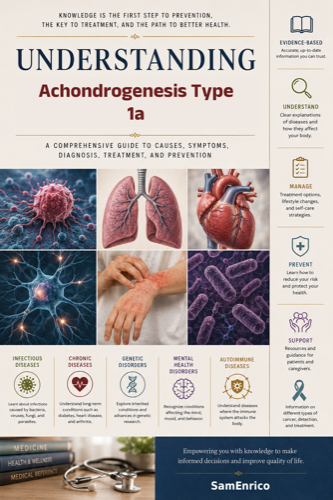
Non-FictionInformativeEducational
Understanding Achondrogenesis Type 1a
This disease publication, published by SamEnrico,
by Uribe Cami
This disease publication, published by SamEnrico, covers Understanding Achondrogenesis Type 1a
Formats
About this book
Free sample
Chapter 1: The Silent Scaffold...–- Every parent imagines the first cry. The first breath. The first time tiny fingers wrap around a thumb. These are the silent promises written into every pregnancy—the expectation that nine months will deliver a whole, living child. But for a small number of families each year, the scaffold upon which a human body is built never properly forms.
The bones—that silent, internal framework—fail to harden. And the first cry never comes.This chapter opens the journey into understanding Achondrogenesis Type 1a (ACG1A), not with cold medical terminology, but with the recognition that behind every diagnosis is a story of love, hope, and profound loss. Whether you are a parent who has just received this news, a family member trying to understand, or a clinician seeking to provide the best possible care, this chapter establishes the foundation: what ACG1A is, where it fits within the family of skeletal disorders, why it is lethal, and—most importantly—why understanding it matters, even when no cure exists.The term "achondrogenesis" comes from Greek roots: *a-* (without), chondros (cartilage), and genesis (formation or creation). Literally, it means "without cartilage formation." But that translation is misleading. In ACG1A, cartilage does form—but it forms incorrectly, and it is never replaced by bone.
To understand this distinction, we must first understand how a normal skeleton grows.The Blueprint of Bone: How a Normal Skeleton Forms Long before a baby takes its first step, its skeleton begins as a flexible model made entirely of cartilage. Cartilage is a firm, rubbery tissue—think of the tip of your nose or your outer ear. It is not bone, but it serves as the template. Beginning around the eighth week of pregnancy, a process called endochondral ossification transforms that cartilage model into hard bone. Specialized cells called chondrocytes (cartilage cells) proliferate, align in neat vertical columns, grow larger (hypertrophy), and then die.
Their death signals other cells—osteoblasts—to move in, deposit calcium phosphate, and build true bone. This process continues throughout fetal development and childhood, lengthening bones at the growth…
This is the end of the free sample. Get the eBook to keep going. Buy now
Contents
- Chapter 1
- Chapter 2
- Chapter 3
- Chapter 4
- Chapter 5
- Chapter 6
- Chapter 7
- Chapter 8
- Chapter 9
- Chapter 10
- Chapter 11
- Chapter 12
Details
- Author
- Uribe Cami
- Publisher
- SamEnrico
- Language
- English
- Genre
- Non-Fiction, Informative, Educational
- Released
- 2026-05-09
- Pages (approx.)
- 159
- Available as
- eBook, Audiobook

Read better in the ZLOADR app
Your eBooks on your phone or tablet. Sign in with your SamEnrico account and start reading.
More by Uribe Cami
 The Monk Who Refused HonorUribe Cami$11.99
 Metta Visualization PracticeUribe Cami$11.99
 TM for Irritable BowelUribe Cami$11.99
 The Family Car Was a BusUribe Cami$11.99
 Teen Gut Health GuideUribe Cami$11.99
 Step Two Sanity GuideUribe Cami$11.99
 Nonprofit Staff ExhaustionUribe Cami$11.99
 Thirty Years War Religious Apocalypse CourseUribe Cami$11.99
 Loneliness Shopping AwarenessUribe Cami$11.99
 Apicius: The Banquet of RomeUribe Cami$11.99
 The Healers of Timbuktu: The Medical Pioneers of the Songhai EmpireUribe Cami$11.99
 Iron & Ice: The Untold Saga of the Arctic’s Last Great Merchant FleetUribe Cami$11.99
You may also like
 Hong Kong Handover 1997Dunn Johnnie$11.99
 Zumba For Postnatal Recovery CourseNeal Christian$11.99
 Zumba for BeginnersLadner Nikia$11.99
 YouTube Comment Mining GuideHumes Pandora$12.99
 Worry Box MeditationCarlin Rudy$11.99
 Workplace Stress MeditationNguyen Lynn$11.99
 Workplace Stress and Sleep RepairHawley Ivory$11.99
 Workplace Perfectionism CureDelaney Jeffry$11.99
 Workplace Injustice Anger GuideWallen Isabelle$11.99
 Work Addiction and Burnout LinkGreenwood Ester$11.99
 Women in Yoga and WellnessBeattie Galina$11.99
 Women in Stand Up ComedyChun Evangeline$11.99