
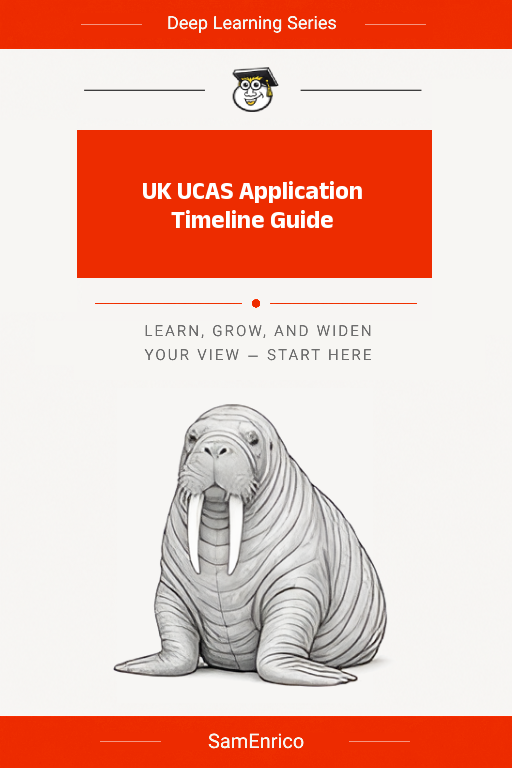
UK UCAS Application Timeline Guide eBook
Submit by January deadline for equal consideration
by Simpson Ira
Submit by January deadline for equal consideration and write personal statement for five choices.
Formats
Free sample
Chapter 1: Reverse Engineering the Hub--–- Let me tell you something most UCAS guides won't: the application portal is not designed to help you succeed. It is designed to process you efficiently. There is a difference, and understanding that difference is the difference between submitting with confidence and submitting with a knot in your stomach that doesn't go away until March.The UCAS Hub – that digital dashboard where your entire future lives for six months – is a database with a friendly face. Every click, every entry, every dropdown menu feeds into a system that must handle over 700,000 applicants annually, each one submitting up to five choices, each choice requiring a unique course code, each application accompanied by a personal statement, a reference, and a payment. The system is robust, but it is not forgiving.
It will not stop you from making catastrophic errors. It will not say, "Are you sure you meant to apply to History at the University of Manchester when your personal statement is clearly about Chemical Engineering?" It will simply process your application and send it into the void.This chapter is your technical reconnaissance mission. Before you write a single word of your personal statement, before you ask a single teacher for a reference, you will understand exactly how the UCAS Hub works – not at the surface level of "click here to continue," but at the structural level of how data flows, where errors hide, and what admissions tutors actually see when they open your file.By the end of this chapter, you will have created your UCAS account, filled out every demographic section (yes, every single one), and developed a mental map of the application that most students never acquire until their second or third attempt. You will be ahead of 90% of applicants who simply "follow the screens" and hope for the best.The Architecture of Your Application Think of the UCAS Hub as a house with twelve rooms. Most students only visit four of them: Personal Details, Education, Employment, and the Personal Statement.
The other eight rooms – Section 1 through Section 8 of your application – sit empty, ignored, or filled with placeholder data that admissions tutors can see.Here is what admissions tutors at a typical Russell Group university see when they open your application, in order of appearance:Section 1: Personal Details. Your name, date of birth, UCAS ID, and contact information. This section is largely administrative, but errors here can delay offers by weeks. A misspelled name or incorrect email address means you will not receive decisions when they are sent. Admissions tutors check this section first for a simple reason: if you cannot spell your own name correctly on an official form, they question your attention to detail on everything that follows.Section 2: Choices.
Your five university and course selections, listed in order of preference. This is the single most important section of your application. Admissions tutors see exactly which five courses you applied to and in what order. They can see if you have applied to five completely unrelated subjects (a red flag) or five complementary courses within the same department (a green flag). They can also see if you have applied to their course as your first choice, second choice, or fifth choice – and yes, some universities factor this into their decision-making.
A candidate who lists the university as their fifth choice is less likely to accept an offer, and admissions tutors know this.Section 3: Education. Your current and previous schools, plus all qualifications you have taken or are taking. This is where most errors occur. Students routinely forget to list GCSEs from Year 10, mislabel their A-level subjects, or incorrectly format their predicted grades. The system allows you to enter almost anything, which is both a blessing and a curse.
Admissions tutors use this section to verify that you meet their minimum entry requirements. If your Education section is incomplete or inconsistent, they will reject you without reading your personal statement. It is not personal. It is simply efficient: if you do not have the required grades, you cannot be admitted, and your personal statement is irrelevant.Section 4: Employment. Paid work experience.
Not volunteering, not extracurricular activities – paid employment. Many students leave this section blank, which is fine. Admissions tutors do not expect 17-year-olds to have significant work histories. But if you do have paid work experience, list it honestly. Inflation or fabrication will be caught during reference checks or background verification.Section 5: Personal Statement.
Your 4,000-character essay answering the three questions (Motivation, Preparedness, Experience). This is the only section that admissions tutors read closely. It is also the only section that most students obsess over, often at the expense of the other eleven sections. This is a mistake. A perfect personal statement attached to an Education section with missing qualifications will never be read.Sections 6-8: References, Fee Payment, and Declaration.
The reference, the payment confirmation, and your digital signature confirming that everything is true. These are binary sections: either they are complete, or your application is not submitted.The key insight – and this is the insight that separates successful applicants from those who receive unexpected rejections – is that every section must be complete and consistent. Admissions tutors do not fill in gaps. They do not assume you meant to include something you forgot. They do not call your school to clarify ambiguous entries.
They simply reject and move to the next application.The Buzzword Trap Let me tell you about the most expensive typo you will ever make.Every course in the UCAS system has a unique four-character code called a buzzword. For example:Q300 = English Literature (standard)Q301 = English Literature with Creative Writing Q310 = English Language and Literature QR31 = History with French (note the mixture of letters and numbers)These codes are not intuitive. Q300 and Q301 are one digit apart but lead to completely different courses, often in different departments, with different entry requirements and different module structures. Students regularly select Q300 when they meant to select Q301, or vice versa. The UCAS system does not warn you.
It does not say, "Are you sure you want to apply to English Literature instead of English Literature with Creative Writing?" It simply processes the application and sends it to the wrong department.Here is what happens next. Your application arrives in the English Literature department. The admissions tutor sees a personal statement about creative writing – your passion for poetry workshops, your collection of short stories, your admiration for a specific creative writing module. The tutor thinks, "This student has applied to the wrong course," and rejects you. You never receive an explanation.
You simply see "Unsuccessful" on your UCAS Hub and wonder what went wrong.The solution is painfully simple and painfully easy to ignore: verify every buzzword against the university's own website before submitting. Do not trust the UCAS course search alone. UCAS aggregates data from universities, but the aggregation is not always perfect. A course that appears as Q300 on UCAS might be listed as Q301 on the university's own admissions portal. The university's version is the correct version.
Always verify.Create a verification table for your five choices. For each course, write down:The university name The full course title…
This is the end of the free sample. Get the eBook to keep going. Buy now
About this book
Details
- Author
- Simpson Ira
- Publisher
- SamEnrico
- Language
- English
- Genre
- Non-Fiction, Student's Shortcut
- Released
- 2026-05-29
- Pages (approx.)
- 140
- Available as
- eBook, Audiobook

Read better in the ZLOADR app
Your eBooks on your phone or tablet. Sign in with your SamEnrico account and start reading.
More by Simpson Ira
 Cognitive Behavioral Dream InterpretationSimpson Ira$11.99
 The Food Tech Capital OutlookSimpson Ira$11.99
 Empath Anxiety TranceSimpson Ira$11.99
 Bad Reference ResponseSimpson Ira$11.99
 Senior Depression EsteemSimpson Ira$11.99
 Recovery from Financial BurnoutSimpson Ira$11.99
 Brain Tumor MiracleSimpson Ira$11.99
 Antwerp Heist Cold Case ReviewSimpson Ira$11.99
 The Scholastic Crossroads: Oxford and the Birth of the Modern MindSimpson Ira$11.99
 The Lost Code of Hammurabi: Decoding the First LawmakerSimpson Ira$11.99
 Operation Gold: The Race for Soviet SecretsSimpson Ira$11.99
 Growing MyrtillocactusSimpson Ira$11.99
You may also like
 Hong Kong Handover 1997Dunn Johnnie$11.99
 Zumba For Postnatal Recovery CourseNeal Christian$11.99
 Zumba for BeginnersLadner Nikia$11.99
 YouTube Comment Mining GuideHumes Pandora$12.99
 Worry Box MeditationCarlin Rudy$11.99
 Workplace Stress MeditationNguyen Lynn$11.99
 Workplace Stress and Sleep RepairHawley Ivory$11.99
 Workplace Perfectionism CureDelaney Jeffry$11.99
 Workplace Injustice Anger GuideWallen Isabelle$11.99
 Work Addiction and Burnout LinkGreenwood Ester$11.99
 Women in Yoga and WellnessBeattie Galina$11.99
 Women in Stand Up ComedyChun Evangeline$11.99