
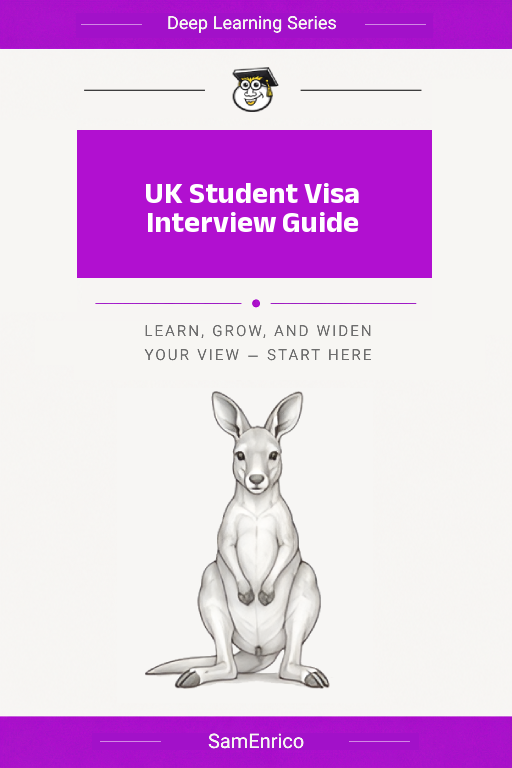
Non-FictionStudent's ShortcutUK Visa
UK Student Visa Interview Guide eBook
Prepare for UK Tier 4 (Student) visa credibility i
Prepare for UK Tier 4 (Student) visa credibility interviews with study plan and funding proof.
Formats
Free sample
Chapter 1: The 12-Minute Verdict...--–- The room is quiet. Too quiet. You sit in front of a webcam or across a desk from someone who holds the next three years of your life in their hands. They have a file with your name on it, a list of questions, and a stamp that says either “approved” or “refused.” The clock starts. In roughly twelve minutes, they will decide if you are a genuine student or a risk.
And here is the truth they do not tell you on the government website: most people fail this interview not because they are dishonest, but because they do not understand what the officer is actually listening for.If you are reading this book, you have already done something difficult. You researched universities. You wrote a personal statement. You took an English test. You gathered transcripts.
You likely paid application fees. You might have celebrated an offer letter. And then, perhaps with a sinking feeling, you realized there was one more hurdle: the credibility interview. For many applicants, this is the first time they will speak directly to a representative of UK Visas and Immigration (UKVI). It is also, for a shocking number of people, where their plans come to a sudden, confusing end.Let us start with a number that should alarm you.
According to UKVI data analyzed over multiple application cycles, nearly 47 to 50 percent of all student visa refusals are based on credibility issues alone. Not missing documents. Not insufficient funds. Not failing the English test. Credibility.
That means the Entry Clearance Officer (ECO) listened to the applicant’s answers and simply did not believe they were a genuine student. The paperwork was fine. The bank statement was sufficient. The CAS was valid. But something in the interview raised a doubt, and that doubt became a refusal stamp.This chapter exists to make sure that does not happen to you.The first and most important thing you must understand is that the credibility interview is not an interrogation.
It is not a test of your English grammar. It is not a courtroom cross-examination designed to trip you up. Despite what you may have read in panicked student forums, the ECO is not your enemy. In fact, most ECOs process hundreds of applications and genuinely prefer to approve applicants who are well-prepared and credible. Their job is to separate genuine students from people who might use a student visa to work illegally, overstay, or circumvent immigration rules.
That is all.When you reframe the interview as a fact-checking mission rather than an interrogation, everything changes. Your goal is not to “beat” the officer or “trick” them into approving you. Your goal is to make their job easy by providing clear, consistent, logical answers that align with your documents. The ECO has a checklist in their head. Your job is to check every box so quickly and naturally that they approve you before their tea gets cold.But to check those boxes, you first need to know what they are.
And that requires understanding something that no official UKVI document will tell you directly: the officer is looking for evidence of four things, and only four things. Every question they ask—no matter how strange or random it sounds—is just a creative way of asking about one of these four pillars. In Chapter 2, we will name those pillars and give you a self-diagnostic checklist. For now, understand that your answers must consistently point back to a single coherent story.Let us talk about what actually happens during the interview. Many applicants are confused about the format because they have heard conflicting stories from friends or online forums.
Some people describe a five-minute video call where they were asked three simple questions. Others describe a thirty-minute grilling about bank statements and family finances. Both can be true, but they describe different types of interviews.The vast majority of Student Visa applicants will experience what we call the Standard Credibility Interview. This interview typically lasts between ten and fifteen minutes, though it can run longer if the officer has concerns. It is conducted either via a secure video link or, in some countries, in person at a Visa Application Centre.
The officer will ask between ten and twenty questions, covering your choice of the UK, your chosen course, your academic background, your career plans, your funding sources, and your ties to your home country. This is the interview this entire book prepares you for.A smaller number of applicants may experience a short “check-in” interview lasting only five minutes. This usually happens for low-risk applicants from countries with high approval rates or for applicants who have previously studied in the UK without issues. The officer essentially confirms basic information and moves on. If you are called for this type of interview, consider yourself lucky—but still prepare using this book, because you never know when a check-in might turn into a deeper conversation.There is also a third scenario, though it is rare.
If your application raises significant red flags—such as a large unexplained deposit in your bank account, a complete change of academic field, or a previous visa refusal—you may be called for a Second Interview. This is longer, more detailed, and more stressful. The officer will drill down into specific concerns. Chapter 8 of this book is dedicated entirely to handling these curveballs.For the purpose of this chapter, and for most readers, we will focus on the Standard Credibility Interview. But the principles we cover apply to all formats.Here is a truth that might surprise you: the interview is not primarily about proving you are smart.
It is about proving you are consistent. The ECO does not need you to be a genius. They need you to be someone whose story holds together under basic questioning. If you say you want to study marketing to help your family’s business, but you cannot name a single marketing module from your course, the story falls apart. If you say you will return home after your degree because you have a job offer, but you cannot describe that job, the story falls apart.
Consistency is credibility. Credibility is approval.One of the most common reasons for refusal is what UKVI calls a “disjointed narrative.” This happens when an applicant gives answers that do not logically connect. For example, imagine an applicant who says they chose the UK because they love British culture, but when asked about their career plans, they say they want to work in the United States. The officer hears two unrelated ideas and suspects the applicant does not have a real plan. Or imagine an applicant who says their parents are funding their studies, but when asked about their parents’ jobs, they give vague or contradictory answers.
The officer flags this as a financial credibility issue.The solution to disjointed narratives is what we call the Golden Thread, which you will learn in full in Chapter 3. The Golden Thread is a single logical line that connects your past (what you have studied or done), your present (why you chose this specific UK course), and your future (exactly what…
This is the end of the free sample. Get the eBook to keep going. Buy now
About this book
Details
- Author
- Raines Damian
- Publisher
- SamEnrico
- Language
- English
- Genre
- Non-Fiction, Student's Shortcut, UK Visa
- Released
- 2026-06-01
- Pages (approx.)
- 128
- Available as
- eBook, Audiobook

Read better in the ZLOADR app
Your eBooks on your phone or tablet. Sign in with your SamEnrico account and start reading.
More by Raines Damian
 Road Rage and HungerRaines Damian$11.99
 The Teacher Emotional RegulationRaines Damian$11.99
 Social Media AuditRaines Damian$11.99
 Leonard Peltier Justice CaseRaines Damian$11.99
 Drug Addiction and AnxietyRaines Damian$11.99
 Affirmation App GuideRaines Damian$11.99
 Business Credit Monitoring SetupRaines Damian$11.99
 Habit Formation for LawyersRaines Damian$11.99
 The Great British Coffee Break: How a 1975 Tea Strike Boiled OverRaines Damian$11.99
 The Fox and the Admiral: Rommel vs. Montgomery in North AfricaRaines Damian$11.99
 Service Providers Guide to Dietitians & NutritionistsRaines Damian$11.99
 How to Produce TransportationRaines Damian$11.99
You may also like
 Hong Kong Handover 1997Dunn Johnnie$11.99
 Zumba For Postnatal Recovery CourseNeal Christian$11.99
 Zumba for BeginnersLadner Nikia$11.99
 YouTube Comment Mining GuideHumes Pandora$12.99
 Worry Box MeditationCarlin Rudy$11.99
 Workplace Stress MeditationNguyen Lynn$11.99
 Workplace Stress and Sleep RepairHawley Ivory$11.99
 Workplace Perfectionism CureDelaney Jeffry$11.99
 Workplace Injustice Anger GuideWallen Isabelle$11.99
 Work Addiction and Burnout LinkGreenwood Ester$11.99
 Women in Yoga and WellnessBeattie Galina$11.99
 Women in Stand Up ComedyChun Evangeline$11.99