
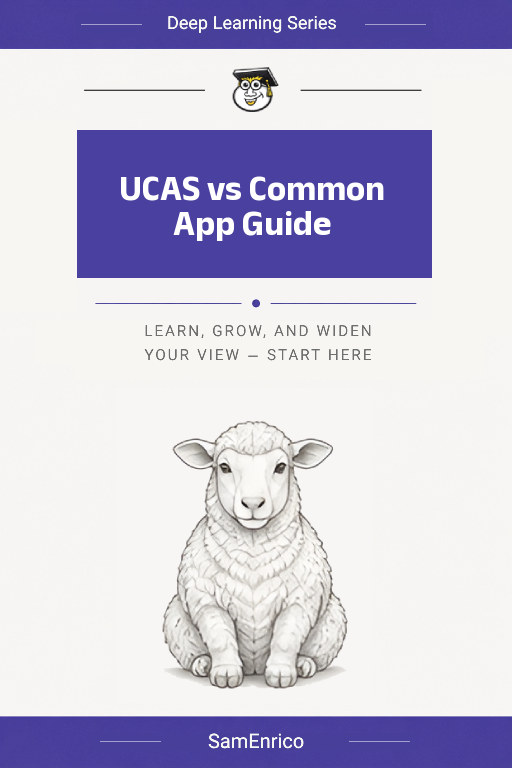
Non-FictionStudent's ShortcutApplications
UCAS vs Common App Guide eBook
Compare UK UCAS application system vs US Common Ap
by Boykin Buddy
Compare UK UCAS application system vs US Common App and Coalition App platforms.
Formats
Free sample
Chapter 1: The Atlantic Divide--You are about to make a decision that will shape not just where you spend your next three or four years, but how you think, how you learn, and who you become.If that sounds like an overstatement, consider this: a student who studies History at Oxford reads primary sources, writes long-form essays, and defends their arguments in weekly tutorials with a don. A student who studies History at Brown takes seminars in postcolonial theory, spends a semester abroad in Ghana, and graduates with a portfolio of digital storytelling projects. Both are excellent historians. They are not the same person.This book exists because the gap between the United Kingdom's university system and the United States' university system is not merely a gap in paperwork. It is a gap in philosophy, a gap in values, and a gap in what universities believe an educated person should look like.
You cannot bridge that gap by filling out forms correctly. You can only bridge it by understanding why the forms are different in the first place.This chapter is about that why.We will explore the intellectual roots of the UK's hyper-specialised model and the US's liberal arts model. We will dismantle the myths that lead students to submit the same essay to both systems and get rejected from both. We will introduce the three platforms you will use—UCAS, Common App, and Coalition App—and explain why the Coalition exists as a corrective to the Common App's limitations. And we will help you diagnose which system, or combination of systems, actually fits the person you are becoming.By the end of this chapter, you will never look at an application form the same way again.
You will see the philosophy hiding beneath the questions.The British Soul: Depth as Virtue Let us begin with the older of the two traditions. The UK university system, as it exists today, was shaped by the medieval universities of Oxford and Cambridge, where scholars gathered not to explore broadly but to master a single discipline—theology, law, medicine—well enough to teach it to others. That DNA remains visible eight centuries later.When you apply through UCAS, you do not apply to a university. You apply to a course at a university. This is not a semantic distinction.
It is the entire framework.A typical UCAS application looks like this: you choose up to five courses. They might be at five different universities, or four at one and one at another, or any combination. But each choice is a specific programme—"Mathematics at Warwick," "Mathematics with Statistics at Leeds," "Mathematics and Philosophy at Oxford"—not merely "the University of Warwick."Why does this matter? Because the admissions decision is made not by a central office but by the department itself. A mathematics tutor reads mathematics applications.
An English tutor reads English applications. These tutors are not looking for well-rounded students. They are looking for future mathematicians and future English scholars. They want to know: can this person handle the intellectual demands of this specific course?The Course is the Contract The specialisation runs deeper than admissions. Once you are admitted to a UK course, you are locked into that course with very little flexibility.
A Chemistry student at Imperial College London will take chemistry courses every term, plus mathematics courses that support chemistry, plus laboratory work that reinforces chemistry. They might have space for one elective over three years. They will not take history, philosophy, foreign languages, or art history unless they actively seek out extracurricular lectures.This is not a bug. It is the feature.The UK system operates on the principle that depth is superior to breadth. An 18-year-old who knows they want to be a chemist should not waste time studying the French Revolution.
They should be in the lab, reading journals, and mastering organic synthesis. By graduation, they will have studied chemistry for three uninterrupted years—roughly 1,800 hours of lectures, tutorials, and practical work. Their US counterpart, who spent freshman year sampling courses and sophomore year declaring a major, will have studied chemistry for perhaps 1,000 hours. The UK chemist is simply more trained.That training comes at a cost. If you discover in your second year that you actually prefer physics, you cannot easily switch.
You would likely need to restart from year one, extending your degree to four or five years. Some students do this. Most do not. They finish the chemistry degree and then pursue a master's in physics, or they leave university and retrain through work. The system rewards certainty and punishes exploration.Firm and Insurance: A Game of Risk The UK application timeline adds another layer of pressure.
When you receive offers from your five chosen courses—conditional offers, meaning they depend on your final exam grades—you must rank them. Your first choice is the firm offer, the university you most want to attend. Your second choice is the insurance offer, a backup with lower entry requirements.On results day, the system checks your grades against your firm offer. If you meet or exceed the requirements, you are in. If you fall short, the system checks your insurance offer.
If you meet those requirements, you are in. If you miss both, you enter Clearing—a frantic process of finding universities that still have spaces.This structure forces you to be strategic. A student who aims too high with their firm offer and chooses an insurance offer that is also high risks missing both and ending up in Clearing. A student who aims too low secures a place but may always wonder what if. The system rewards self-knowledge and punishes overconfidence.What UK Tutors Actually Want When a UK admissions tutor reads your personal statement, they are looking for three things, in this order:First, evidence of academic engagement with the subject.
Have you read beyond the A-Level syllabus? Can you name a recent paper or book that excited you? Do you understand the current debates in the field? One of my former students, now at the University of Edinburgh, wrote her personal statement about a single footnote she encountered in a textbook—a reference to a contested translation of a medieval Arabic text. She spent three paragraphs explaining why the footnote mattered and how she tracked down the original source.
That is the level of specificity tutors want.Second, evidence that you understand what the course actually involves. Many students apply to study Law because they watched a legal drama and thought it looked exciting. Those students are weeded out immediately. A strong applicant mentions specific modules offered by that university, specific research interests of faculty members, or specific skills the course will develop.Third, evidence of relevant extracurricular engagement—but only if it connects directly to the subject. A future medic who volunteered at a care home is demonstrating relevant experience.
A future medic who plays competitive chess is not, unless they can argue that chess taught them strategic thinking applicable to diagnosis.That third point is where most dual applicants go wrong. They assume that because US universities care deeply about extracurriculars, UK universities must care a little. This is false. UK…
This is the end of the free sample. Get the eBook to keep going. Buy now
About this book
Details
- Author
- Boykin Buddy
- Publisher
- SamEnrico
- Language
- English
- Genre
- Non-Fiction, Student's Shortcut, Applications
- Released
- 2026-06-01
- Pages (approx.)
- 146
- Available as
- eBook, Audiobook

Read better in the ZLOADR app
Your eBooks on your phone or tablet. Sign in with your SamEnrico account and start reading.
More by Boykin Buddy
 Remote Work for Social WorkersBoykin Buddy$11.99
 Design Thinking for Vision SettingBoykin Buddy$11.99
 Veteran Sleep MeditationBoykin Buddy$11.99
 Willingness vs WillfulnessBoykin Buddy$11.99
 Empathy and AttachmentBoykin Buddy$11.99
 The Twelve Step Beginner PrimerBoykin Buddy$11.99
 NVC in Schools GuideBoykin Buddy$11.99
 Catherine Territorial ExpansionBoykin Buddy$11.99
 The Resurrectionists: Canada's Victorian Grave Robbery ScandalBoykin Buddy$11.99
 The Armored Train of the Red Army: Tsaritsyn's Iron GambitBoykin Buddy$11.99
 A Collector's Handbook to the Hillman Minx (1940-44)Boykin Buddy$11.99
 10 Ways to Use Hyssop (Recipe Book)Boykin Buddy$11.99
You may also like
 Hong Kong Handover 1997Dunn Johnnie$11.99
 Zumba For Postnatal Recovery CourseNeal Christian$11.99
 Zumba for BeginnersLadner Nikia$11.99
 YouTube Comment Mining GuideHumes Pandora$12.99
 Worry Box MeditationCarlin Rudy$11.99
 Workplace Stress MeditationNguyen Lynn$11.99
 Workplace Stress and Sleep RepairHawley Ivory$11.99
 Workplace Perfectionism CureDelaney Jeffry$11.99
 Workplace Injustice Anger GuideWallen Isabelle$11.99
 Work Addiction and Burnout LinkGreenwood Ester$11.99
 Women in Yoga and WellnessBeattie Galina$11.99
 Women in Stand Up ComedyChun Evangeline$11.99