
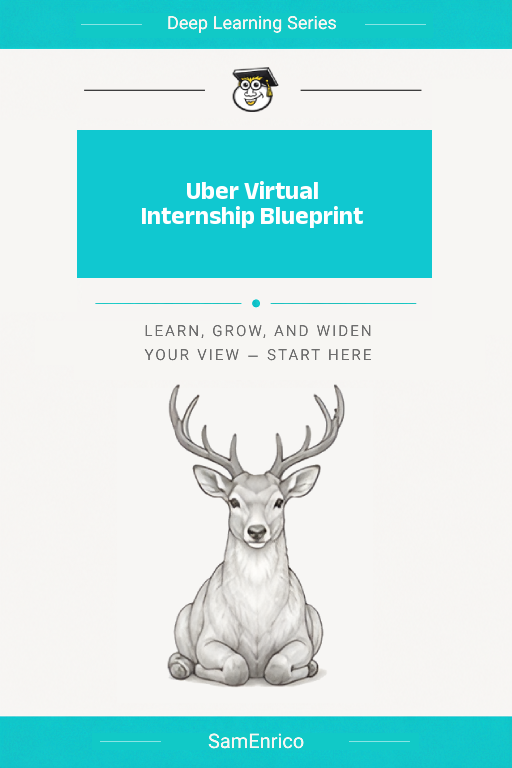
Non-FictionStudent's ShortcutMobility InternshipUber Careers
Uber Virtual Internship Blueprint eBook
Work remotely for Uber on mobility or delivery pro
Work remotely for Uber on mobility or delivery projects including logistics optimization and virtual team coordination.
Formats
Free sample
Chapter 1: The Data, Not The Door...--The first thing you need to unlearn is that you are going to work for a taxi company. You are not. You are not going to work for a food delivery service, a logistics provider, or a technology platform in the traditional sense. You are about to step into a role that barely existed five years ago and will look completely different five years from now. You are applying to become a remote operations intern for a company that moves more people in a single weekend than most airlines move in a year, yet owns no cars.
A company that delivers millions of meals daily but owns no kitchens. A company that moves billions of dollars in freight across North America but owns no trucks.Welcome to the virtual internship.If you are reading this book, you have likely already submitted your application, passed the initial screening, or at least started dreaming about what it means to work remotely for one of the most operationally complex companies on earth. You have probably watched the You Tube videos of interns presenting their final projects. You have scrolled through the Linked In profiles of former interns who now work in strategy roles at Uber, Google, or Mc Kinsey. You have heard the stories about free Uber credits, virtual happy hours, and the mythical "Uber culture" that somehow persists across thousands of remote employees.Forget all of that.This chapter is not about perks, recruitment tips, or how to format your resume.
This chapter is about the fundamental shift in perspective that separates interns who get return offers from those who fade into the digital noise. It is about understanding the battleground before you set foot on it. And it starts with a simple but brutal truth: you will never touch the product. Not physically, anyway.The Virtual Intern’s Reality Imagine for a moment that you are interning at a traditional logistics company. You might walk onto a shipping floor.
You might see pallets being wrapped, trucks being loaded, drivers holding paper manifests. You could touch a box, trace a route on a physical map, or shake the hand of a carrier who has driven eighteen hours straight. There is a tangibility to that world. It smells like diesel and cardboard.Now imagine that same role, but remote. You are sitting in your apartment, perhaps wearing sweatpants, staring at three monitors.
One screen shows a dashboard of live trip data in São Paulo. Another shows a Slack channel where drivers in Chicago are reporting app glitches. A third shows a Jupyter notebook where you are testing whether increasing the estimated time of arrival by sixty seconds reduces cancellation rates. You have never met any of these drivers. You have never visited São Paulo or Chicago.
You have never been inside an Uber Greenlight Hub. And yet, by the end of your internship, you will have made decisions that affect the earnings of thousands of drivers and the wait times of millions of riders.That is the virtual intern's reality. You operate entirely through data. Every action you take is mediated by a screen, a query, a dashboard, or a chat message. Your impact is real, but your physical presence is zero.
This is not a limitation. It is the entire point.Uber’s Digital-First Evolution To understand why this internship exists, you need to understand how Uber itself has evolved. In the company’s early years, operations were intensely local. Cities had General Managers who knew their drivers by name. Greenlight Hubs (physical storefronts where drivers could get help) were considered essential.
If there was a surge at the airport, someone on the ground would call drivers directly.That era is over.Starting around 2018, but accelerating dramatically during the COVID-19 pandemic, Uber began a quiet transformation toward what insiders call a "digital-first" operating model. Greenlight Hubs were closed or converted into appointment-only centers. In-person driver onboarding moved entirely online. The team that once handled driver document verification went from a dozen people in an office to a remote team using automated workflows and exception-based escalation.Why did this happen? Two reasons.
First, cost. Physical hubs are expensive to lease, staff, and maintain. Second, scale. When you operate in ten thousand cities globally, you cannot have a physical presence in all of them. You need centralized, data-driven systems that work everywhere from Tulsa to Tokyo.For the intern, this evolution is both a threat and an opportunity.
The threat is that you will have fewer human touchpoints. You cannot rely on charisma, hallway conversations, or a friendly smile to get things done. The opportunity is that your ability to query data, write clear documentation, and design automated workflows becomes exponentially more valuable. In a digital-first world, the person who can manipulate the data manipulates the business.The Three Marketplaces You Need To Know Before you write your first line of SQL or send your first Slack message, you need to understand the structure of Uber’s business. It is not a single marketplace.
It is three distinct marketplaces, each with its own dynamics, metrics, and stakeholders. As a remote intern, you will likely be assigned to one of these verticals. Understanding all three will make you more adaptable and more valuable.The first marketplace is Mobility. This is the original Uber: moving people from point A to point B. The supply side is drivers with personal or rental vehicles.
The demand side is riders requesting trips. The key tension is between wait time (what riders want) and utilization (what drivers want). Mobility operates in real-time. Trips last minutes, not hours. The optimization problems are about matching, rerouting, and surge pricing.
If you are assigned to Mobility, you will spend your days analyzing ETAs, driver availability, and the infamous "sticky surge."The second marketplace is Delivery, most commonly known as Uber Eats. At first glance, Delivery looks like Mobility. You have a supply side (delivery drivers, often on bikes or scooters) and a demand side (customers ordering food). But the differences are profound. Delivery trips have two physical locations (restaurant and customer) instead of one.
There is a preparation time variable that Mobility does not have. Batched deliveries (one driver picking up two orders from the same restaurant) create complex optimization problems. And perhaps most importantly, Delivery has a three-way relationship: Uber, the customer, and the restaurant. The restaurant is not just a passive participant; it can cancel orders, delay preparation, or offer its own promotions. If you are assigned to Delivery, you will learn about batching algorithms, restaurant onboarding, and the delicate art of estimating when a pizza will actually be ready.The third marketplace is Freight.
This is Uber’s attempt to disrupt the massive, old-fashioned trucking industry. Freight connects shippers (companies with goods to move) with carriers (trucking companies with drivers and rigs). Unlike Mobility and Delivery, which operate in minutes, Freight operates in days. The optimization problems are about lane density, trailer utilization, and intermodal shifts (moving cargo from trucks to trains). The stakeholders are more corporate and less consumer.
If you are assigned to Freight, you will learn about contract rates, load boards, and the arcane world of shipping…
This is the end of the free sample. Get the eBook to keep going. Buy now
About this book
Details
- Author
- Wallace Elizabeth
- Publisher
- SamEnrico
- Language
- English
- Genre
- Non-Fiction, Student's Shortcut, Mobility Internship, Uber Careers
- Released
- 2026-06-01
- Pages (approx.)
- 152
- Available as
- eBook, Audiobook

Read better in the ZLOADR app
Your eBooks on your phone or tablet. Sign in with your SamEnrico account and start reading.
More by Wallace Elizabeth
 Large Audience Anxiety GuideWallace Elizabeth$11.99
 Kidnapped Journal FoundWallace Elizabeth$11.99
 Emotion Intensity Reduction ManualWallace Elizabeth$11.99
 Hearst World Building IconWallace Elizabeth$11.99
 Parental Anger and Screaming CessationWallace Elizabeth$11.99
 Rumbling Beneath the Sands: The Forgotten Seismologists of the Middle EastWallace Elizabeth$11.99
 The Moscow Paradox: The Spy Who Vanished in 1985Wallace Elizabeth$11.99
 Understanding Borrone–di Rocco–crovato SyndromeWallace Elizabeth$17.99
 How to Start a Hobby in Image editing (with Adobe Photoshop for example)Wallace Elizabeth$11.99
 Kenyan Public Holidays Remote GuideWallace Elizabeth$12.99
 Buckeye Chicken BreedingWallace Elizabeth$11.99
You may also like
 Hong Kong Handover 1997Dunn Johnnie$11.99
 Zumba For Postnatal Recovery CourseNeal Christian$11.99
 Zumba for BeginnersLadner Nikia$11.99
 YouTube Comment Mining GuideHumes Pandora$12.99
 Worry Box MeditationCarlin Rudy$11.99
 Workplace Stress MeditationNguyen Lynn$11.99
 Workplace Stress and Sleep RepairHawley Ivory$11.99
 Workplace Perfectionism CureDelaney Jeffry$11.99
 Workplace Injustice Anger GuideWallen Isabelle$11.99
 Work Addiction and Burnout LinkGreenwood Ester$11.99
 Women in Yoga and WellnessBeattie Galina$11.99
 Women in Stand Up ComedyChun Evangeline$11.99