
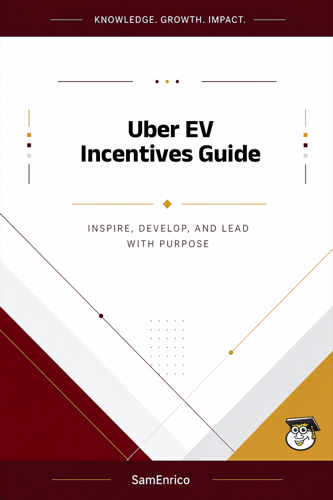
Non-FictionBusiness BriefEV Incentives
Uber EV Incentives Guide Audiobook
Access electric vehicle bonuses and charging disco
by Murillo Hoyt
Access electric vehicle bonuses and charging discounts.
Formats
Free sample
Chapter 1: The $20,000 Blind Spot--The average Uber driver who switches to an electric vehicle without reading this book will leave $20,000 on the table over three years. Not because they are lazy or uninformed. Because the system is deliberately fragmented across five different incentive sources—Uber, the IRS, state governments, utility companies, and auto manufacturers—none of which talk to each other. The Uber app does not remind you about the federal tax credit. The IRS does not tell you about the $4,000 Uber grant.
Your local utility does not advertise the EVgo charging discount that requires Gold status. And the dealership financing officer has every incentive to steer you away from stacking discounts because their commission shrinks when you do.This chapter reveals the structural blind spot that costs drivers thousands, introduces the Profit & Loss framework you will use for the rest of this book, and delivers the first actionable tool: the True Cost Per Mile calculator. By the final page, you will know with mathematical certainty whether switching to an EV makes sense for your specific driving habits, market, and financial situation—before you spend a single dollar on a vehicle.The Myth That Keeps Drivers Poor Let us start with the most dangerous sentence in rideshare economics: “I’m saving money on gas.”Every driver who has ever said this believes they are making a smart financial decision. And they are partially correct—electricity is cheaper than gasoline on a per-mile basis, typically by 60 to 70 percent depending on your local rates. But focusing exclusively on fuel savings is like celebrating that you saved fifty percent on a pair of shoes you did not need.
The savings are real, but the context is missing.Consider two drivers in Los Angeles. Driver A keeps their 2018 Toyota Camry hybrid, which gets 50 miles per gallon. Driver B buys a new Tesla Model 3 for $50,000. Driver B celebrates cutting their fuel bill from $400 per month to $120 per month—a $280 monthly saving, or $3,360 per year. Over three years, that is $10,080 in fuel savings.
Driver B feels brilliant.But Driver B’s Tesla depreciated by $22,500 over those same three years (45 percent of $50,000). Driver A’s Camry hybrid depreciated by only $8,000 (35 percent of approximately $23,000). Driver B paid $1,500 more per year for commercial insurance. Driver A paid $900 more per year for their hybrid’s insurance. Driver B spent $1,200 on new tires due to regenerative braking wear.
Driver A spent $800 on tires.When you run the full Profit & Loss statement, Driver A came out ahead by…
This is the end of the free sample. Get the Audiobook to keep going. Buy now
About this book
Details
- Author
- Murillo Hoyt
- Publisher
- SamEnrico
- Language
- English
- Genre
- Non-Fiction, Business Brief, EV Incentives
- Released
- 2026-06-07
- Pages (approx.)
- 127
- Available as
- eBook, Audiobook

Listen in the VoxFlicks app
Audiobooks and audio dramas wherever you go. Sign in with your SamEnrico account and press play.
More by Murillo Hoyt
 Growth Hormone and mTOR BalancingMurillo Hoyt$11.99
 The Deep Work Interruption ContractMurillo Hoyt$11.99
 OCD Thought Stopping Self TalkMurillo Hoyt$11.99
 Ibogaine Treatment GuideMurillo Hoyt$11.99
 Travel Goal Action PlanMurillo Hoyt$11.99
 Grief and Siblings After Parent DeathMurillo Hoyt$11.99
 Equifax Credit Freeze FailuresMurillo Hoyt$11.99
 Crowns of the New World: How Europe Charted the GlobeMurillo Hoyt$11.99
 Baba Yaga’s Bone House: The Witch of the Forest’s Dark BargainMurillo Hoyt$11.99
 A Collector's Handbook to the Opel Manta CoupeMurillo Hoyt$11.99
 Growing Aira (Hair Grass)Murillo Hoyt$11.99
 Termination Legal Trap HandbookMurillo Hoyt$12.99
You may also like
 Hong Kong Handover 1997Dunn Johnnie$11.99
 Zumba For Postnatal Recovery CourseNeal Christian$11.99
 Zumba for BeginnersLadner Nikia$11.99
 YouTube Comment Mining GuideHumes Pandora$12.99
 Worry Box MeditationCarlin Rudy$11.99
 Workplace Stress MeditationNguyen Lynn$11.99
 Workplace Stress and Sleep RepairHawley Ivory$11.99
 Workplace Perfectionism CureDelaney Jeffry$11.99
 Workplace Injustice Anger GuideWallen Isabelle$11.99
 Work Addiction and Burnout LinkGreenwood Ester$11.99
 Women in Yoga and WellnessBeattie Galina$11.99
 Women in Stand Up ComedyChun Evangeline$11.99