
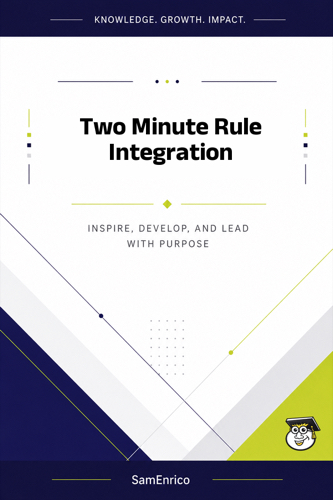
Two Minute Rule Integration eBook
Combine quick wins with Eisenhower for rapid task
Combine quick wins with Eisenhower for rapid task clearance.
Formats
Free sample
Chapter 1: The Empty Inbox Trap--It is 4:47 PM on a Tuesday, and Sarah has answered forty-three emails, responded to twelve Slack messages, attended three back-to-back meetings, and cleared her task list down to zero. She feels exhausted but accomplished. Her inbox is empty. Her to-do list has no unchecked boxes. By every conventional measure, she has had a productive day.And yet, as she closes her laptop, she realizes with a sinking feeling that she did not touch the quarterly strategy presentation.
The one her manager needs by Friday. The one that could determine her promotion. The one that actually matters.Sarah is not lazy. She is not disorganized. She is not a procrastinator in the traditional sense.
Sarah has fallen into what this book will call the Empty Inbox Trap—the seductive, dangerous belief that clearing small tasks is the same as making meaningful progress.If you have ever ended a day feeling busy but not effective, exhausted but not accomplished, then you have been in this trap too. And you are not alone.The Most Expensive Mistake Knowledge Workers Make Let us begin with a radical claim: most of what you do every day does not matter.Not because you are incompetent. Not because you are lazy. But because the modern work environment has been engineered to reward reactivity over strategy. Every notification, every email, every Slack ping is designed to trigger a dopamine response—the same neurological reward pathway activated by gambling and social media likes.
When you clear a small task, your brain gives you a hit of satisfaction. When you clear ten small tasks in a row, you feel like a productivity god.But here is the deception: busyness is not business.Peter Drucker, the legendary management consultant, drew a distinction that will serve as the foundation for everything in this book. He distinguished between efficiency—doing things right—and effectiveness—doing the right things. Efficiency asks: “How fast can I get through this list?” Effectiveness asks: “Is this list even the right list?”The empty inbox is the ultimate symbol of efficiency. It feels clean.
It feels complete. It feels like victory. But an empty inbox is often just an empty calendar where your most important work used to be.Let me give you a concrete example. Consider two knowledge workers at the same company.Alex starts the day by checking email at 8:00 AM. He sees fifteen messages.
He replies to the ones that take less than two minutes. He flags a few for later. By 9:00 AM, his inbox is at zero. He feels great. He spends the rest of the morning bouncing between Slack threads, quick requests from colleagues, and small administrative tasks.
By 5:00 PM, he has cleared sixty-two items from various lists. He is exhausted. He has also made zero progress on the product launch roadmap that his VP asked for two weeks ago.Jordan starts the day by closing all notification windows. At 8:00 AM, Jordan looks at the calendar and sees a two-hour block labeled “Product Launch Roadmap—Quadrant II.” Jordan does not check email. Jordan does not open Slack.
Jordan works on the roadmap for ninety minutes. At 9:30 AM, Jordan takes a five-minute break, then spends fifteen minutes processing email and Slack—but only the messages flagged as important by a filter. By 5:00 PM, Jordan’s inbox is not empty. There are thirty-seven unread messages. Jordan does not care.
The roadmap is 80 percent complete and will be delivered tomorrow.Who had the better day? By traditional productivity metrics, Alex wins. Alex cleared more tasks. Alex has an empty inbox. Alex looks busy.
But Jordan is the one who will get promoted. Jordan is the one who will be called “strategic.” Jordan is the one who understands that an empty inbox is a symptom of reactivity, not effectiveness.This chapter exists to burn that lesson into your bones before we teach you a single technique. Because if you do not internalize the difference between efficiency and effectiveness, no system—not the Two-Minute Rule, not the Eisenhower Matrix, not any of the tools we will build—will save you. You will simply become faster at doing things that do not matter.The Origins of the Two-Minute Rule (And How It Got Hijacked)To understand where we are going, we must first understand where the Two-Minute Rule came from—and how it became dangerous.The Two-Minute Rule was popularized by David Allen in his landmark book Getting Things Done. In Allen’s original formulation, the rule was simple: if a task takes less than two minutes to complete, do it immediately rather than deferring it, writing it down, or tracking it.
The reasoning was elegant: the cognitive cost of remembering, organizing, and returning to a sub-two-minute task is higher than the cost of just doing it.For example, if you notice a coffee cup on your desk that needs to go to the kitchen, that takes thirty seconds. If you write it on a list, you will spend more time managing the list than just carrying the cup. So do it now.The Two-Minute Rule is brilliant for what Allen intended: physical, low-stakes, administrative closure. It is designed to keep your system from clogging with trivial garbage.But here is what happened. The Two-Minute Rule escaped from GTD and entered popular productivity culture as a universal maxim: “If it takes less than two minutes, just do it.” People applied it to everything.
Email replies. Slack messages. Quick edits. Small requests. Tiny favors.And suddenly, the rule that was meant to protect your deep work became the primary destroyer of your deep work.Why?
Because most of the tasks that arrive in your inbox or task list are not like carrying a coffee cup to the kitchen. They are what we will call False Two-Minute Tasks—tasks that seem like they should take less than two minutes but reliably expand into fifteen, thirty, or sixty minutes.Consider these examples, drawn from real clients I have coached:“Let me just quickly check my website analytics.” Two hours later, you have redesigned the homepage in your mind.“I’ll draft a quick reply to this email.” Twenty minutes later, you have rewritten it seven times.“Let me just organize this one folder.” Forty-five minutes later, you have re-categorized three years of documents.“I’ll just see what’s happening on Linked In.” Ninety minutes later, you have watched fourteen cat videos and read eight political arguments.These are not two-minute tasks. These are rabbit holes with two-minute entrances. And the Two-Minute Rule, applied indiscriminately, is the shovel that digs the hole.The Eisenhower Matrix: Great Strategy, Poor Execution Now let us turn to the other half of our integration: the Eisenhower Matrix.Named after President Dwight D. Eisenhower—who famously said, “What is important is seldom urgent, and what is urgent is seldom important”—this matrix divides tasks into four quadrants based on two questions:Is this task urgent?
(Does it demand immediate attention? Does it have a tight deadline?)Is this task important? (Does it contribute to my long-term goals, values, or mission?)The four quadrants are:Quadrant I: Urgent and Important. Crises, deadlines, emergencies. Do these now.Quadrant II…
This is the end of the free sample. Get the eBook to keep going. Buy now
About this book
Details
- Author
- Braun Concepcion
- Publisher
- SamEnrico
- Language
- English
- Genre
- Non-Fiction, Self-Help, GTD
- Released
- 2026-06-08
- Pages (approx.)
- 135
- Available as
- eBook, Audiobook

Read better in the ZLOADR app
Your eBooks on your phone or tablet. Sign in with your SamEnrico account and start reading.
More by Braun Concepcion
 DBT for Adoptive ParentsBraun Concepcion$11.99
 Accepting Physical ChangesBraun Concepcion$11.99
 Carb Cycling GuideBraun Concepcion$11.99
 Empathy for CaregiversBraun Concepcion$11.99
 Francis Rebuilding the ChurchBraun Concepcion$11.99
 Insulin Sensitivity GuideBraun Concepcion$11.99
 Cleopatra Religious AuthorityBraun Concepcion$11.99
 The Quantum Elegance: France's Atomic VisionariesBraun Concepcion$11.99
 Starlight Pilgrimage: The Last Ark of AtlantisBraun Concepcion$11.99
 How to Produce Industrial CabinetsBraun Concepcion$11.99
 US Phone Number for BankingBraun Concepcion$12.99
 ARIPO Fee Reduction for SMEsBraun Concepcion$12.99
You may also like
 Hong Kong Handover 1997Dunn Johnnie$11.99
 Zumba For Postnatal Recovery CourseNeal Christian$11.99
 Zumba for BeginnersLadner Nikia$11.99
 YouTube Comment Mining GuideHumes Pandora$12.99
 Worry Box MeditationCarlin Rudy$11.99
 Workplace Stress MeditationNguyen Lynn$11.99
 Workplace Stress and Sleep RepairHawley Ivory$11.99
 Workplace Perfectionism CureDelaney Jeffry$11.99
 Workplace Injustice Anger GuideWallen Isabelle$11.99
 Work Addiction and Burnout LinkGreenwood Ester$11.99
 Women in Yoga and WellnessBeattie Galina$11.99
 Women in Stand Up ComedyChun Evangeline$11.99