
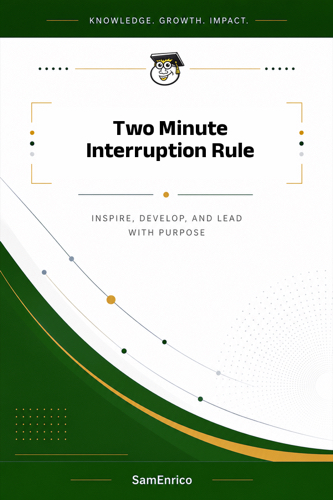
Non-FictionSelf-HelpTask Management
Two Minute Interruption Rule eBook
Teaches immediate capture and deferral of distract
Teaches immediate capture and deferral of distractions lasting under two minutes.
Formats
Free sample
Chapter 1: The 20-Minute Theft--You are about to lose the next twenty minutes of your life, and you won’t even notice it happening.Not because this book is boring. Not because you will put it down and scroll through your phone. But because before you finish reading this paragraph, a notification will buzz, a thought will pop into your head, or a colleague will appear at your shoulder with something they swear will “just take a second.” And when that happens, your brain will perform a silent, invisible, devastatingly expensive operation. It will switch contexts. It will leave the world of this page and enter another world entirely.
Then, when you return—if you return—it will spend the next twenty minutes sputtering like a car engine trying to turn over in cold weather. You will read the same sentence four times. You will lose your place. You will feel vaguely frustrated without knowing why.That twenty minutes is not a cost of doing business. It is not an unavoidable tax of modern life.
It is theft. And the thief is not your phone, your boss, or your wandering mind. The thief is a fundamental property of human attention that almost nobody understands and almost everybody suffers from. It is called the cognitive switching cost, and once you see it, you will never unsee it.This chapter is the foundation of everything that follows. If you skip it, the rest of the book will feel like a collection of clever tricks rather than a coherent system.
If you read it carefully, you will acquire a superpower: the ability to see interruptions not as annoyances but as expensive transactions, and to make decisions about them with the cold precision of an accountant. By the end of this chapter, you will understand why a thirty-second interruption costs twenty minutes of focus, why two minutes is the most dangerous number in your workday, and why “just peeking” at your email is one of the most expensive habits you have.Let us begin with a story about a woman named Priya, a report, and an email that ruined her afternoon.The Case of the Sixty-Second Peek Priya is a marketing manager at a midsize software company. She has two hours before a deadline to finish a quarterly report. The report requires concentration: she needs to analyze data from three different spreadsheets, synthesize customer feedback from a dozen emails, and write a summary that will be presented to the executive team. She clears her desk, closes Slack, puts her phone face down, and opens her document.
She types the first sentence: “Q3 performance exceeded targets in all but one region.”Then her email icon flashes. A new message. The preview reads: “Quick question about the budget…”Priya has a choice. She can ignore the email and continue writing. Or she can “just peek” to see what it says.
She decides to peek. It takes six seconds to click over, ten seconds to read the message, and another fifteen seconds to realize that the question is not actually quick—it requires pulling a spreadsheet she does not have open. She tells herself she will answer it later, clicks back to her report, and resumes typing.That six-second peek cost her twenty minutes. Not the six seconds. Those are negligible.
The twenty minutes are the cognitive switching cost.Here is what happened inside Priya’s brain. When she was writing the report, her working memory was holding several pieces of information: the structure of the report, the key findings from the spreadsheets, the tone she wanted to use, and the deadline pressure. That collection of information is called a “context.” It is fragile. It exists only in the temporary workspace of her prefrontal cortex, and it takes energy to maintain.When she switched to the email, she dumped that context. Not deleted it—dumped it, like removing books from a table to make room for new ones.
Her brain loaded a new context: the sender’s name, the question about the budget, the mental note to find the spreadsheet later. When she switched back to the report, she had to reload the original context. But here is the cruel trick: reloading is not instant. It takes time, and it takes energy. For the next twenty minutes, Priya will write more slowly, make more errors, and feel more tired than she would have if she had never looked at the email at all.The research on this is startling.
In a landmark study at the University of California, Irvine, researchers found that after a three-second interruption, it takes an average of twenty-three minutes to return to the original task with the same depth of focus. Other studies have replicated the finding with variations: fifteen minutes, twenty-two minutes, nineteen minutes. The exact number matters less than the shape of the curve. A tiny interruption—a glance, a buzz, a thought—produces a disproportionately large cost. The relationship is not linear.
It is exponential.Priya did not know this. She thought she was losing six seconds. She was losing twenty minutes. By the end of the day, she had “just peeked” eleven times, lost over three hours of focus, and finished her report at 7 PM feeling exhausted and inadequate. The tragedy is that she worked hard.
She stayed late. She felt busy. But she was not productive. She was fragmented.The Physics of Attention To understand why interruptions are so expensive, you need to understand a basic fact about the brain: it is not a computer. A computer can switch between tasks instantly because it has separate processors for different operations.
Your brain does not. It has one central processor, and it uses a mechanism called “attention” to direct that processor toward one thing at a time.When you shift attention from Task A to Task B, your brain performs three operations. First, it disengages from Task A. Second, it moves attention to Task B. Third, it re-engages with Task B.
That sounds simple, but each operation takes time and consumes a limited resource called “cognitive fuel.” The more you switch, the more fuel you burn. By the end of a day of frequent switching, you are running on fumes, which is why you feel exhausted even if you have not done anything physically demanding.The research on this is robust and replicated across dozens of studies. One of the most famous experiments was conducted by Gloria Mark at UC Irvine. She observed knowledge workers in their natural environments and found that the average employee switches tasks every three minutes and five seconds. Most of those switches are self-interruptions—the employee chooses to check email, Slack, or a website.
Each switch costs an average of twenty-three minutes to recover from. Do the math: if you switch every three minutes, you are spending almost all of your time in recovery, not in work.Another study, this one from Microsoft Research, used electroencephalogram (EEG) caps to measure brain activity during task switching. The researchers found that even a two-second interruption—a notification badge appearing on a screen—produced a measurable spike in theta waves, which are associated with distraction and mind-wandering. The spike lasted an…
This is the end of the free sample. Get the eBook to keep going. Buy now
About this book
Details
- Author
- Hamby Osvaldo
- Publisher
- SamEnrico
- Language
- English
- Genre
- Non-Fiction, Self-Help, Task Management
- Released
- 2026-06-07
- Pages (approx.)
- 143
- Available as
- eBook, Audiobook

Read better in the ZLOADR app
Your eBooks on your phone or tablet. Sign in with your SamEnrico account and start reading.
More by Hamby Osvaldo
 The Disabled Worker Confidence GuideHamby Osvaldo$11.99
 CrossFit Endurance WODsHamby Osvaldo$11.99
 Taking an Exam Dream WorkbookHamby Osvaldo$11.99
 Wholesaling Repair Estimate GuideHamby Osvaldo$11.99
 Mentorship for Administrative ProfessionalsHamby Osvaldo$11.99
 Public Speaker Breath PracticeHamby Osvaldo$11.99
 Following Home PreventionHamby Osvaldo$11.99
 Marissa Mayer YahooHamby Osvaldo$11.99
 The Icebox Murders: How a Killer Froze TimeHamby Osvaldo$11.99
 Bridges of the Forgotten: The Collapse That Built a NationHamby Osvaldo$11.99
 Constantinople: The Last Bastion of RomeHamby Osvaldo$11.99
 AI Art Creation FundamentalsHamby Osvaldo$11.99
You may also like
 Hong Kong Handover 1997Dunn Johnnie$11.99
 Zumba For Postnatal Recovery CourseNeal Christian$11.99
 Zumba for BeginnersLadner Nikia$11.99
 YouTube Comment Mining GuideHumes Pandora$12.99
 Worry Box MeditationCarlin Rudy$11.99
 Workplace Stress MeditationNguyen Lynn$11.99
 Workplace Stress and Sleep RepairHawley Ivory$11.99
 Workplace Perfectionism CureDelaney Jeffry$11.99
 Workplace Injustice Anger GuideWallen Isabelle$11.99
 Work Addiction and Burnout LinkGreenwood Ester$11.99
 Women in Yoga and WellnessBeattie Galina$11.99
 Women in Stand Up ComedyChun Evangeline$11.99