
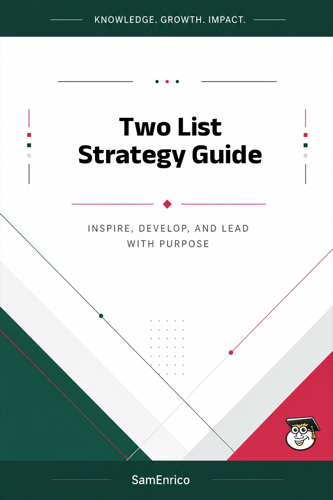
Non-FictionSelf-HelpPrioritization
Two List Strategy Guide eBook
Focus only on your top three priorities each day u
Focus only on your top three priorities each day using Warren Buffett's method.
Formats
Free sample
Chapter 1: The Pilot’s Mistake--–- The story you think you know about Warren Buffett’s famous productivity method is wrong. Not factually wrong—the details are accurate—but strategically wrong. Almost everyone who hears the story of Mike Flint walks away with the opposite lesson of what Buffett intended. They hear “focus on your top priorities” and nod along, but inside they are already planning how to squeeze in the other twenty goals during evenings, weekends, or that mythical “spare time” that never actually materializes. This chapter will dismantle that misconception before it takes root, because if you carry it forward, the Two List Strategy will not just fail you—it will actively make your situation worse than before you started.The Story That Launched a Thousand To-Do Lists The year is unknown.
The setting is a private plane or perhaps an office—the details have shifted across retellings, which is a sign of a story that has achieved mythic status. Mike Flint is Warren Buffett’s personal pilot. For years, Flint has flown the Oracle of Omaha to meetings, acquisitions, and shareholder events. Along the way, he has absorbed more business wisdom than most MBA graduates. But at some point, Flint decides to ask the master directly.“How do I prioritize my career goals?” Flint asks.
“I have so many things I want to accomplish, and I never seem to make real progress on any of them.”Buffett, who is not known for wasting words, gives Flint a simple three-step exercise.Step one: Write down your top twenty-five career goals. Not ten. Not fifty. Twenty-five. This number is specific because it is large enough to force honesty but small enough to be manageable.
Most people can name twenty-five things they genuinely want before they start scraping the bottom of the barrel.Step two: Review the list and circle your top five. Not your top ten. Not your top eight. Your top five. These are the goals that, if you accomplished nothing else, would make your life and career a resounding success.Step three: Now here is where the misinterpretation begins.Flint looks at his two lists: the circled top five and the remaining twenty.
He smiles, relieved. “I see,” he says. “I’m going to focus on my top five. And I’ll work on the other twenty in my spare time.”Buffett stops him cold. “No,” he says.
“You’ve got it wrong. The other twenty—you avoid at all costs. They will distract you from your top five. No progress on them until your top five are done.”This is the moment the story pivots from conventional wisdom to radical strategy. And this is the moment that almost everyone misses.The Trap of “Spare Time”Why does Flint instinctively say he will work on the other twenty goals “in my spare time”?
Because he is a reasonable, ambitious, hardworking person. And reasonable, ambitious, hardworking people believe that spare time is a resource to be filled productively. They believe that working on secondary goals is harmless at worst and virtuous at best. After all, isn’t it better to learn Spanish in your spare time than to watch television? Isn’t it better to build that side business on weekends than to sleep in?The answer, according to Buffett and the entire body of cognitive psychology research, is no.
It is not better. It is actively worse.Here is why. The human brain does not experience “spare time” as a separate, sealed compartment. Your cognitive resources are not like a bank account where you can withdraw focus for your top five goals from nine to five, then withdraw a different kind of focus for your other twenty goals from five to nine. Focus is a single, finite, leaky resource.
When you work on a secondary goal in the evening, you are not just using evening energy. You are also:Depleting the general reservoir of willpower you need tomorrow morning Keeping the secondary goal active in your working memory, where it competes for attention Creating a sense of false progress that reduces your hunger for real progress Training your brain to value starting new things over finishing important ones The trap of “spare time” is that it feels productive while being counterproductive. You go to bed feeling virtuous because you spent an hour on your side business. But that hour was not neutral—it was stolen from your top five goals. Not directly stolen, not in a way you can point to on a timesheet.
But stolen nonetheless, because the energy, attention, and cognitive overhead you used for the side business is energy, attention, and cognitive overhead you no longer have for what matters most.This is the hidden cost of being “busy.” And it is the primary reason that intelligent, motivated people stay stuck in mediocrity for years or decades.The Formula: Output Equals Focus Minus Distractions Let us make this concrete with a simple formula that will appear throughout this book:Output = Strength of Focus – Number of Distractions This is not a metaphor. It is a functional equation. Your output on any meaningful goal is determined by two variables: how deeply you can focus on that goal (intensity) and how many competing claims exist for your attention (diffusion).Most productivity advice focuses on the first variable. Meditate. Eliminate notifications.
Work in deep work blocks. Use the Pomodoro Technique. All of that is useful. But the second variable—number of distractions—is equally important and far more neglected.A distraction is not just a phone notification or a chatty coworker. A distraction is anything that competes for your attention without advancing your top priorities.
And crucially, a distraction can be a goal as much as a task. Learning to cook gourmet meals is a distraction if your top five career goals require you to work late. Training for a marathon is a distraction if your top five health goals require strength training, not endurance. Reading business books is a distraction if your top five goals require you to actually build a business rather than read about building a business.The goals on List B—the twenty you are supposed to avoid at all costs—are not low-value activities. That is what makes them so dangerous.
If they were low-value, you would ignore them without effort. Who struggles to ignore watching paint dry? No one. The struggle comes from ignoring things you genuinely want to do. Things that are valuable, interesting, and aligned with your identity.
Things that your friends are doing. Things that feel like progress.The phrase “avoid at all costs” is not hyperbole. It is a clinical instruction. Every time you touch an item from List B, you are not just failing to advance List A. You are actively stealing from List A.
There is no neutral activity. There is only supporting your top priorities or sabotaging them.Why Ambition Becomes a Liability If you are reading this book, you are likely an ambitious person. You have multiple interests. You want to excel in your career, maintain strong relationships, stay physically fit, learn new skills, contribute to your community, travel, read, create, and grow. This ambition…
This is the end of the free sample. Get the eBook to keep going. Buy now
About this book
Details
- Author
- Sams Angelena
- Publisher
- SamEnrico
- Language
- English
- Genre
- Non-Fiction, Self-Help, Prioritization
- Released
- 2026-06-06
- Pages (approx.)
- 145
- Available as
- eBook, Audiobook

Read better in the ZLOADR app
Your eBooks on your phone or tablet. Sign in with your SamEnrico account and start reading.
More by Sams Angelena
 Will Repository And Notice GuideSams Angelena$11.99
 TikTok Beauty ComparisonSams Angelena$11.99
 Self Talk for First RespondersSams Angelena$11.99
 Menopause and Autoimmune Disease GuideSams Angelena$11.99
 The Divine Veena: Saraswati's Forgotten MelodySams Angelena$11.99
 Physical Tension AuditSams Angelena$12.99
 Private Credit Investment GuideSams Angelena$12.99
 Narrative Consistency Across PlatformsSams Angelena$11.99
 Understanding Juvenile GoutSams Angelena$17.99
 How to Become a Nozzle-and-sleeve WorkerSams Angelena$11.99
You may also like
 Hong Kong Handover 1997Dunn Johnnie$11.99
 Zumba For Postnatal Recovery CourseNeal Christian$11.99
 Zumba for BeginnersLadner Nikia$11.99
 YouTube Comment Mining GuideHumes Pandora$12.99
 Worry Box MeditationCarlin Rudy$11.99
 Workplace Stress MeditationNguyen Lynn$11.99
 Workplace Stress and Sleep RepairHawley Ivory$11.99
 Workplace Perfectionism CureDelaney Jeffry$11.99
 Workplace Injustice Anger GuideWallen Isabelle$11.99
 Work Addiction and Burnout LinkGreenwood Ester$11.99
 Women in Yoga and WellnessBeattie Galina$11.99
 Women in Stand Up ComedyChun Evangeline$11.99