
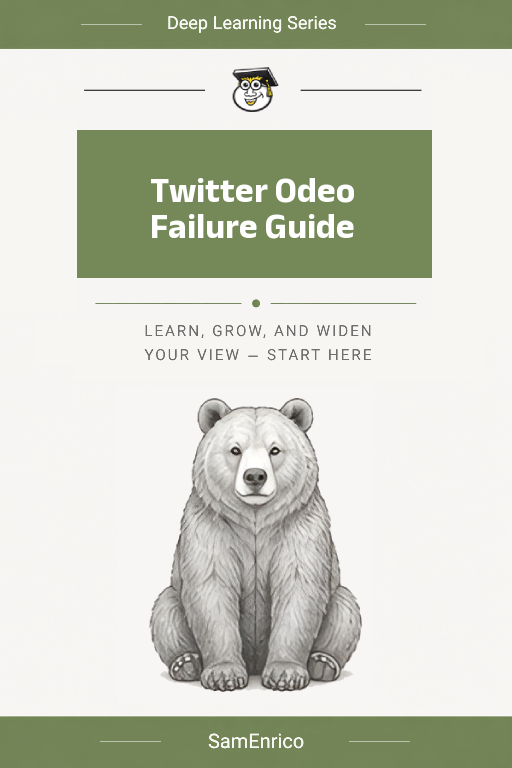
Twitter Odeo Failure Guide eBook
Extract lessons from Twitter's origin inside Odeo,
by Kuhn Yukiko
Extract lessons from Twitter's origin inside Odeo, a failed podcasting platform, including founder conflict, internal pivots, and bet the company decisions.
Formats
Free sample
Chapter 1: The Unloved Product--In the winter of 2004, two men walked into a San Francisco coffee shop with a dream that would cost millions to build and exactly zero people to love. Their names were Evan Williams and Noah Glass. Their dream was called Odeo. And before it died—spectacularly, expensively, and with a lesson attached like a warning label—it would teach the startup world something uncomfortable about success. You cannot build what you do not crave.Evan Williams had already won.
He had sold Blogger to Google in 2003 for a sum that made him independently wealthy—estimates range from 10millionto10 million to 10millionto30 million, depending on who tells the story. He had founded Pyra Labs. He had been written up in Wired. He was the kind of person who could raise venture capital by showing up to a meeting in a hoodie and mumbling a few sentences about "the future of media." Investors trusted him because he had already made them money elsewhere.Noah Glass was the opposite. He was broke.
He lived in a cramped apartment with a laptop that overheated if he ran too many browser tabs. He talked too fast and interrupted too often. He had ideas the way other people have heartbeats: constantly, rhythmically, and sometimes painfully. He was also brilliant in a way that made people uncomfortable. He could see around corners.
He just couldn't get anyone to follow.Together, they made an odd pair. The rich, quiet, deliberate ex-Googler and the broke, loud, chaotic idea machine. But they shared one thing that mattered more than their differences. Neither of them actually liked podcasts.This is the original sin of Odeo. And it is the subject of this chapter.The Hype Machine Podcasting was supposed to be the next big thing in 2004.
The term had been coined just months earlier by Ben Hammersley in a Guardian article. Adam Curry and Dave Winer were building the first podcasting tools. Apple hadn't yet integrated podcasts into i Tunes, which meant the space was wide open, unclaimed, and shimmering with possibility.Venture capitalists salivated. The logic was simple and seductive: blogging had disrupted newspapers. Podcasting would disrupt radio.
And if Blogger could sell to Google for tens of millions, Odeo could sell for hundreds of millions. The math was clean, the narrative was compelling, and the checks were large.Charles River Ventures wrote a check for approximately $5 million in early 2005. The term sheet came together in weeks. There was no extended due diligence. No one asked the obvious question.
No one said, "Evan, how many podcasts do you listen to in a typical week?" No one asked Noah, "Show me your podcast app." No one sat Biz Stone down and said, "Walk me through your daily podcast routine."They didn't ask because they didn't want to know the answer. They were betting on the team, not the product. And the team looked like a winning hand. Two-time founder. Exit to Google.
Charismatic engineer. Sleek design. What could go wrong?Everything. Because the team was not the user.The Person Who Didn't Exist Every failed product has a ghost. The ghost is the person the founders imagine will use their creation.
This person has a name, a backstory, a set of habits, and a carefully researched set of needs. The ghost appears in pitch decks and user personas and product roadmaps. The ghost is discussed in meetings and invoked in debates. The ghost is always invoked when someone asks, "Who is this for?"The ghost of Odeo was the dedicated podcast listener. He was a commuter who spent two hours a day in a car.
He was a jogger who needed audio content to pass the miles. He was a tech enthusiast who wanted to discover shows before they became mainstream. He was the person who would open Odeo every morning, browse new episodes, and hit subscribe.There was just one problem. The dedicated podcast listener did not exist in large numbers. Not in 2005.
Not anywhere near the numbers required to support a venture-backed startup.The real podcast listener in 2005 was a niche creature. He was a tech insider. He had a blog. He knew what RSS meant. He probably listened to one or two shows—maybe "This Week in Tech," maybe a Mac-focused podcast—but he did not listen to dozens.
He did not spend hours browsing. He did not need a discovery platform because he discovered shows through other blogs and personal recommendations.He was also, crucially, not Evan Williams. Not Noah Glass. Not Biz Stone.The Odeo founders were not podcast listeners. They found the format tedious.
They found the discovery process clunky. They found the engagement low. They were building a product for a person they had invented—a person who shared none of their actual habits or preferences.This is the ghost problem. When you build for a person who does not exist, you are not building a product. You are building a hypothesis.
And hypotheses are fine when you are testing them quickly and cheaply. But Odeo was not testing. Odeo was raising millions of dollars and hiring dozens of engineers and building a platform that no one on the team wanted to use.The ghost does not pay. The ghost does not return. The ghost does not give feedback.
The ghost is a figment of your imagination, and figments do not generate revenue.The Zero-User Feedback Loop Odeo launched in the summer of 2005. The platform allowed users to discover, subscribe to, and share podcasts. It had social features—you could see what your friends were listening to—and a clean interface that was easier to navigate than most podcasting tools of the era. The tech press was kind. The initial reviews were positive.But the numbers told a different story.Users signed up.
They poked around. They subscribed to a few shows. And then they never came back. Retention curves flatlined within thirty days. The average user listened to fewer than three podcast episodes before abandoning the platform entirely.
The team was baffled. They had built what the market wanted. Why wasn't anyone using it?They blamed the user interface. They redesigned the homepage. They simplified the navigation.
They added a "featured podcasts" section. They tweaked the colors and the fonts and the button placements. None of it worked.The problem was not the interface. The problem was that no one on the team used Odeo themselves. They could not feel the boredom because they were not the ones experiencing it.
They could not identify the friction because they were not the ones stumbling over it. They were building in a vacuum, shipping features that sounded good in meetings but fell flat in the real world.This is the zero-user feedback loop. When you are not your own user, you lose the ability to distinguish between "important" and "interesting." Everything seems important because you have no visceral sense of what actually matters.Is this bug critical? You don't know. You haven't felt it yourself.Is this feature valuable?
You don't know. You haven't needed it yourself.Is this redesign an improvement? You don't know. You weren't frustrated by the old version.The zero-user…
This is the end of the free sample. Get the eBook to keep going. Buy now
About this book
Details
- Author
- Kuhn Yukiko
- Publisher
- SamEnrico
- Language
- English
- Genre
- Non-Fiction, Startup Guide, Founder Resilience
- Released
- 2026-05-29
- Pages (approx.)
- 129
- Available as
- eBook, Audiobook

Read better in the ZLOADR app
Your eBooks on your phone or tablet. Sign in with your SamEnrico account and start reading.
More by Kuhn Yukiko
 Menopause Nightmare GuideKuhn Yukiko$11.99
 Cody Johnson Texas Country GuideKuhn Yukiko$11.99
 The Workaholism And Depression CycleKuhn Yukiko$11.99
 Family Anger Patterns WorkbookKuhn Yukiko$11.99
 Silent Brainstorming Method GuideKuhn Yukiko$11.99
 Grimnir’s Last Stand: The Troll King of the Northern WastesKuhn Yukiko$11.99
 Frozen Echoes: The Antarctic Forensic Mystery of the Terra Nova ExpeditionKuhn Yukiko$11.99
 How to Start a Bag Clasp Business (Beginners Guide)Kuhn Yukiko$11.99
 Anti-kidnapping DrivingKuhn Yukiko$11.99
 Understanding Frontonasal DysplasiaKuhn Yukiko$17.99
 Shipping Pricing InflationKuhn Yukiko$12.99