
Non-FictionSelf-HelpPlain Language
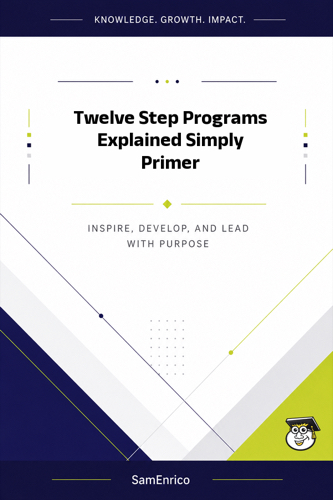
Twelve Step Programs Explained Simply Primer eBook
Offers a straightforward, jargon-free introduction
Offers a straightforward, jargon-free introduction to twelve-step recovery.
Formats
Free sample
Chapter 1: The Unexpected Mirror--–- Imagine standing in front of a mirror that does not show you what you look like. Instead, it shows you what you have become. The reflection staring back is not the person you planned to be at ten, at sixteen, at twenty-five. The eyes are yours, but something behind them has shifted. There is exhaustion there.
Secrecy. A flicker of shame that you have gotten very good at hiding from everyone except yourself in the small hours of the night when sleep will not come and the thoughts will not stop.This chapter is about what happens when you finally stop turning away from that mirror. It is about the moment you admit that the strategies you have been using to manage your life are not working. And it is about the strange, unlikely story of how two desperate men in the 1930s stumbled upon a solution that has since helped millions of people—not by fixing them, but by showing them how to stop running.If you are reading this book, there is a good chance you have already tried everything. You have made promises.
You have broken them. You have sworn off the substance, the behavior, the person, the pattern, only to find yourself back in the same seat, doing the same thing, wondering what is wrong with you. Here is what I need you to understand before we go any further: nothing is wrong with you that has not been wrong with millions of others. Your particular flavor of suffering is unique to you, but the structure of that suffering—the shame, the secrecy, the failed attempts at control, the growing isolation—is almost identical to what every person in recovery has experienced.This book is called a primer because that is exactly what it is: a first introduction. It assumes you know nothing about twelve-step programs except that they exist and that people sometimes call them cults or credit them with saving their lives.
It assumes you may be skeptical, hostile, curious, or desperate. It assumes you may have religious trauma that makes the word "God" land like a punch to the stomach. It assumes you may be someone who loves an addict and is trying to understand what they are going through. All of these readers are welcome here. All of them will find something useful in these pages.The Day Everything Changed On a cold afternoon in May 1935, a man named Bill Wilson sat in the living room of a surgeon named Dr.
Bob Smith in Akron, Ohio. Bill was a former stockbroker from New York who had lost everything to alcohol. He had been sober for about six months, which felt like a miracle and also like a fluke. Dr. Bob was a distinguished physician whose hands shook so badly from withdrawal that he could barely hold a scalpel.
He had been drinking heavily for days and was terrified he would lose his practice, his family, and his life.What happened in that living room was not dramatic. There was no thunderbolt, no angelic visitation, no sudden cure. Bill simply told Dr. Bob the truth about his drinking. Not the polite version he told his wife.
Not the minimized version he told his doctors. The ugly, humiliating, secret truth about the binges, the lies, the blackouts, the morning-after promises, and the evening-before failures. And when Bill finished, Dr. Bob said something that would become the foundation of a worldwide movement. He said, "That is exactly what happened to me."In that moment, something shifted.
Dr. Bob, who had tried everything—willpower, religion, medical treatments, asylum confinements—realized he was not alone. The shame that had been crushing him did not disappear, but it loosened its grip. Because shame cannot survive in the presence of honest connection. Shame requires secrecy.
It requires the belief that you are the only one. The moment another person says "me too," the shame loses its power.Dr. Bob took his last drink on June 10, 1935. He never drank again. Bill Wilson stayed sober until his death in 1971.
Together, they wrote a book called Alcoholics Anonymous—the "Big Book"—and started a fellowship that has since spread to nearly every country on earth. Their discovery was simple, radical, and counterintuitive: one addict helping another is more powerful than any professional intervention, any medication, any punishment, or any promise made in isolation.Why Willpower Always Fails Before we go any further, we need to talk about willpower. Because if you are like most people who come to twelve-step programs, you have tried willpower. You have tried it hard. And you have watched it fail.Here is the problem with willpower: it is a limited resource that addiction is specifically designed to exhaust.
Think of willpower as a muscle. It gets tired. When you wake up in the morning, your willpower reserves are full. You can say no to the first urge, maybe the second. But by the end of the day, after you have dealt with work stress, family stress, financial stress, and the thousand small humiliations of being alive, your willpower muscle is exhausted.
The addiction, which never gets tired, is waiting for that moment. And that is when you use.This is not a moral failure. It is biology. The addicted brain has been rewired to prioritize the substance or behavior above everything else—food, sleep, relationships, safety. This is not because you are weak.
It is because addiction is a brain disease that hijacks the neural circuits responsible for motivation and reward. Telling an addict to "just stop" is like telling someone with asthma to "just breathe." They would if they could. They cannot.There is a famous psychological experiment that illustrates this perfectly. Researchers asked participants to suppress all thoughts of a white bear. Whatever you do, do not think about a white bear.
What happened? The participants could not stop thinking about white bears. The attempt to suppress the thought guaranteed its return. This is called ironic rebound, and it is exactly what happens when you try to suppress an addictive urge by sheer force of will. The more you try not to think about the drink, the more you think about the drink.
The more you try not to gamble, the more you imagine the slot machines. The more you try not to binge, the more you picture the food.This is why Step One of every twelve-step program begins with an admission that sounds like defeat but is actually the first taste of freedom: powerlessness. Not worthlessness. Not hopelessness. But the honest recognition that your best efforts have failed, and that trying harder is not the answer.The Six Actions That Actually Work Now let me tell you what does work.
After nearly a century of experience with millions of people, twelve-step programs have identified six non-negotiable actions that form the backbone of recovery. I call them the Six-Pack. They are not complicated, but they are not easy. And they only work if you do all of them.First, stop using. This sounds obvious, but it is the hardest part.
Stopping means complete abstinence from the substance or behavior. Not moderation. Not "just on weekends." Not "only when things are…
This is the end of the free sample. Get the eBook to keep going. Buy now
About this book
Details
- Author
- Clinton Chanel
- Publisher
- SamEnrico
- Language
- English
- Genre
- Non-Fiction, Self-Help, Plain Language
- Released
- 2026-06-10
- Pages (approx.)
- 134
- Available as
- eBook, Audiobook

Read better in the ZLOADR app
Your eBooks on your phone or tablet. Sign in with your SamEnrico account and start reading.
More by Clinton Chanel
 Goal Setting for Early RetirementClinton Chanel$11.99
 Recording Hypnotic ReframingClinton Chanel$11.99
 Elderly Parent Loss GuideClinton Chanel$11.99
 Letting Go of Family GrudgesClinton Chanel$11.99
 Credit Freeze vs Credit Lock DebateClinton Chanel$11.99
 Jill Tarter BioClinton Chanel$11.99
 Gossip and Rumors After SuicideClinton Chanel$11.99
 Tokyo’s Graffiti Revolution: The Underground Artists Who Redefined Fashion (1980s-1990s)Clinton Chanel$11.99
 The Charge of the Light Brigade: A Tragic Misstep That Changed WarfareClinton Chanel$11.99
 Growing Anemone (Windflower)Clinton Chanel$11.99
 Cash Flow Forecasting WorkbookClinton Chanel$12.99
 Mailchimp Plain Text vs HTML GuideClinton Chanel$12.99
You may also like
 Hong Kong Handover 1997Dunn Johnnie$11.99
 Zumba For Postnatal Recovery CourseNeal Christian$11.99
 Zumba for BeginnersLadner Nikia$11.99
 YouTube Comment Mining GuideHumes Pandora$12.99
 Worry Box MeditationCarlin Rudy$11.99
 Workplace Stress MeditationNguyen Lynn$11.99
 Workplace Stress and Sleep RepairHawley Ivory$11.99
 Workplace Perfectionism CureDelaney Jeffry$11.99
 Workplace Injustice Anger GuideWallen Isabelle$11.99
 Work Addiction and Burnout LinkGreenwood Ester$11.99
 Women in Yoga and WellnessBeattie Galina$11.99
 Women in Stand Up ComedyChun Evangeline$11.99