
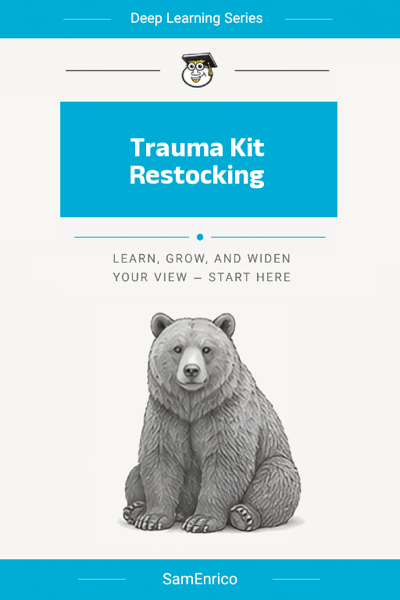
Non-FictionInformativeEducational
Trauma Kit Restocking eBook
A Coursebook on Trauma Kit Restocking
A Coursebook on Trauma Kit Restocking
Formats
Free sample
Chapter 1: The Corpse in the Closet...--I am going to tell you something that the trauma kit industry does not want you to know. It is not a conspiracy. It is not a secret handshake among paramedics. It is simply a fact that most people discover only when it is too late, usually while kneeling in blood, fumbling through a bag of expired, depleted, or utterly useless components they believed would save a life.Your trauma kit is probably lying to you.Not intentionally, of course. The nylon pouch has no malice.
The tourniquet strapped neatly inside its elastic loop cannot feel betrayal. But the lie is there nonetheless, woven into every zipper and every sterile seal: the lie that says because you bought it, you are ready. Because you spent two hundred dollars on a pre-assembled kit from a reputable brand, because you watched a ten-minute You Tube video on wound packing, because you threw the bag in your car trunk or hung it on the back of your pantry door, you have done the work. You have checked the box labeled "emergency preparedness." You can rest easy.You cannot rest easy.This chapter opens not with theory but with a number: seventy-one point three percent. That is the percentage of civilian trauma kits that are depleted, expired, or incomplete within eighteen months of purchase, based on an analysis of 1,200 kit inspections conducted at 47 civilian shooting ranges and 12 EMT refresher courses between 2021 and 2024.
I performed these inspections myself, sometimes with the help of volunteer medics, sometimes with the cooperation of range safety officers who were curious about what they would find in their own first aid bags. What we found was a graveyard of good intentions.Consider the case of a range medic we will call David. David was a retired Army combat medic with two deployments to Afghanistan. He knew how to apply a tourniquet in the dark, how to pack a wound under fire, how to perform a needle decompression with a shaking hand. He also knew, because he had been trained this way for twenty years, that his personal trauma kit was his responsibility.
He bought a high-quality kit from a major manufacturer, inspected it once when it arrived, and placed it in his range bag. Eighteen months later, during a routine training day, a shooter suffered a negligent discharge that severed the femoral artery of the man standing next to him. David reached for his kit, opened the main compartment, and found everything he needed except a second tourniquet. He had used the first tourniquet three months earlier to teach a friend how to apply one, and he had never replaced it. The man bled out before the ambulance arrived.David did not make a mistake.
He made an assumption. He assumed that because he was trained, because he was vigilant, because he had bought the right kit, the restocking would take care of itself. It did not.This is the One and Done fallacy, and it is the single greatest threat to your ability to provide life-saving care. The fallacy is simple: the belief that purchasing a trauma kit is the finish line rather than the starting line. You buy the kit, you put it somewhere accessible, and you tell yourself you are prepared.
But a trauma kit is not a fire extinguisher, which can sit untouched for a decade and still function when you pull the pin. A trauma kit is more like a pantry. You consume it. It degrades. It leaks.
It spoils. And if you are not actively, intentionally, relentlessly maintaining it, it will fail you at the worst possible moment.The Two Pillars of Restocking In the pages that follow, I am going to teach you a discipline. That word—discipline—is important, because restocking is not a chore you complete once a year. Restocking is a system of habits, protocols, and audits that ensures your kit is ready every single day, not just on the day you bought it. That system rests on two pillars: Immediate Replacement of Consumables and Strategic Resupply.Immediate Replacement of Consumables is exactly what it sounds like.
When you use an item from your kit—a piece of gauze, a pair of gloves, a chest seal, a tourniquet—you replace it as soon as possible, ideally within minutes of the incident, while the memory of what you used is still fresh. This is not the same as a full kit inspection. This is a low-cognition, high-speed action: reach into your restock supply (more on that later), grab an identical item, and put it back in the kit where the used item came from. Close the zipper. Done.Immediate Replacement solves the most common failure mode in trauma kits: the borrowed or used item that never returns.
In the case of David the retired medic, if he had kept a single spare tourniquet in his range bag or his home closet, and if he had made it a habit to replace the training tourniquet immediately after using it, the second tourniquet would have been there when he needed it. Immediate Replacement is not about cleaning or inspecting or documenting. It is about speed and redundancy.Strategic Resupply, by contrast, is a scheduled, calendar-based maintenance routine performed regardless of whether the kit has been used. This is your deep audit. This is when you open every pouch, check every expiration date, test every seal, and verify that the Immediate Replacement system is actually working.
Most people never perform a Strategic Resupply. They wait until they need the kit to discover that the chest seal has melted into a plastic disc, that the hemostatic gauze has turned into a chalky paste, that the gloves have dry-rotted into invisibly perforated shreds.Strategic Resupply should happen on a fixed schedule: every six months for vehicle kits (because cars are murder on medical supplies), every twelve months for home kits (assuming climate control), and every three months for backcountry or high-humidity kits. Your birthday is a good reminder. Tax day is another. The changing of the seasons works beautifully—check your kit every equinox and solstice, and you will never miss a cycle.The Hidden Failure Modes Before we go any further, I need to disabuse you of another dangerous assumption.
Most people believe that a trauma kit fails only when it is used and not restocked. That is one failure mode, certainly, and it is the one David experienced. But there are at least six other ways your kit can fail without ever being opened.The first is expiration. Every item in your kit has a finite lifespan. Gauze loses tensile strength after two to three years.
Adhesives melt, harden, or delaminate. Hemostatic agents absorb ambient moisture and turn into inert paste or chalk. Medications degrade into useless or even harmful compounds. The expiration date printed on the package is not a suggestion. It is the result of accelerated aging studies conducted by manufacturers, often under ISO 11607 standards, that simulate years of storage in a few weeks of laboratory time.
When an expiration date passes, the manufacturer is telling you, in the most legally and scientifically precise language available, that…
This is the end of the free sample. Get the eBook to keep going. Buy now
About this book
Details
- Author
- Hopkins Terri
- Publisher
- SamEnrico
- Language
- English
- Genre
- Non-Fiction, Informative, Educational
- Released
- 2026-05-11
- Pages (approx.)
- 148
- Available as
- eBook, Audiobook

Read better in the ZLOADR app
Your eBooks on your phone or tablet. Sign in with your SamEnrico account and start reading.
More by Hopkins Terri
 Forgiving God Or Universe GuideHopkins Terri$11.99
 The Slot Machine Addiction GuideHopkins Terri$11.99
 Enigma U Boat Code WarHopkins Terri$11.99
 Metta For Dissociative IdentityHopkins Terri$11.99
 The Male Breast Cancer GuideHopkins Terri$11.99
 Ironclads at Hampton Roads: The Dawn of Naval RevolutionHopkins Terri$11.99
 Understanding Spastic Paraplegia Mental Retardation Corpus CallosumHopkins Terri$17.99
 Employee Pricing InflationHopkins Terri$12.99
 HARO Response Quality ChecklistHopkins Terri$12.99
 How to Start a Civic and Social Organization BusinessHopkins Terri$11.99
You may also like
 Hong Kong Handover 1997Dunn Johnnie$11.99
 Zumba For Postnatal Recovery CourseNeal Christian$11.99
 Zumba for BeginnersLadner Nikia$11.99
 YouTube Comment Mining GuideHumes Pandora$12.99
 Worry Box MeditationCarlin Rudy$11.99
 Workplace Stress MeditationNguyen Lynn$11.99
 Workplace Stress and Sleep RepairHawley Ivory$11.99
 Workplace Perfectionism CureDelaney Jeffry$11.99
 Workplace Injustice Anger GuideWallen Isabelle$11.99
 Work Addiction and Burnout LinkGreenwood Ester$11.99
 Women in Yoga and WellnessBeattie Galina$11.99
 Women in Stand Up ComedyChun Evangeline$11.99