
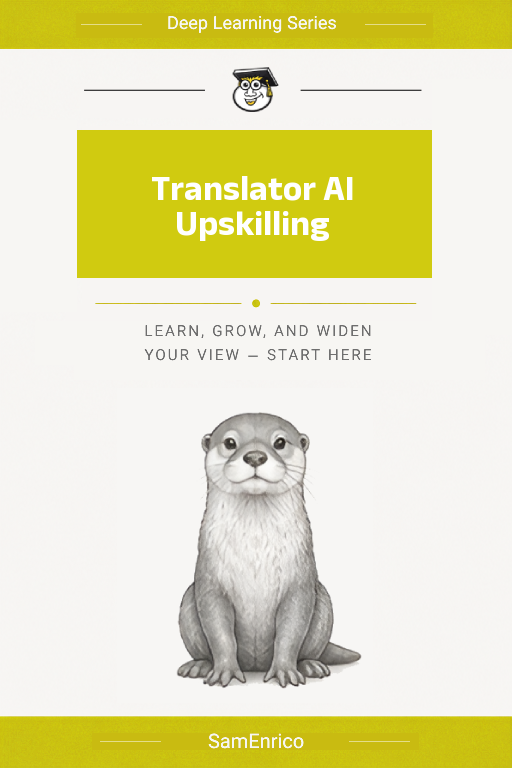
Translator AI Upskilling
Train human translators to work alongside AI effec
by Vetter Libby
Train human translators to work alongside AI effectively. Develop skills in post-editing, prompt engineering, and quality management.
Formats
About this book
Free sample
Chapter 1: The Brilliant Intern--–- Maria stared at the screen, her coffee growing cold for the third time that morning. The legal contract she had been translating for seven years—the same type, the same clauses, the same careful precision—now sat before her with two versions side by side. On the left, her own painstaking work, three hours in the making. On the right, the output from an AI model that had taken eleven seconds. They were nearly indistinguishable.
Not identical—the AI had missed a nuance in the indemnification clause, and the register wavered slightly in the recitals—but close enough that her client would have accepted it without question. Maria was not afraid of being replaced. She was afraid of something far more unsettling: being asked to do less, to think less, to become a proofreader of machine-generated text rather than a shaper of meaning. And she was not alone.This chapter dismantles the industry hype that AI will soon replace human translators, replacing fear with clarity. It explains why “perfect” AI translation remains theoretically impossible, introduces the crucial distinction between linguistic accuracy and functional usability, and establishes a realistic mental model—the brilliant but unreliable intern—that will guide every subsequent chapter in this book.
By the end, you will understand exactly what AI can and cannot do, and why your value as a translator has never depended on keystrokes alone.The Great Unsettling: Why This Moment Feels Different The translation industry has weathered technological storms before. Computer-assisted translation (CAT) tools in the 1990s were met with skepticism. Translation memories in the early 2000s prompted predictions of obsolescence. Neural machine translation (NMT) in 2016 produced headlines declaring the end of human translation as a profession. Each time, the fears subsided, and translators adapted.
The tools became aids, not replacements. The profession continued.But the arrival of large language models (LLMs) feels different—and not without reason. Unlike NMT, which learned statistical patterns of word alignments from parallel corpora, LLMs learn something closer to reasoning (or a plausible simulation thereof). They can summarize, rephrase, explain, and generate text in ways…
This is the end of the free sample. Get the eBook to keep going. Buy now
Contents
- Chapter 1
- Chapter 2
- Chapter 3
- Chapter 4
- Chapter 5
- Chapter 6
- Chapter 7
- Chapter 8
- Chapter 9
- Chapter 10
- Chapter 11
- Chapter 12
Details
- Author
- Vetter Libby
- Publisher
- SamEnrico
- Language
- English
- Genre
- Non-Fiction, AI Operator
- Released
- 2026-05-29
- Pages (approx.)
- 156
- Available as
- eBook, Audiobook

Read better in the ZLOADR app
Your eBooks on your phone or tablet. Sign in with your SamEnrico account and start reading.
More by Vetter Libby
 Twelve Step Phone List GuideVetter Libby$11.99
 Long Term Journaling for Mood TrackingVetter Libby$11.99
 Stress and Rituals for CouplesVetter Libby$11.99
 African Coastal Fortress GateVetter Libby$11.99
 The Royal Dancers of the Kongo: Grace, Power, and the Birth of African BalletVetter Libby$11.99
 Chief Learning OfficerVetter Libby$11.99
 How to Become a Heel PrickerVetter Libby$11.99
You may also like
 Hong Kong Handover 1997Dunn Johnnie$11.99
 Zumba For Postnatal Recovery CourseNeal Christian$11.99
 Zumba for BeginnersLadner Nikia$11.99
 YouTube Comment Mining GuideHumes Pandora$12.99
 Worry Box MeditationCarlin Rudy$11.99
 Workplace Stress MeditationNguyen Lynn$11.99
 Workplace Stress and Sleep RepairHawley Ivory$11.99
 Workplace Perfectionism CureDelaney Jeffry$11.99
 Workplace Injustice Anger GuideWallen Isabelle$11.99
 Work Addiction and Burnout LinkGreenwood Ester$11.99
 Women in Yoga and WellnessBeattie Galina$11.99
 Women in Stand Up ComedyChun Evangeline$11.99