
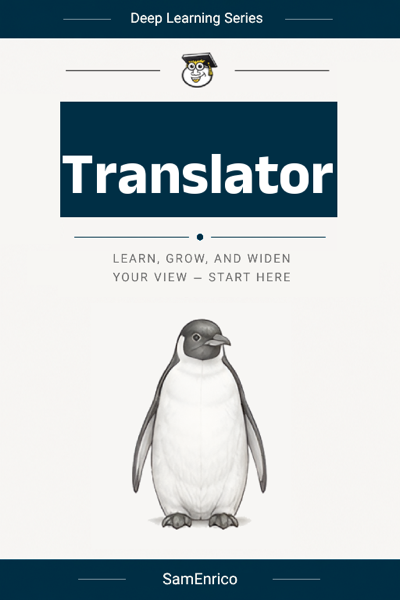
Translator eBook
A Coursebook on Translator
A Coursebook on Translator
Formats
Free sample
Chapter 1: The Mistranslation That Started a War--–- On August 10, 1945, the Japanese government received the Allied response to their conditional surrender offer. The reply contained a single English word that would be translated into Japanese as "ignoring" when it should have read "no comment." Some historians believe this error led directly to the atomic bombing of Nagasaki three days later. A mistranslation did not merely change a sentence. It changed history. And the translator who made that error?
No one knows their name. No one ever will.This is not an isolated story. In 1980, a Spanish translator working for a major airline mistranslated the English word "altimeter" as "altura" (height) rather than "altímetro" in a maintenance manual. The crew of a commercial flight subsequently misread their altitude instruments. The plane crashed into a mountainside, killing all 146 people on board.
The word that killed them was three letters long. Alt. Three letters. One hundred and forty-six lives. And the translator?
Their name appears nowhere in the accident report. Only their error does.Welcome to the invisible world of translation. It is a world where single words carry the weight of wars, where sentences determine the fate of patients on operating tables, where the difference between "gift" (poison in German) and "Gift" (present in English) has ended diplomatic careers. It is also a world whose workers are almost entirely unseen, uncredited, and misunderstood by the very people who depend on them daily.If you have read a foreign novel, watched a subtitled film, used a translated software interface, read a UN report, taken a medication with instructions in your language, or eaten food with ingredients translated from another country — you have relied on a translator. You have almost certainly never thought about them.
That is about to change.The Great Myth: Translation as Substitution The most damaging myth about translation is also the most common. It goes like this: Translation is the process of finding equivalent words in another language. A word in Language A equals a word in Language B. The translator is a kind of human dictionary, swapping out lexical units until the meaning transfers intact from one side to the other.This myth is wrong. Not slightly wrong.
Catastrophically wrong. And believing it has consequences.Consider the word "no." In English, it means refusal, negation, denial. In Japanese, the closest equivalent — "iie" — is almost never used in direct refusal because Japanese culture prioritizes harmony over confrontation. A Japanese speaker might say "That would be difficult" or "I will think about it" to mean no. An English speaker hearing those phrases might think the answer is still open for negotiation.
That misunderstanding has cost billions of dollars in failed business deals.Consider the word "gift." In English, it is a present. In German, "Gift" means poison. Consider the word "embarazada" in Spanish. It looks like "embarrassed" in English. It actually means pregnant.
A tourist who says "Estoy embarazada" to explain their awkward silence at a dinner party is not saying "I am embarrassed." They are announcing an unexpected pregnancy.These are not amusing anecdotes. They are evidence of a fundamental truth: Words do not have meanings. People have meanings, and words are imperfect vehicles for carrying them across the divide between minds. When you add language barriers to that divide, the imperfection becomes a chasm.Jakobson's Three Ways of Translating In 1959, the Russian-American linguist Roman Jakobson published a short essay that changed how scholars think about translation. He argued that the word "translation" actually describes three distinct activities, only one of which is what most people imagine.The first is intralingual translation, or rewording.
This is translation within the same language. When a lawyer explains a legal document in plain English, they are translating. When a parent simplifies a news story for a child, they are translating. When you summarize a long email to a colleague, you are translating. Every act of paraphrasing, simplifying, or rephrasing is a form of translation because it involves taking meaning from one set of words and carrying it into another set of words within the same linguistic system.The second is interlingual translation, or translation proper.
This is what most people mean when they say "translation": moving meaning from one language to another. Japanese to English. Spanish to Mandarin. Arabic to French. This is the classic form, and it is the primary focus of this book.The third is intersemiotic translation, or transmutation.
This is translation between different sign systems. Turning a book into a film is intersemiotic translation. Turning a painting into a poem is intersemiotic translation. Turning a musical composition into a dance performance is intersemiotic translation. In each case, meaning moves from one medium to another, and just as with interlingual translation, it is transformed in the process.Why does this matter?
Because once you understand that translation happens even within a single language, you realize that the problem is not language barriers per se. The problem is meaning itself. Meaning is slippery, contextual, and dependent on shared knowledge between speaker and listener. Adding a language barrier simply adds another layer of slipperiness. But the fundamental act — of taking meaning from one form and recreating it in another — is something every human does every day.
Translation is not exotic. Translation is universal.Translation as Rewriting The second foundational concept of this chapter comes from the Belgian translation scholar André Lefevere. In his 1992 book Translation, Rewriting, and the Manipulation of Literary Fame, Lefevere made a provocative argument: Every translation is a form of rewriting. And every rewriting, no matter how faithful, is also a form of manipulation.This sounds alarming. It should.
But let us be precise about what Lefevere meant.When you translate a sentence, you cannot simply "copy" it into another language. You must make choices. Do you preserve the syntax of the original, even if it sounds strange in the target language? Do you change the syntax to sound natural, even if that means losing some of the original's rhythm? Do you translate every word, even if some words have no direct equivalent?
Do you omit words that would confuse the target reader? Do you add words that clarify what the source text left implicit?Every one of those choices is an act of rewriting. And because you are choosing, you are also manipulating. You are shaping how the target reader will experience the original text. You are deciding what they will find easy or difficult, familiar or strange, clear or ambiguous.
You cannot avoid this. Even the most "literal" translation is a series of choices about what literal means.Consider a simple sentence: "The cat sat on the mat." Translate it into French: "Le chat s'est assis sur le tapis." That seems straightforward. But notice what happened. English uses the simple past "sat." French requires a choice between the passé composé (s'est assis, a completed action in the past) and the imparfait (s'asseyait, an ongoing or habitual action in the past). The translator chose passé composé.
But what if the original English sentence was meant to describe a habitual action — the cat sat on the mat every afternoon? The English sentence does not specify. The French…
This is the end of the free sample. Get the eBook to keep going. Buy now
About this book
Details
- Author
- Sampson Claudette
- Publisher
- SamEnrico
- Language
- English
- Genre
- Non-Fiction, Informative, Educational
- Released
- 2026-06-02
- Pages (approx.)
- 144
- Available as
- eBook, Audiobook

Read better in the ZLOADR app
Your eBooks on your phone or tablet. Sign in with your SamEnrico account and start reading.
More by Sampson Claudette
 MBSR For Perfectionism WorkbookSampson Claudette$11.99
 Burnout Prevention for Parents HandbookSampson Claudette$11.99
 The RLS Progressive Muscle RelaxationSampson Claudette$11.99
 Cousteau's World Without SunSampson Claudette$11.99
 Fundamental Rights Impact AssessmentSampson Claudette$11.99
 Contract Review AI Assistant GuideSampson Claudette$12.99
 Understanding Keratosis, SeborrheicSampson Claudette$17.99
 How to Become a TumblerSampson Claudette$11.99